


When SpaceX filed for its historic IPO, the promise of a 30% retail allocation drew billions in crypto capital. But institutional demand crushed that vision, forcing widespread cancellations on platforms that had created tokenized access to the offering.
🔑 Key Takeaways
- SpaceX cut its IPO retail allocation from an initially promised 30% to approximately 20% due to massive institutional demand.
- Exchanges including Bybit, Binance, and Bitget launched tokenized products (perpetual futures, xStocks) offering pre-IPO access to retail investors.
- A shortage of underlying shares triggered cancellations, technical adjustments like Binance’s Rebase, and managed oversubscription.
- The tokenized equities market hit a $5.5 billion market cap, but this episode reveals a vulnerability in the supply chain.
- Democratizing IPO access via tokenization remains a work in progress, facing the realities of institutional allocations.
The Mechanics of Tokenized IPO Access
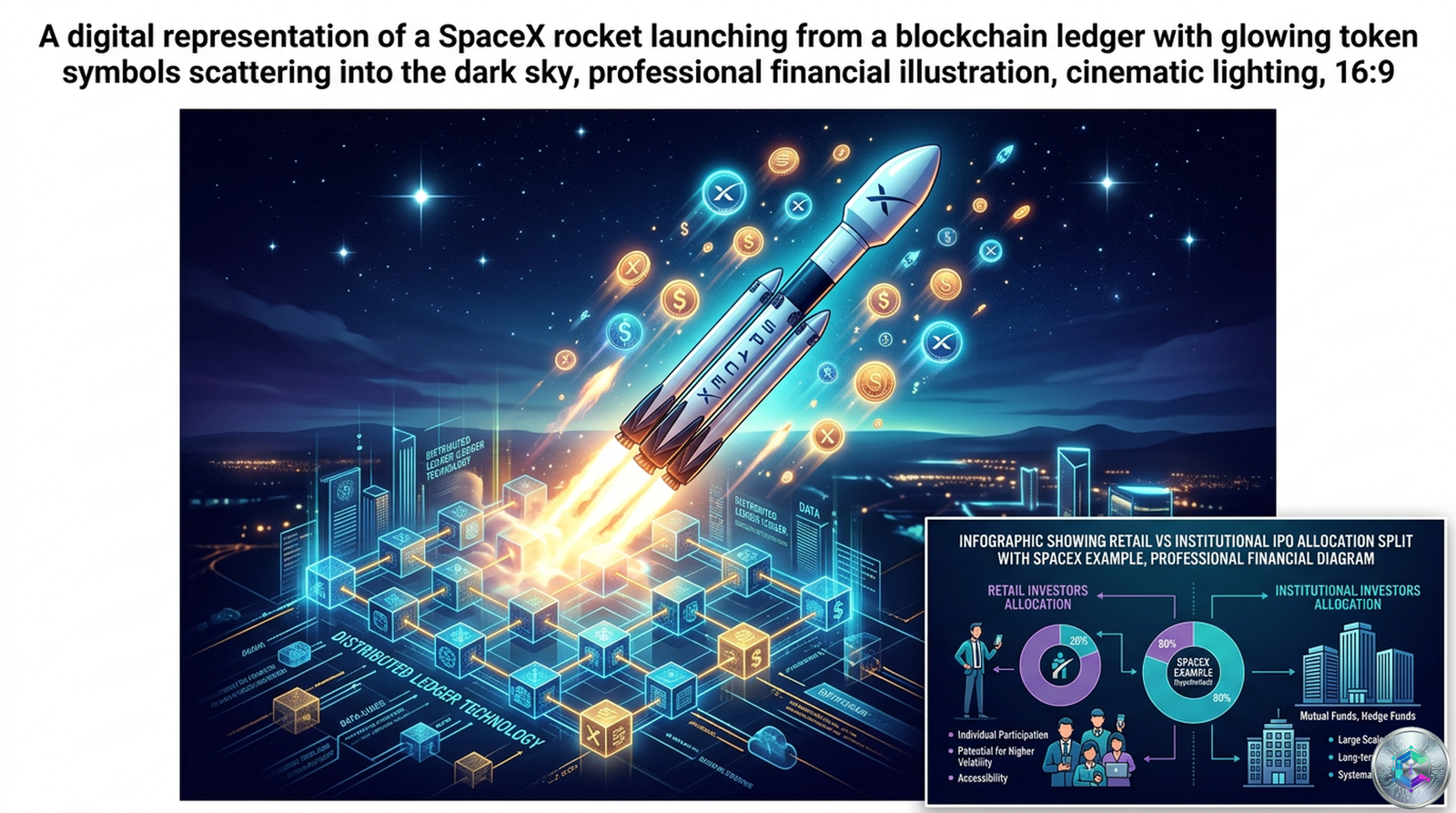
To understand why the cancellations occurred, it helps to examine the tokenized access model. Pioneered by Payward Services’ xStocks framework and adopted by Kraken, Bybit, Bitget, and others, it involves converting traditional IPO allocations into blockchain-based tokens. When a broker or exchange receives an allocation of shares, it can tokenize them—creating digital tokens representing partial ownership of that allocation. These tokens are then traded on the platform, offering users price exposure without needing traditional brokerage access.
The model worked in theory. For a company like SpaceX, where demand vastly outstripped supply, offering tokenized exposure through crypto platforms extended access to investors in countries often overlooked by traditional IPO distribution networks. For instance, Bybit’s IPO Express was available to global VIP and Pro-tier users, allowing commitment of USDC at an indicative price of $135 per share plus a 5% underwriting fee. Bitget Wallet went further, opening its SpaceX xStock (ticker SPCXx) subscription to all wallet users with no tier requirements and a minimum entry of just $10.
However, the critical dependency is that the tokenized product must be backed by real shares. When SpaceX reduced its retail allocation from the expected 30% to approximately 20%, the pool of shares available to feed these tokenized products shrank accordingly. Exchanges that had already marketed the products and attracted subscriptions suddenly faced a structural shortfall—too many tokens sold, not enough underlying shares to back them.
Bitget Wallet: A Case Study in Oversubscription
Bitget Wallet’s experience illustrates the scale of the problem. The platform opened its SpaceX xStock subscription on June 9, 2026, with an initial allocation of $3 million. Within 30 minutes, the subscription was oversubscribed by a factor of four, forcing Bitget to expand the allocation to $13 million to meet demand. The platform described the response as a sign of strong conviction in self-custodial wallets seeking direct onchain access to high-profile public listings.
Alvin Kan, COO of Bitget Wallet, stated that self-custodial wallets are becoming a serious channel for capital markets access, pointing to the surge in interest as evidence that crypto-native users have zero tolerance for gatekeepers. But even Bitget’s expanded $13 million allocation was a fraction of what retail investors sought. Across the broader crypto ecosystem, numbers were far larger. According to an analysis by Binance’s research team, as of June 10, over 15 crypto exchanges and platforms had offered retail investors SpaceX pre-IPO products. These included perpetual futures contracts, SPV tokens (which indirectly held SpaceX shares via a specially established holding company before tokenizing them for retail sale), and direct tokenized IPO allocations through the xStocks framework. Bitget packaged $61 million it held into a product sold entirely to retail investors. Platforms like Gate.io, MEXC, and BitMart collectively exceeded $35 million in similar products. The total distribution of pre-IPO tokens across all platforms approached $100 million, while broader crypto retail exposure to SpaceX—including perpetual contract holdings and SPV tokens—exceeded $1 billion.
Binance’s Rebase Adjustment
Binance’s experience provided a window into how the allocation squeeze manifested in practice. The exchange had launched a SpaceX pre-IPO perpetual contract with a Rebase mechanism—a feature designed to adjust the contract’s exposure as underlying share capital changed. Terms stipulated that any deviation in share capital exceeding 3% would trigger an adjustment. When SpaceX’s S-1A disclosure revealed deviations far exceeding that threshold, Binance was forced to execute a 1.1x Rebase on June 8, with the adjustment taking effect on June 10.
The Rebase was a technical mechanism, but its implications were significant. It demonstrated that the structural mismatch between tokens sold and shares available was large enough to require active exchange intervention. For retail traders who had built positions in these instruments, the Rebase meant their exposure was being mathematically adjusted—a reminder that pre-IPO products carry risks traditional investors rarely encounter.
Institutional Demand Wins Again
The SpaceX IPO cancellation episode is ultimately a story of institutional demand overwhelming retail access, even when the company signals openness to individual investors. SpaceX’s original intent to allocate 30% to retail was itself extraordinary for a deal of this magnitude. The fact that even that unusually large retail slice had to be trimmed speaks to the intensity of interest from hedge funds, sovereign wealth funds, and other institutional players.
According to CNBC, only 20% of the IPO was ultimately allocated to retail, with the remainder going to institutional investors. This marks a return to historical norms despite SpaceX’s populist framing. The decision to limit retail access was reportedly driven by the sheer scale of institutional demand, not regulatory or structural constraints. A person familiar with the matter told CNBC that institutional demand for the shares had been strong as investors competed for access to the hottest IPO in recent years.
« Self-custodial wallets are becoming a serious channel for capital markets access, and this surge in interest proves that crypto-native users have zero tolerance for gatekeepers. »
Alvin Kan, COO, Bitget Wallet
For crypto exchanges that had positioned themselves as the great equalizer—bringing IPO access to anyone with a smartphone and stablecoins—the outcome was a diplomatic setback. Their platforms had attracted enormous interest and billions in capital flows, but the underlying allocation shortage meant they could not deliver on the core value proposition they had advertised.
What This Means for Tokenized Equities
The SpaceX episode arrives at a pivotal moment for the tokenized equities market. According to data reported by The Block, tokenized stocks had grown from $2.23 billion to $5.5 billion in market capitalization since the start of 2026—a roughly 147% increase in six months. SpaceX IPO access was a major driver of that growth. The category had become the fourth-largest real-world asset (RWA) segment, and the expectation was that high-profile listings would continue to attract capital into tokenized products.
The cancellations introduce a note of caution. Tokenized IPO products depend on brokers receiving allocations first. When a company like SpaceX controls its allocation process and prioritizes institutional investors, the supply chain that feeds tokenized products can be constricted. This is not necessarily a structural flaw in the tokenization thesis—the technology works, the access is real, and the demand is evident. But it exposes a vulnerability: in a world where the most coveted IPO allocations are scarce, even tokenized versions of those allocations inherit the same scarcity.
It’s important to note the growth of the tokenized equities market. Per The Block data, market cap surged from $2.23 billion to $5.5 billion in H1 2026, a 147% rise. This segment became the fourth-largest RWA category, with platforms like Ondo Global Markets and xStocks together holding approximately $1.5 billion in assets under management. However, the SpaceX episode shows that growth can be throttled by upstream supply constraints.
The Longer View: Democratization Remains a Work in Progress
Despite the cancellations, the SpaceX IPO episode demonstrated that the appetite for retail access to major listings is enormous and growing. The crypto industry’s effort to democratize IPO access did not fail—it ran into the limits of a supply-side constraint that existed before the tokenization layer was even built. SpaceX chose to allocate the vast majority of its deal to institutional investors, and no amount of tokenization technology could overcome that decision at the source.
The platforms that survived the episode intact—Kraken, Bybit, Bitget, and others—are likely to refine their offerings for future listings. The lesson is not that tokenized IPO access is flawed, but that the model depends on alignment with company-level allocation decisions that have historically favored institutional players. As the tokenized equities market continues to grow—with Ondo Global Markets and xStocks together holding approximately $1.5 billion in assets under management—the industry will need to advocate more forcefully for retail allocations if it hopes to deliver on its democratization promise.
For now, the story of SpaceX’s tokenized IPO access is a story of great expectations meeting the cold realities of allocation mechanics. The demand was there. The technology worked. The shares simply were not enough to go around.
Sources
- The Block: Bybit follows Kraken in offering tokenized SpaceX IPO access via xStocks
- The Block: Tokenized equities reach $5.5 billion market cap, fueled by SpaceX IPO access and exchange expansion
- CoinDesk: Bybit challenges Wall Street with a massive push into tokenized U.S. IPOs
- CryptoBriefing: SpaceX cuts retail IPO allocation to low 20% range as institutional demand overwhelms offering
- CNBC: SpaceX allocations mostly decided, only 20% of IPO allocated to retail
- Binance Square: On the eve of SpaceX’s IPO, crypto retail traders quietly exceed $1 billion in exposure
- Markets Insider: Bitget Wallet: $13M in Tokenized SpaceX IPO Subscriptions Close in 30 Minutes
- Business Insider: Bitget Wallet and xStocks Bring Tokenized SpaceX IPO Access to Retail Investors
- Reuters: Cryptocurrency exchange Bybit to open SpaceX tokenized IPO access
- Ledger Insights: SpaceX listing should boost tokenized stocks, not bury them
- Finance Magnates: SpaceX IPO Access: Three Ways to Buy Before It Lists, and None of Them Are the Same Thing
This article is published for informational and educational purposes only. It does not constitute investment advice. Conduct your own research (DYOR) before making any decisions.

