


On August 10, 2026, Nvidia orchestrated an unprecedented partnership with six Wall Street heavyweights to mobilize more than $500 billion aimed at financing the global AI infrastructure buildout. For the first time, hardware and compute are being recognized as a standalone asset class, on par with equities, bonds or commodities.
🔑 Key takeaways
- Six Wall Street firms (Apollo, BlackRock, Blackstone, Brookfield, Goldman Sachs, KKR) join forces with Nvidia to raise over $500 billion for AI infrastructure.
- Proceeds will fund data centers, chip fabs and Nvidia GPU-related projects.
- AI compute becomes an official financeable asset class, backed by institutional credit, insurance funds and private capital.
- The move comes after a July 2026 market sell-off and fuels concerns over “circular dealmaking”.
A landmark alliance between Nvidia and Wall Street
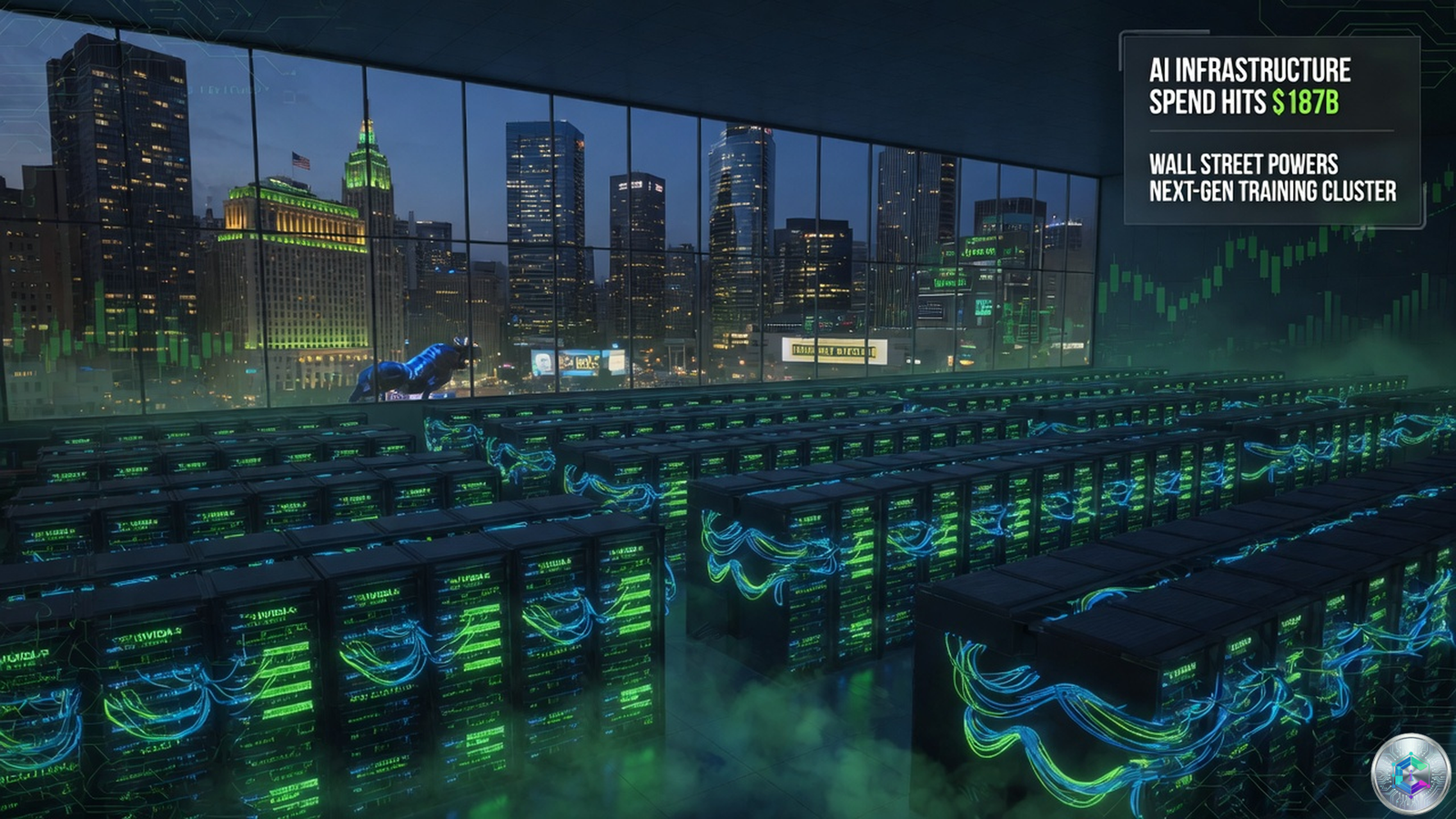
On August 10, 2026, Nvidia formalized a partnership with Apollo Global Management, BlackRock, Blackstone, Brookfield Asset Management, Goldman Sachs and KKR. The stated goal: raise more than $500 billion to accelerate the construction of AI infrastructure worldwide. The deal marks a symbolic turning point — for the first time, institutional investors are treating compute hardware and data centers as a genuine asset class, on par with stocks or bonds.
Funds raised will be deployed across Nvidia’s own projects and those of its partners. They will finance the construction of new data centers capable of hosting hundreds of thousands of Nvidia GPUs, as well as new semiconductor fabrication facilities designed to meet growing client demand. The agreement illustrates the growing convergence between traditional finance and the generative AI ecosystem, where hardware becomes the backbone of a multi-trillion-dollar economy.
Compute becomes a standalone asset class
Jensen Huang, Nvidia’s CEO, laid out the central thesis of the operation: compute is no longer a cost center, but a revenue source. Nvidia hardware, widely adopted and transferable from one customer to another, becomes a productive, durable and fungible asset comparable to a power grid or a telecom network.
“In AI, compute is revenue. We are bringing together the world’s leading long-term capital providers to independently underwrite AI infrastructure.”
Jensen Huang, CEO of Nvidia
Partner firm executives echo the view. David Solomon (Goldman Sachs) called it a watershed moment of a historic AI investment cycle, where the bank plays an arranging and distribution role for credit backed by Nvidia compute. Larry Fink (BlackRock) drew a parallel with the birth of mortgage-backed securities in the 1970s, calling it “the future of financial engineering”. Jon Gray (Blackstone) likened compute to a financeable asset analogous to a mortgaged property, noting that AI demand in Blackstone’s portfolio has multiplied sevenfold in a year.
“This is truly the first time that technology chips become an investable asset class. They are revenue-generating assets now. They are productive, durable, fungible and flexible.”
Jensen Huang, CEO of Nvidia
$1 trillion already spent by hyperscalers
Nvidia is now the main beneficiary of the AI boom. Nearly every major player in the sector — Google, Microsoft, Meta Platforms, Amazon, SpaceX, OpenAI and Anthropic — uses its GPUs to power services, features and chatbots. According to SiliconANGLE, these players have collectively spent more than $1 trillion on AI projects and infrastructure over the past three years, a flow expected to keep accelerating. Nvidia’s stock has multiplied fivefold over the same period.
The Wall Street alliance aims precisely to relieve the balance sheets of these customers. By tapping institutional credit, insurance funds and private capital, Nvidia lets them accelerate deployments without piling on their own debt. The move is part of a broader strategy of massive financial engagement: in July 2026, Nvidia already announced a $500 billion deal with SK hynix to secure memory chip supply, while talks are reportedly underway for a $250 billion agreement with OpenAI to co-finance the 10-gigawatt AI factory planned in Ohio by 2028, alongside a separate $350 billion deal for chip purchases.
Market reactions on August 10, 2026
| Company | Change on Aug 10, 2026 (NYSE) |
|---|---|
| Apollo Global Management | +2.31% |
| Blackstone | +2.41% |
| KKR | +1.01% |
| BlackRock | -0.74% |
| Goldman Sachs | -0.79% |
| Nvidia | -2.46% |
Critics warn of “circular dealmaking” and systemic risk
The initiative is not without pushback. It comes on the heels of a global market sell-off in July 2026, when investors began questioning the returns on massive AI investments by tech giants. Rating agencies, including Moody’s, have warned that unprecedented capex is starting to compress free cash flow and force hyperscalers to take on more debt.
Several observers also flag a “circular dealmaking” risk: Nvidia is weaving an entangled web of agreements with a handful of companies whose interests overlap, many of which have already struck multi-billion-dollar deals among themselves. Should one of these commitments falter, the contagion effect could extend far beyond the AI sector, given the sheer size of the sums involved.
“AI is already so pervasive and important that compute has become a critical asset. As we have built our approach to digital infrastructure, we have learned that delivery — not ambition — is the hard part.”
Joe Bae and Scott Nuttall, co-CEOs of KKR
Conclusion: a financial bet on the longevity of AI
By bringing together six of the world’s largest asset managers around the financing of its GPUs and data centers, Nvidia is institutionalizing compute as a new structured asset. For Wall Street, the deal opens up a potentially enormous market backed by a sector whose demand shows no sign of slowing. For Nvidia, it secures a revenue pipeline while locking in its biggest customers. For markets, it raises a central question: will the large-scale financialization of generative AI deliver on its yield promises — or will it eventually replicate the excesses of past great credit cycles?
Sources
- SiliconANGLE — Nvidia taps Wall Street for a half-trillion dollars to fuel global AI infrastructure buildout
- CNBC — Nvidia, Wall Street asset managers, $500 billion AI push
- Wall Street Journal — Nvidia, Wall Street firms strike AI financing deal targeting $500 billion
- Bloomberg — Nvidia to team with Wall Street on $500 billion package
This article is published for informational and educational purposes only. It does not constitute investment advice. Do your own research (DYOR) before making any decision.

