


Morpho, the decentralized credit protocol, has raised $175 million in a historic funding round, pushing its valuation to $2 billion. Led by Paradigm and a16z Crypto, this move marks a major milestone for institutional adoption of DeFi and promises to reshape the architecture of global credit.
🔑 Key Takeaways
- Record $175M raise for Morpho, valued at $2 billion.
- Co-led by Paradigm, a16z Crypto, and Ribbit Capital, with participation from Apollo, VanEck, etc.
- Used by Coinbase for over $2.17B in USDC loans, as well as Kraken, Binance, and others.
- Total deposits exceed $11 billion; vision of founder Paul Frambot: a global open credit network.
- MORPHO token surged over 10% following the announcement.
Unprecedented Scale of the Raise
The $175 million funding round by Morpho represents the largest single funding event ever recorded in the decentralized finance (DeFi) sector. Co-led by three heavyweights in crypto venture capital—Paradigm, a16z Crypto, and Ribbit Capital—the round values the protocol at approximately $2 billion. The announcement immediately sent the MORPHO token surging by over 10%, reflecting investor confidence in Morpho’s vision to build ‘the open credit network for the world’.
Beyond Morpho itself, this raise signals broader institutional acceptance of onchain credit infrastructure at a scale previously unimaginable in DeFi. Investors came from diverse backgrounds: beyond the lead investors, participants included Apollo Funds, Circle Ventures, VanEck, Ledger Cathay, Variant, Wintermute Ventures, HashKey, Japan’s SBI Group, France’s Bpifrance, IOSG, and Mirana. This diversified investor base reflects Morpho’s ambition to serve not just crypto-native users but also traditional financial institutions seeking exposure to onchain credit markets.
The funding was structured as a purchase of MORPHO tokens at the average monthly price, aligning with the protocol’s decentralized ethos by distributing token ownership across a broad set of stakeholders.
How Morpho Works Under the Hood
At its core, Morpho is a lending protocol that sits on top of existing liquidity pool protocols like Compound and Aave, introducing a peer-to-peer matching engine that dramatically improves capital efficiency. Traditional pooled lending protocols like Compound work by pooling user deposits into a shared liquidity pool, where borrowers draw at a uniform interest rate determined by supply and demand. While simple, this model often doesn’t offer users the most competitive rates.
Morpho’s innovation lies in its ability to match lenders and borrowers directly, peer-to-peer, while still leveraging the underlying liquidity pools for security and liquidity. The result: borrowers often get lower rates than in standard pooled protocols, while lenders earn higher yields—all without sacrificing the safety guarantees from the underlying protocol’s liquidation mechanisms.
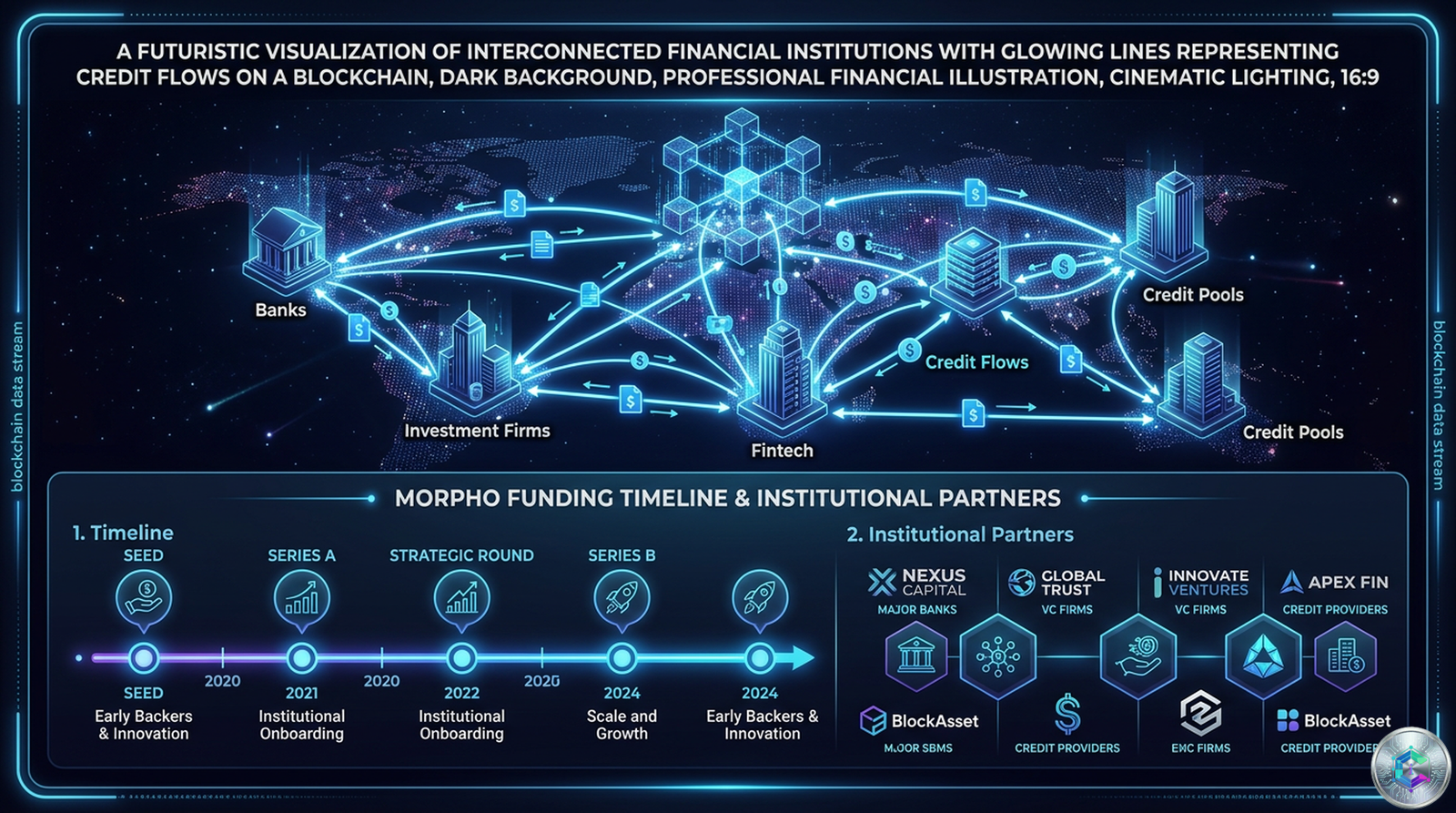
This hybrid approach makes Morpho particularly attractive to institutional players. Banks, asset managers, fintechs, and crypto exchanges can integrate Morpho’s infrastructure to offer customized lending products with parameters tailored to specific risk profiles, rather than accepting the one-size-fits-all terms of a single protocol.
Institutional Adoption and Vision Ahead
One of the most compelling aspects of Morpho’s growth trajectory is the roster of major institutional players already using the protocol. According to data from Morpho, Coinbase has originated over $2.17 billion in USDC loans through its Morpho-powered service. The platform has since expanded to the UK, where borrowers can access up to $5 million in borrowing power against supported crypto assets.
Other major integrations include Kraken, Binance, Anchorage Digital, Galaxy Digital, Bitwise, and Tempo, the Stripe and Paradigm-backed payments blockchain. Each integration represents a vote of confidence from organizations that have undergone rigorous due diligence.
The volume of capital flowing through the protocol is staggering. Total deposits on Morpho now exceed $11 billion, while the Morpho Blue implementation alone holds approximately $6.57 billion in total value locked (TVL) according to DeFiLlama.
| Institutional Integration | Key Details |
|---|---|
| Coinbase | Over $2.17B in USDC loans originated via Morpho |
| Kraken & Binance | Lending services for users |
| Anchorage Digital & Galaxy | Institutional-grade lending infrastructure |
| Tempo (Stripe/Paradigm) | Payments blockchain integrating Morpho |
Paul Frambot, Morpho’s co-founder, has articulated a vision that extends far beyond building another DeFi protocol. His stated mission is to construct ‘the open credit network for the world’—a fundamental rearchitecting of how credit flows through the global financial system.
« Every bank, asset manager, and pension fund will want exposure to onchain credit markets. »
Frankie, General Partner at Paradigm
Guy Wuollet, a partner at a16z Crypto, echoed this sentiment, noting that the technology behind Morpho is already being used by major financial institutions and that the potential for expansion is enormous.
Market Context and Use of Funds
The timing of the raise is notable given the broader context of traditional credit markets. The private credit sector, which has grown to rival traditional bank lending, is experiencing significant turbulence, as highlighted by issues with Blackstone’s flagship fund. In contrast, onchain credit protocols like Morpho offer a fundamentally different value proposition: every transaction is recorded on a public blockchain, every interest rate is calculated by transparent smart contract code, and every liquidation event is executable automatically.
The proceeds will be used across three primary areas: technical development (improving the peer-to-peer matching engine and liquidation mechanisms), commercial integrations (expanding to hundreds of institutional partners), and deeper institutional partnerships (building trust and track record).
Challenges Ahead and Outlook
Despite the optimism, Morpho faces real challenges. The most significant is converting new capital and institutional partnerships into lasting borrowing demand. Deposits are one thing; active borrowing that generates fee revenue is another. The protocol needs to demonstrate that integrated platforms can attract borrowers outside the crypto-native market at sufficient scale to justify valuations.
Market liquidity is another consideration. In bear markets or periods of crypto volatility, lending demand can compress significantly. Morpho’s success will depend partly on its ability to maintain deep liquidity and competitive rates even in adverse conditions.
Risk controls are paramount. The protocol’s liquidation mechanisms have been battle-tested, but new institutional partners, asset types, and market conditions create opportunities for unforeseen risks. Ongoing investment in risk management and monitoring systems will be critical.
Regulatory uncertainty remains a wildcard. Onchain credit protocols operate in a gray zone in many jurisdictions, and the arrival of major institutional players could attract scrutiny. Morpho’s collaborative approach, positioning as infrastructure for regulated institutions, may provide some protection, but the landscape remains unpredictable.
Conclusion
Morpho’s $175 million raise is more than a funding milestone. It signals that institutional adoption of DeFi infrastructure has reached a new stage. Major venture capital firms, traditional financial institutions, and crypto-native platforms are converging on the view that onchain credit infrastructure is a legitimate and valuable part of the future financial system.
The path forward will not be without obstacles. Competition is intensifying, regulatory scrutiny is growing, and technical challenges of scaling a protocol handling billions in deposits are substantial. But the backing of Paradigm, a16z Crypto, and Ribbit Capital, combined with a clear product-market fit and a roster of major institutional users, gives Morpho a strong foundation. As Paul Frambot put it, Morpho is building the open credit network for the world. Whether that vision is realized at scale will depend on execution, institutional commitment, and the broader regulatory and market environment. The $175 million raise suggests the market believes in the journey, even if the destination remains uncertain.
Sources
- CoinAcademy – Morpho raises $175M with Paradigm and a16z crypto
- Crypto.news – Morpho raises $175M at $2B valuation
- Morpho.org – Morpho Raises $18M Co-led by a16z and Variant
- The Block – a16z and Variant lead $18 million round
- Binance Square – Morpho’s $50M Funding
This article is published for informational and educational purposes only. It does not constitute investment advice. Conduct your own research (DYOR) before making any decisions.

