


The world of traditional finance is crossing a historic threshold. Morgan Stanley Investment Management has filed with the SEC a registration statement for the Morgan Stanley Bitcoin Trust, a spot Bitcoin ETF marking the official entry of one of the world’s banking giants into the digital assets market. This strategic move comes exactly two years after the historic approval of the first spot Bitcoin ETFs by the SEC, confirming that cryptocurrency is no longer a niche asset but a full-fledged institutional investment class.
A Direct Physical Bitcoin Holding ETF
The Morgan Stanley Bitcoin Trust stands out for its simplicity and transparency. Unlike complex derivative products or leveraged strategies, this fund will physically hold Bitcoins and aim to faithfully replicate the BTC price, net of fees. The net asset value (NAV) will be calculated daily from an aggregated price benchmark of major Bitcoin spot exchanges.
Key characteristics of the trust include:
- Direct holding: No recourse to futures contracts or synthetic derivative products
- Passive structure: No active trading based on market conditions
- Creations and redemptions: Reserved for authorized participants in large blocks, executable in cash or in-kind
- Retail access: Individual investors will be able to trade shares on the secondary market through their standard brokerage accounts
Shares will be listed on a U.S. national securities exchange upon regulatory approval, although the ticker symbol has not yet been disclosed.
A Multi-Asset Vision: Bitcoin and Solana
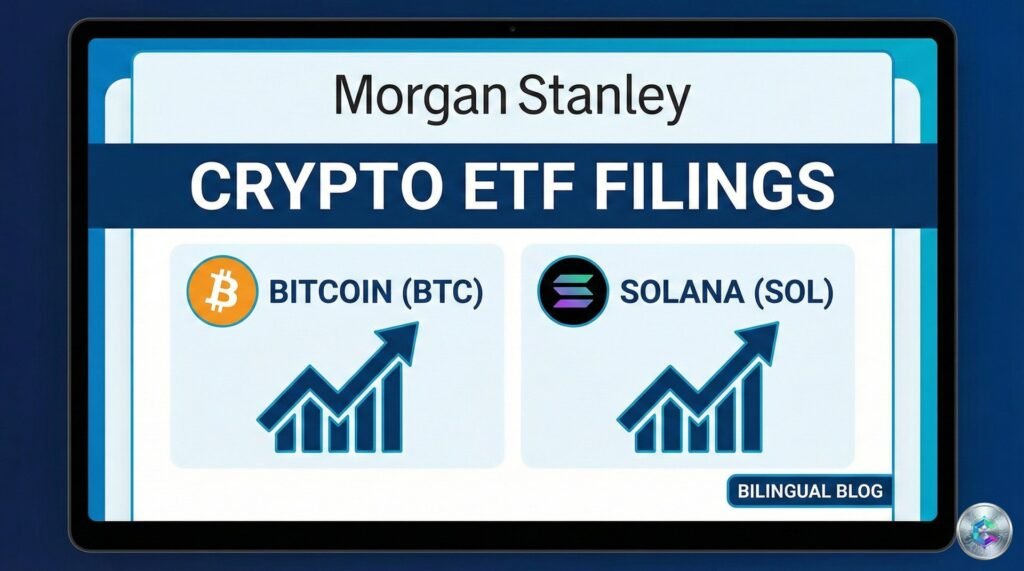
Morgan Stanley isn’t limiting itself to Bitcoin. The banking giant simultaneously filed a request for a spot Solana ETF, demonstrating broader strategic ambition across the crypto ecosystem. The Solana fund would even incorporate staking to generate additional returns, a major innovation in the crypto ETF landscape.
This multi-asset approach positions Morgan Stanley as a visionary player. While most institutions focus exclusively on Bitcoin, the choice to include Solana with its native staking mechanism reflects deep understanding of the technological differentiators of next-generation blockchains.
Institutional Adoption Reaches New Heights
The numbers speak for themselves. By the end of 2025, Bitcoin ETFs were already managing $115 billion in assets. On January 5, 2026, daily inflows reached a record $694.7 million. U.S. institutions now hold 57% of Bitcoin ETF assets, with emblematic cases like Harvard University’s endowment, which increased its exposure by 257% to reach 3,868 BTC equivalents.
BlackRock IBIT, the market leader, manages $50 billion alone, while Morgan Stanley already showed Bitcoin exposure of $724 million in Q3 2025.
Democratization of Access for All Clients
In October 2025, Morgan Stanley lifted restrictions that limited crypto investments to its wealthiest clients. Now, all clients—including those with retirement accounts—can invest in Bitcoin ETFs. This opening coincides with expanded trading capabilities on ETrade, which will enable native BTC, ETH, and SOL trading by 2026.
A Structural Supply-Demand Imbalance
Institutional adoption creates unprecedented buying pressure. With a post-halving supply of only 164,250 BTC per year against projected institutional demand of 775,000 BTC, the supply-demand imbalance reaches a factor of 4.7x. Analysts project that U.S. ETFs could acquire more than 100% of new Bitcoin supply in 2026.
A Widespread Wall Street Movement
Morgan Stanley joins a select but growing club. Bank of America has approved four spot Bitcoin ETFs for its advisors (Bitwise, Fidelity, Grayscale Mini Trust, and BlackRock IBIT). Wells Fargo and Merrill Lynch have also begun allocations, with net flows of $500 million in a single day in early January 2026.
T. Rowe Price has also filed its application for its first crypto ETF, while the global crypto ETF space has reached $200 billion in assets under management with over $45 billion in inflows in 2025.
Risks and Regulatory Prudence
Despite the optimism, risks persist. December 2025 saw net outflows from Bitcoin ETFs amid broader market volatility. Morgan Stanley reduced its MicroStrategy (MSTR) positions by $5.38 billion in Q3 2025, suggesting prudent management of concentration risk.
Expansion beyond Bitcoin will depend on market maturity and available liquidity. Regulatory compliance requirements remain high, and each client allocation remains subject to individual risk profiles.
Conclusion: Crypto Enters the Institutional Era
Morgan Stanley’s filing for its spot Bitcoin ETF isn’t simply a new financial product—it’s a catalyst for institutional validation. With $1.8 trillion in assets under management, Morgan Stanley brings unparalleled credibility to the crypto ETF market.
Supported by the Trump administration’s pro-crypto policies, this move positions cryptocurrency as a pillar of institutional-grade diversified investment. For investors, the message is clear: crypto is no longer a speculative niche asset, but a mainstream component of modern portfolio theory.
The crypto ETF market, now backed by the world’s largest financial institutions, is poised to become the primary institutional access channel to digital assets. The question is no longer if institutions will adopt Bitcoin, but at what speed and scale this adoption will reshape the global financial landscape.

