

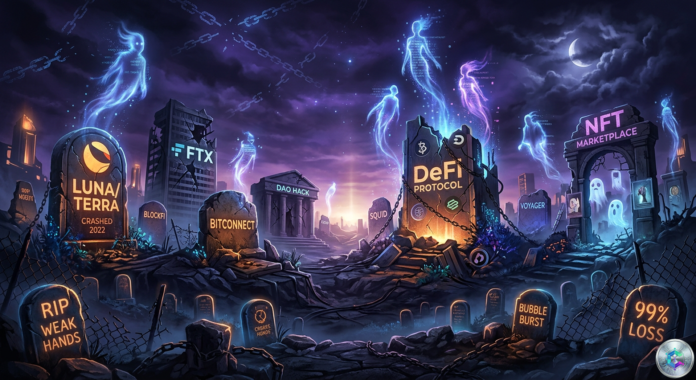
More Than 20 Crypto Projects Shut Down in Q1 2026: The Blockchain Graveyard Fills Up Faster Than Expected
Introduction

Three months into 2026, the blockchain graveyard is filling up faster than anyone expected. Over twenty crypto projects — from DeFi heavyweights to NFT marketplaces, governance tools, and even Bitcoin miners — have already announced shutdowns, phased wind-downs, or outright bankruptcy.
This is not the rug-pull chaos of 2022. These are mostly honorable exits: user funds are returned, teams communicate transparently about math that no longer adds up. Here is a comprehensive overview of every confirmed case with key details on timing and reasons.
The Spring Cleanup: The Projects Affected
Tally: Decentralized Governance Goes on Pause
Tally, the governance platform that powered votes for over 500 DAOs including Uniswap, Arbitrum, and ENS, quietly ceased all operations in mid-March 2026. The reason: unsustainable costs to maintain an online voting service. With server, development, and compliance costs rising relentlessly, the team preferred to shut down rather than compromise the security of entrusted funds. It is a hard blow for the DAO ecosystem, which loses its main on-chain coordination tool.
Balancer Labs: The Historic Swap Protocol in Survival Mode
The original entity behind the Balancer Protocol wound down operations in late March 2026, citing legal exposure from past exploits, lack of sustainable revenue, and corporate overhead. The decentralized Balancer protocol itself continues to exist, but the corporate entity developing it throws in the towel. A concerning signal for other DeFi protocols that rely on centralized structures to ensure their development and maintenance.
Angle Protocol: Euro and Dollar Stablecoins in Freefall
Angle Protocol launched a phased shutdown of its EURA and USDA stablecoins, which had reached a combined TVL of $250 million at peak. The announcement, made in early March, reflects the challenges of a rapidly changing stablecoin market, where competition from established giants like USDC and USDT makes survival for alternatives increasingly difficult. The evaporated liquidity made it impossible to maintain the required collateral.
Milky Way: Celestia’s Liquid Staking Protocol Disappears
Milky Way, Celestia’s liquid staking protocol that had reached $250 million in TVL, permanently closed its doors on January 15, 2026. Liquidity completely dried up on the protocol, making staking positions illiquid and rewards insufficient to attract new depositors. Without secondary liquidity, the liquid staking model collapses.
Polynomial Protocol: On-Chain Derivatives Say Goodbye
Polynomial Protocol, the derivatives platform that had processed up to $4 billion in volume at its peak, simply walked away from operations due to persistent liquidity issues and high costs. The decentralized derivatives market remains dominated by a few major players, and the smaller ones are sinking.
Step Finance: The Hack That Triggered Everything
Step Finance announced the shutdown of all its operations in late February, after a major hack and failed rescue attempts led to an immediate shutdown. When a project’s hack is serious enough to exhaust the team’s reserves and user trust, shutdown becomes the only option.
Magic Eden: The NFT Giant Bends
Magic Eden, the dominant NFT marketplace especially on Solana and Bitcoin Ordinals/Runes, launched the phased shutdown of its EVM marketplace and Bitcoin API on March 9, with a wallet shutdown on April 1 and full closure eyed for early April. The NFT market has collapsed by more than 90% from its 2024-2025 peaks, and volumes no longer justify maintained teams.
Nifty Gateway: The Other NFT Marketplace Disappearing
Nifty Gateway, the Gemini-owned NFT marketplace, shut down effective February 2026, as NFT trading volumes collapsed. With platforms like OpenSea struggling and Magic Eden folding, the NFT ecosystem seems to enter a phase of forced consolidation.
DappRadar: Web3 Analytics With No Viable Model
DappRadar, the veteran dApp analytics platform that tracked metrics across thousands of decentralized projects, shut down after years of unsuccessful monetization attempts. Without a viable business model, the project could not stay afloat in a market that does not generate enough advertising revenue to sustain such a service.
Parsec: AI-Powered On-Chain Analytics Vanishes
Parsec, the AI-driven on-chain analytics platform, shut down on February 19, 2026 after five years of operation. AI on blockchain is a promising field, but development and infrastructure costs evidently exceeded generated revenues.
Entropy: Self-Sovereign Custody That Returned Funds
Entropy, the self-custody and crypto custody startup that had raised $25 million, completely shut down in January 2026. The founder returned remaining capital to investors due to insufficient growth in current market conditions. A rare case of closure with full restitution, illustrating the rigor of the founding team.
Bitcoin Miners in Survival Mode
The quarter was also marked by a bloodbath among Bitcoin miners. Bit.com launched a phased shutdown in late 2025 with full closure by March 31, 2026. NFN NUMX Group, a US-based Bitcoin miner, filed Chapter 11 bankruptcy after a devastating data center fire. BitRiver, Russia’s largest mining operation, entered bankruptcy proceedings. Bitfarms, a publicly listed miner, completely exited Bitcoin mining operations to pivot to AI data centers, even rebranding. Bitdeer Technologies sold off all Bitcoin holdings and redirected treasury toward AI and HPC infrastructure. American Bitcoin Corp, backed by Trump, suffered massive losses and a 90%+ stock decline, effectively in high-risk territory.
GameFi: Blockchain Games in Decline Mode
GENSO Online, the fantasy RPG GameFi title, announced the full shutdown of servers, marketplace, and services for April 30, 2026, citing server costs running five times revenue. Pixiland, a strategy game on Ronin, indefinitely suspended all Web3/token plans in mid-January and pivoted to a pure Web2/offline model. Forgotten Runiverse, the Ethereum/Ronin-based MMORPG, went dark indefinitely citing financial infeasibility while preserving player data.
Classic Sector Bankruptcies
Archblock, the crypto firm, filed for Chapter 11 in early February 2026, with $100 million in liabilities against only $10 million in assets. Blockfills, the crypto trading and lending platform, filed for Chapter 11 on March 15, 2026 amid a liquidity crisis. Tudou Guarantee, the Telegram-based crypto escrow marketplace (Southeast Asia-focused), shut down in January following regulatory action tied to illicit activity.
The Causes of the Great Cleanup
The Post-2025 Liquidity Hangover
The obvious culprit is the post-2025 liquidity hangover. After a bull run that pumped TVL to record levels, capital retreated to safety: Bitcoin ETFs, blue-chip protocols, and stablecoins.
What is left behind are projects that chased growth with unsustainable incentives, only to watch users bolt when APYs normalized. High fixed costs — legal teams, compliance, cross-chain maintenance — became fatal. Add a occasional hack, and the math turns ugly fast.
Narrative Whiplash
Narrative whiplash has not helped either. Restaking, GameFi, and NFTs, the dominant stories of 2024-2025, have lost their shine. Capital is rotating toward « real yield » and tokenized real-world assets, leaving the rest to fight over scraps.
Macroeconomic uncertainty, including US policy gridlock, has not exactly boosted confidence either. Institutional investors, who could have provided a lifeline, remain on the sidelines waiting for clearer signals.
The Question of Model Durability
At the heart of the problem lies a fundamental question: did these projects have a viable business model or were they primarily living off token inflation and speculation? When the music stops, those without a chair find they must leave.
The Bright Side: Honorable Exits
Yet there is a bright side in this cleanup. Most of these shutdowns have been orderly: teams communicate early, users withdraw funds safely, and there are no sudden rug pulls. This is a far cry from the Wild West days.
Balancer leads by example: zero token emissions, fees routed to the DAO, and strict product focus. This is the same medicine others are swallowing, or should be. True decentralization is no longer just a buzzword; it is the only way to shed corporate drag and legal risk.
DAOs and foundations are stepping up where VCs and labs once held sway. RootData now lists 21 entries in its « 2026 Crypto Dead Projects List » and counting. Trackers like PANews call it a « brutal reshuffle. » But history suggests these resets clear the field for the next wave.
What History Tells Us
The 2018 ICO crash birthed DeFi. The 2022 crash birthed institutions. 2026’s purge? It could birth something leaner, more resilient, and protocols that generate real fees, not just hype.
In 2018, the surviving projects were those with real utility and adaptable teams. In 2022, survivors had solid balance sheets and non-speculative revenue sources. In 2026, survivors will be those who embedded economic sustainability in their DNA from day one.
For builders, the lesson is stark: build for revenue from day one, not endless dilution. For users and investors, it is a reminder that not every token moonshot is built to last. Capital and talent are consolidating around the strong. The weak are exiting the stage.
Conclusion: This Is Not the Death of Crypto Innovation
This is not the death of crypto innovation. It is the painful adolescence of an industry finally growing up. The survivors will inherit a DeFi landscape worth several trillion dollars that rewards substance over spectacle. The question now is who is left standing when the dust settles.
The coming months will witness further shutdowns. RootData’s list will continue to grow. But for every project that closes, two others learn from its mistakes. The industry is getting stronger, even if it does so painfully. And when the next bull cycle arrives, the foundations will be more solid to welcome it.
Sources:
- MEXC / Technext, « Inside the 2026 blockchain graveyard: 20+ crypto projects that died in Q1, » April 2026
- PANews, « List of crypto projects that shut down, transformed, or went bankrupt in 2026, » March 2026
- Small World FS, « Crypto market undergoes significant reset as projects shutter, » April 1, 2026
- Binance Square, « 2026 Death List: Games are dead, DeFi is dead, tools are dead »

