

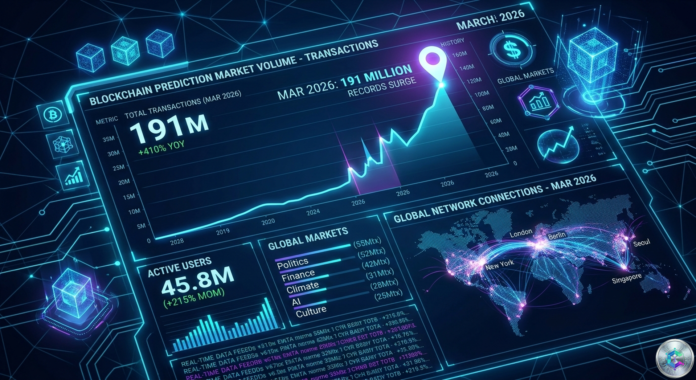
March 2026: Prediction Markets Shatter All Records — 191 Million Transactions and $23.9 Billion in Trading Volume
Blockchain prediction markets are living through their most spectacular month in history. In March 2026, more than 191 million transactions were recorded on these decentralized forecasting platforms — a staggering 2,838% increase compared to the same period last year. The monthly notional trading volume reached $23.9 billion, up from just $1.9 billion in March 2025. These figures, reported by Dune Analytics, outline a profound shift in the way the financial and geopolitical world evaluates uncertainty.

Behind this explosion, several forces converge: the democratization of platform access, growing integration with traditional media, and above all a regulatory framework that — despite some turbulence — is moving in an overall favorable direction. Here is a look at a phenomenon redefining collective intelligence in real time.
Explosive Growth That Defies Imagination
Just two years ago, prediction markets were relegated to the status of a curiosity for crypto insiders. Today, they have become genuine barometers of public opinion, consulted by millions of people around the world.
Dune’s data shows a trajectory that is anything but an isolated accident. From a monthly volume of $1.9 billion in March 2024, prediction markets climbed to $4.2 billion in June 2024, then $8.7 billion in September, before reaching $14.3 billion in December. By March 2026, the $23.9 billion figure buries forever the idea that these platforms were a marginal phenomenon.
« Prediction markets have scaled rapidly due to improved accessibility, regulatory developments, and integration with mainstream platforms. They are increasingly used as real-time indicators of geopolitical and macroeconomic events, » summarized blockchain intelligence firm TRM Labs in a recent report.
This acceleration is particularly visible in the geographical distribution of activity. While North America and Europe remain the main hubs, it is in Asia that the most spectacular growth rates are being observed — a sign of truly global democratization.
Google Finance and Mainstream Media Change the Game
One of the major turning points of 2026 is the integration of prediction market odds into Google Finance. This decision, seemingly minor on the surface, has had a considerable multiplier effect: hundreds of millions of users now have access to market probabilities without even needing to understand what lies behind them.
This integration has contributed to the rise of American political events as the main volume drivers. Contracts linked to American politics — nomination of candidates for 2028, whether Israeli Prime Minister Benjamin Netanyahu will remain in office by year-end — now dominate the ranking of the most active markets on Polymarket, representing several billion dollars in positions.
At the same time, traditional financial media have profoundly changed their approach. Where analysts were still avoiding citing Polymarket or Kalshi odds just two years ago, they now regularly integrate them into their research notes. This virtuous circle — media coverage generating more participation, which produces more reliable data, which attracts more attention — is one of the most powerful engines of the observed growth.
Stablecoins and Crypto Rails: The Invisible Engine
It would be impossible to understand this explosion without acknowledging the role of stablecoins and blockchain infrastructure in how these markets operate.
The majority of prediction market platforms use stablecoins like USDC or USDT for position settlement. This approach offers several decisive advantages: transaction finality in seconds rather than days, marginal transaction costs thanks to layer-2 solutions, and unprecedented accessibility for users in regions where traditional banking systems are slow or inaccessible.
This crypto-native infrastructure has also enabled the emergence of markets on events previously impossible to process: electoral outcomes in countries without developed financial infrastructure, evolution of geopolitical conflicts, or macroeconomic variables in emerging economies. By providing a minimal trust layer, blockchain has made these markets accessible where no traditional regulator could have intervened.
The Central Role of American Politics
March 2026’s figures cannot be fully understood without acknowledging that prediction market volume is now directly correlated with the American political calendar.
According to TRM Labs: « Geopolitical events, US politics, and macroeconomic decisions account for the majority of trading volume. Crypto-native topics, while prevalent, now represent a smaller share of overall activity. »
This marks a turning point compared to the origins of prediction markets within the crypto ecosystem. In 2024 and 2025, contracts on memecoins and digital assets still dominated a significant portion of activity. Today, it is political events that attract the largest volumes.
The five most active contracts on Polymarket at the beginning of March 2026 all focused on American and foreign policy questions: nomination of Republican and Democratic candidates for the 2028 presidential election, and the stability of the Netanyahu government. This concentration illustrates the capacity of prediction markets to transform public opinion into exploitable financial data.
Regulatory Challenges: A Framework Under Construction
But this exponential growth does not come without clouds. Prediction markets face growing scrutiny from regulatory authorities, particularly in the United States.
In March 2026, things accelerated. Kalshi and Polymarket jointly announced plans to introduce trading guardrails to protect their platforms against allegations of insider trading. The same day, a bipartisan bill was introduced in the US Congress to ban event contracts that resemble a « casino-style game » — language that directly targets prediction market platforms.
In Nevada, a judge temporarily blocked Kalshi from operating in the state, raising fundamental questions about the legality of these markets across different American jurisdictions. These developments show that the regulatory framework remains one of the major unknowns for the sector’s future.
TRM Labs notes that « continued growth of prediction markets will depend on how key challenges, including market integrity and susceptibility to manipulation, are addressed. »
From Speculative Playground to Information Infrastructure
Beyond the record-breaking numbers, it is the very nature of prediction markets that is changing. TRM Labs goes so far as to suggest these platforms « have the potential to evolve beyond speculative platforms into core infrastructure for real-time information aggregation and risk pricing. »
« As liquidity deepens and participation broadens, these markets could increasingly serve as forward-looking indicators for policy decisions, geopolitical developments, and macroeconomic trends — complementing, and in some cases competing with, traditional forecasting tools, » the report adds.
This vision is shared by several institutional players. Risk management departments now use prediction markets for scenario analysis. Research teams integrate the collective wisdom of these markets into their forecasting models. Trading desks monitor market probabilities as sentiment indicators.
The Impact of Improved Interfaces and Mobile Accessibility
It would be a mistake to underestimate the role that technical improvements have played in this democratization. Over the past months, the main prediction market platforms have considerably modernized their user interfaces.
Simplified onboarding processes have reduced barriers to entry for new participants. Intuitive designs have made participation accessible to non-technical users. Mobile optimization has ensured constant accessibility, enabling real-time position adjustments.
These improvements, combined with layer-2 scalability solutions that have drastically reduced transaction costs, have created the technical conditions necessary for mass adoption. Without these infrastructure advances, processing 191 million transactions in a single month would simply have been technically impossible.
Cross-chain interoperability protocols have also expanded asset accessibility across different blockchain ecosystems. Users can now participate in prediction markets using various digital assets without complex bridging procedures — eliminating a major obstacle for newcomers.
Geopolitical Events Take Center Stage
It is remarkable how much geopolitical events have overtaken strictly financial topics in prediction market volumes. The ongoing war in the Middle East, trade tensions between major powers, and uncertainties around central bank monetary policies have created a particularly fertile environment for these markets.
This evolution shows that prediction markets are no longer merely tools for speculating on financial assets — they have become instruments for measuring geopolitical uncertainty on a global scale. Where traditionally only specialized analysts could offer their view on the probability of a geopolitical event, any user can now take a position and contribute to establishing a market price for that information.
The fact that wars, elections, and natural disasters are now tradable on decentralized platforms raises fundamental ethical questions. Is the financialization of human uncertainty a step forward for information transparency or a drift toward a planetary casino? The debates are far from settled, but they can no longer be ignored.
Institutional Integration Changes the Equation
Beyond individuals, it is now major institutional players exploring the possibilities of prediction markets. Investment funds use these platforms to complement their risk models. Consulting firms integrate market probabilities into their client recommendations. International media use odds as reference indicators for their analyses.
This institutional integration has a paradoxical effect: by democratizing access to information, prediction markets attract increasingly powerful actors who, in turn, influence probabilities through their positions. This virtuous — or vicious — circle is one of the most fascinating phenomena in today’s financial ecosystem.
Layer-2 solutions have played a determining role in this evolution. By drastically reducing transaction costs, they have enabled the emergence of high-frequency trading strategies on modest-sized positions — previously economically impossible. Protocols like Arbitrum, Optimism, and Base have allowed thousands of users to participate in markets once reserved for large players.
Three Scenarios for the Future
As March 2026 ends on historical records, the question of what comes next naturally arises. Will prediction markets consolidate their gains or hit a plateau?
Several scenarios are possible. The first is progressive consolidation, where volumes remain high but exponential growth slows as the market reaches a form of maturity. The second scenario involves ever-deeper integration into traditional financial tools, with the arrival of major institutional players and the development of derivative products on market probabilities. The third, darker scenario is a regulatory crackdown that would force platforms to restructure deeply, or even exit certain markets.
What seems certain is that prediction markets have now moved beyond the status of a curiosity to become a structural phenomenon in the global financial and geopolitical landscape. With $23.9 billion in monthly volume and growth of nearly 2,900% in a single year, they have demonstrated their ability to attract considerable capital and the attention of the entire world.
The coming years will tell whether this growth can be sustained while addressing the regulatory and integrity challenges that accompany it. But already, March 2026 will remain as the month when prediction markets officially entered the financial mainstream.
Conclusion
Blockchain prediction markets are living through a pivotal moment. With 191 million transactions and $23.9 billion in volume in March 2026, these decentralized forecasting platforms have not only broken all records but have demonstrated their potential to become a reference information infrastructure for the 21st century.
Integration into Google Finance, growing media coverage, and technical improvements have transformed these markets into mainstream tools, while crypto rails and stablecoins provide reliable infrastructure for millions of users worldwide.
Regulatory challenges remain considerable — from the US « casino-style game » bill to Nevada’s blocking of Kalshi — but the sector has shown a remarkable ability to adapt and grow despite headwinds.
For investors, analysts, and ordinary citizens alike, prediction markets now offer a unique window onto the world’s collective intelligence in real time. The question is no longer whether these markets will transform how we evaluate uncertainty — but how quickly that transformation will unfold.
Sources: Cointelegraph, Dune Analytics, TRM Labs, Polymarket, Binance Research, Mexc News

