

In January 2026, the tokenized stocks market crosses a historic milestone by surpassing $1 billion in market capitalization, representing a growth of over 5000% in one year. This spectacular explosion is no accident: crypto exchanges Kraken and Bitget are now positioning tokenized stock trading at the heart of their strategy, heralding a profound transformation in access to traditional financial markets.
Explosive Growth Redefining Markets
The numbers speak for themselves. From $20 million in 2025, the tokenized stocks market now reaches $1.34 billion. Projections for 2030 are even more impressive: according to Tiger Research, if only 1% of global stocks were tokenized, the market could reach $1.34 trillion – a 2,680-fold multiplication of its current size.
Major financial institutions share this overwhelming optimism. McKinsey projects $2 to $4 trillion in tokenized assets by 2030, while Boston Consulting Group pushes estimates to $16 trillion. Standard Chartered goes even further with a forecast of $30 trillion by 2034.
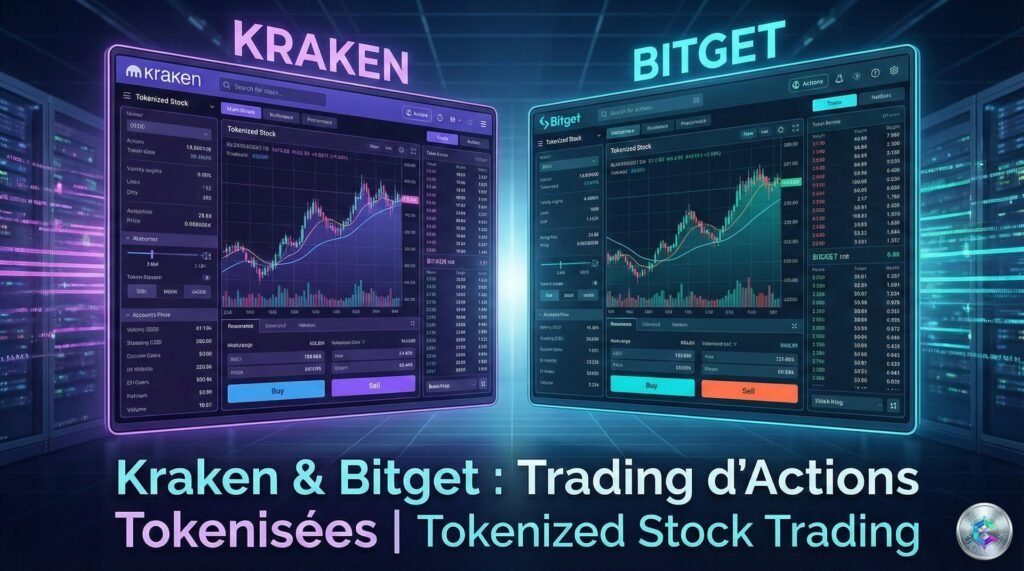
Kraken Consolidates Position with Backed Finance Acquisition
In December 2025, Kraken made a major move by acquiring Backed Finance, the Swiss company behind xStocks. This platform enables the issuance of tokens representing US stocks and ETFs, each backed 1:1 by real shares held by regulated Swiss banking institutions.
xStocks’ performance is remarkable: since its launch in June 2025, the platform has attracted over 84,000 holders, generated daily volumes exceeding $30 million, and accumulated $175 million in assets under management. At the time of acquisition, xStocks held 58.3% market share with $600 million in market capitalization.
Arjun Sethi, Kraken’s co-CEO, underscores the strategic ambition: « Integrating Backed into Kraken strengthens the foundational architecture necessary for open and programmable capital markets. Unifying issuance, trading, and settlement under one framework ensures that infrastructure for tokenized assets remains transparent, reliable, and globally accessible. »
The platform currently offers 60 tokenized assets, including giants like Apple (AAPLx), Tesla (TSLAx), Nvidia (NVDAX), Microsoft, Meta, and Amazon. The major innovation: trading available 24 hours a day, 5 days a week, eliminating traditional market time constraints.
Bitget Focuses on Efficiency and Accessibility
While Kraken structures its infrastructure through acquisition, Bitget adopts a different but equally strategic approach. The exchange, claiming 120 million users, migrated its tokenized stock tokens from Ethereum to BNB Chain (BEP20) in December 2025.
This technical decision directly addresses user concerns about Ethereum’s prohibitive transaction fees. By migrating to BSC, Bitget eliminates costly gas fees while maintaining a zero trading fee promotion on tokenized stocks until January 16, 2026.
Gracy Chen, Bitget’s CEO, explains: « It’s really about listening to our community and delivering what matters most to them. BSC gives our traders the speed and cost efficiency they need to succeed. »
Results speak volumes: trading volume surged 446% before migration. Even more revealing: 95% of tokenized stock traders on Bitget also hold cryptocurrencies, demonstrating this new market attracts crypto-native investors seeking portfolio diversification.
Solana Emerges as Dominant Infrastructure
One blockchain has emerged as the preferred infrastructure for tokenized stocks: Solana. Data reveals overwhelming dominance with 95.6% of total tokenized stock trading volume, relegating Gnosis (1.98%) and Ethereum (1.8%) far behind.
This dominance is no accident. Solana offers high transaction speeds, minimal costs, and fast finality – essential characteristics for financial asset trading. In September 2025, Solana attracted $2 billion in new stablecoin inflows, bringing the total to $14.3 billion and consolidating 60% of tokenized stock transactions.
The tokenized stocks market value on Solana tripled to reach $48 million in just two weeks in July 2025. Backed Finance (xStocks) dominates with $88 million in assets under management, while new competitor Remora Markets reached $3.5 million in one month.
DeFi Integration: Beyond Simple Trading
One of the most transformative value propositions lies in integration with DeFi protocols. On Solana, xStocks can be traded, exchanged, or deployed in liquidity pools on protocols like Raydium, Jupiter, and Kamino.
Superstate activated the first major utility in December 2025: collateralization in Kamino. Eligible investors can now borrow stablecoins against their tokenized stocks, accessing liquidity while maintaining exposure to underlying shares.
This ability to combine regulatory compliance with DeFi utility represents a major innovation. Investors gain onchain collateral utility, while issuers and regulators obtain precise, continuously updated shareholder tracking.
Transformative Advantages for Investors
Tokenized stocks offer several structural advantages that directly address traditional market inefficiencies:
- 24/7 Trading: Market access anytime, without time constraints or closures for weekends or holidays
- Fractional Ownership: Invest in $1,000 stocks with just $10, democratizing access to premium securities
- Instant Settlement: Transactions settled in seconds rather than 2 days (T+2), eliminating counterparty risk
- Fee Reduction: Elimination of multiple intermediaries through smart contracts
- Global Accessibility: No more geographic or regulatory barriers for cross-border investment
- Blockchain Transparency: Immutable and auditable ledger of all transactions
Risks and Challenges Not to Be Underestimated
Despite promises, investors must understand significant risks. Volatility remains a major concern in less liquid markets. Custody and private key security questions represent a unique challenge: losing a key generally results in permanent, irrecoverable asset loss.
Absence of voting rights constitutes an important limitation. Most tokenized stock structures don’t confer these privileges to token holders. Regulatory uncertainty also hangs like a sword of Damocles over the entire industry, with tax treatments and compliance rules varying considerably between jurisdictions.
Regulatory Framework: Complex but Evolving Navigation
The principle established by global regulators is clear: tokenized securities remain securities. In the European Union, the MiCA (Markets in Crypto-Assets) regulation establishes a unified framework for crypto-assets, with clear compliance obligations for issuers and service providers.
In the United States, the situation remains more ambiguous but evolving rapidly. Tokenized stocks are currently not accessible to US, Canadian, British, or Australian residents, reflecting persistent uncertainties. The SEC’s Crypto Task Force aims to create a regulatory framework, but concrete details remain to be defined.
Programmable compliance emerges as a solution: smart contracts can directly encode compliance rules into tokens themselves, automatically restricting transfers to authorized investors and respecting geographic limits.
The Future: Convergence and Transformation
The year 2026 emerges as a pivotal moment. Growing regulatory clarity, particularly in Europe, progressively eliminates uncertainties. Financial institutions move from experimentation to large-scale operations – a crucial qualitative evolution.
Expansion beyond Treasury bonds toward tokenized funds and private markets considerably broadens the addressable market. Technical infrastructure continues maturing rapidly, with cross-chain interoperability solutions and consolidation of standards like ERC-3643.
Over 280 public companies adopted digital asset treasury (DAT) strategies in 2025, collectively holding more than $115 billion in crypto. This normalization indicates CFOs now treat tokenized treasury as an integral part of corporate finance.
Conclusion: A New Paradigm Under Construction
Kraken and Bitget aren’t just offering a new feature to their users. They’re participating in building a new financial infrastructure that could fundamentally redefine global capital circulation.
Tokenized stocks aren’t simply digital versions of traditional assets. They represent programmable financial primitives combining economic advantages of established markets with blockchain’s transformative properties: 24/7 availability, instant settlement, fractional ownership, DeFi composability, and global accessibility.
Challenges remain considerable – regulatory uncertainty, technical risks, liquidity concerns. Yet the trajectory seems irrevocable. When the market crossed $1 billion in January 2026 with 50-fold growth in one year, it demonstrated real, substantial demand exists for this innovation.
The dawn of a new financial era doesn’t rise abruptly but progressively, as infrastructure builds, use cases prove themselves, and adoption broadens. Tokenized stocks represent one of the most concrete manifestations of this transformation – a tangible bridge between the established $134 trillion financial world and the emerging blockchain ecosystem.
For investors, institutions, and regulators who can navigate this transition with prudence and vision, opportunities could be as transformative as they are considerable.

