

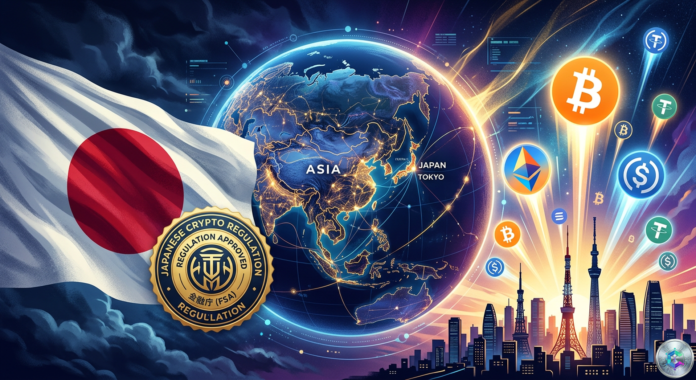
Japan, Hong Kong, IMF: Crypto Regulation Intensifies Globally
Subtitle: As Japan puts KuCoin and several foreign platforms in the FSA’s crosshairs, Hong Kong delays its stablecoin licenses and the IMF warns about tokenization risks — the crypto sector faces an unprecedented week of regulatory tightening.

Japan Launches Historic Regulatory Offensive Against Foreign Platforms
On March 26, 2026, Japan’s Financial Services Agency (FSA) officially added KuCoin to its list of entities conducting financial instrument business without registration. The Japanese monetary authority specifically targeted the cryptocurrency exchange for offering over-the-counter (OTC) derivatives trading services without registration with Japanese authorities, and for actively marketing these services to Japanese residents via the internet.
KuCoin is not alone in the regulator’s sights. The authority also listed other international platforms operating illicitly in the Japanese market: NeonFX, theoption, and GTCFX. These companies are accused of online solicitation of financial derivatives — an activity strictly regulated in Japan and requiring prior registration with the FSA.
This offensive comes against a backdrop of significant growth in the Japanese crypto market. With a population of approximately 123 million people, FSA data reveals that more than 12 million cryptocurrency accounts have been identified in the country. Chainalysis’s 2025 Global Crypto Adoption Index ranks Japan 19th globally in terms of adoption — a figure that reflects a dynamic ecosystem despite a strict regulatory framework.
Japan’s legal framework is particularly clear: any cryptocurrency platform wishing to operate in the country must register with the FSA. This requirement extends to derivatives services, margin trading products, and digital financial instruments offered to Japanese residents. Platforms operating from abroad and deliberately targeting this market without authorization face administrative and potentially criminal sanctions.
KuCoin: A Growing List of Regulatory Problems
KuCoin’s case is particularly revealing of the growing tensions between major cryptocurrency platforms and global regulatory authorities. Even before this Japanese warning, KuCoin had already pleaded guilty in U.S. court proceedings and agreed to pay approximately $300 million to U.S. authorities. This conviction related notably to accusations of violating securities laws and money laundering.
KuCoin’s apparent recidivism — continuing to operate in regulated markets without the necessary authorizations — illustrates a structural problem in the crypto sector: the temptation for certain platforms to expand into regulatory gray areas rather than actively seeking compliance in each jurisdiction.
For Japanese users of KuCoin, this FSA warning is no administrative formality. It means that the services they have been using could be considered illegal, and that funds deposited on these platforms operate without the protection mechanisms provided by Japanese financial regulations.
Global Context: An Unprecedented Regulatory Wave
This Japanese offensive is not occurring in a vacuum. It is part of a global trend where regulatory authorities are progressively tightening their grip on the cryptocurrency ecosystem at multiple levels.
United States: SEC and CFTC actions continue to shape the industry. The settlement with FTX and its executives — including Nishad Singh ordered to pay $3.7 million and subject to a trading ban — demonstrates that legal consequences for irregular practices are very real.
Hong Kong: The Hong Kong Monetary Authority (HKMA) had announced a target for issuing stablecoin licenses by March 2026, with persistent rumors that banking giants such as HSBC and Standard Chartered would be among the first recipients. However, at the time of this article, no licensed issuer yet appears on the HKMA’s official register of licensed stablecoin issuers.
This delay strongly contrasts with Hong Kong’s ambitions to become a global digital asset hub. Authorities explain this caution by the need to ensure that licensees have innovative use cases, viable business models, and robust regulatory compliance capabilities. The approach clearly prioritizes quality over speed.
IMF and Tokenization: In a report published in late March 2026, the International Monetary Fund (IMF) adopted a nuanced position on the tokenization of financial assets. The institution recognizes that this technology can significantly improve financial market efficiency by streamlining settlement and ownership transfer processes, while reducing transaction costs and increasing transparency.
However, the IMF also warns that the rapid adoption of tokenized systems could introduce new risks to financial stability, governance, and regulatory oversight. The 23-page report emphasizes that « the net effect of tokenization on financial stability is uncertain, » adding that « atomic settlement and enhanced transparency reduce some traditional risks, but speed and automation introduce new ones. »
This position from the IMF comes as the market for real-world asset tokens (RWA) has grown by approximately 66% in 2026, according to DeFiLlama data. This rapid expansion reflects the growing interest of traditional institutions in bringing conventional financial instruments onto blockchain networks.
Australia: The country has taken a significant step by making it mandatory for cryptocurrency exchange platforms to obtain financial services licenses under new legislation. This measure aims to strengthen investor protection for Australians and align the crypto sector with regulatory standards applied to other financial services in the country.
Analysis: What Does This Increased Regulation Mean for the Crypto Industry?
The multiplication of regulatory actions across the globe is not necessarily bad news for the crypto sector in the long term. On the contrary, it could be interpreted as a sign of maturity: authorities are implicitly recognizing the importance and permanence of the cryptocurrency market by applying the same standards to it as to other financial markets.
Investor protection: Unregistered platforms generally operate without the safeguards provided by financial regulations: segregation of client assets, regular audits, protection against market manipulation, and dispute resolution mechanisms. Regulatory actions by Japan, the United States, and other jurisdictions specifically aim to protect users from these risks.
Market rationalization: Historically, financial sectors go through a phase of regulation that eliminates the least scrupulous actors and creates a healthier environment for serious players. Exchanges that invest in regulatory compliance should benefit from a competitive advantage in the long term.
Institutional integration: Bitcoin and Ethereum ETF products approved in the United States in 2024-2025 marked a turning point in the institutional acceptance of cryptocurrencies. This integration continues and deepens, but it requires a clear and predictable regulatory framework. Current regulatory actions contribute to establishing this framework.
Challenges for users: In the short term, some users may see their access to certain platforms restricted. Japanese residents using KuCoin or other unregistered platforms may need to migrate to registered or compliant alternative platforms. This disruption can be frustrating, but it follows a protective logic.
Bitcoin and Ethereum Face These Regulatory Tensions
In this context of global regulatory tightening, the two largest cryptocurrencies by market capitalization display distinct but interconnected behaviors.
Bitcoin (BTC) remains the digital asset of reference for institutional flows. Despite net outflows of $194 million in the week of March 30 according to CoinShares, BTC maintains a positive balance of $964 million cumulatively since the start of 2026 — the highest of all digital assets. This resilience reflects the persistent confidence of major investors in Bitcoin’s profile as a digital store of value and portfolio diversification instrument.
Technically, Bitcoin closed March with a bullish candle after five consecutive months of decline, which could signal a trend change. The support level at $65,000 remains crucial: maintaining it opens the way to testing resistance at $71,000, while a break below $60,000 would return the market to bearish territory.
Ethereum (ETH) faces more marked pressures, with outflows of $222 million last week and an annual cumulative now negative at -$273 million. This situation is notably linked to uncertainties around the U.S. CLARITY Act and growing competition in the smart contracts space. However, Ethereum retains its role as the fundamental infrastructure for DeFi, non-fungible tokens (NFT), and increasingly for real-world asset tokenization.
Stablecoins: The Regulatory Battlefield of the Future
Stablecoins occupy an increasingly central position in regulatory debates. These tokens pegged to fiat currencies, primarily the U.S. dollar, have become the pivot of the crypto ecosystem: they serve as entry and exit points, collateral for DeFi products, and increasingly vectors for cross-border payments.
Regulating stablecoins raises considerable stakes. Their ability to facilitate fast, low-cost transactions makes them a powerful tool, but also a potential risk if their reserves are not adequately secured or if their governance is opaque. Past episodes of depeg — such as the USR stablecoin from Resolv Labs in March 2026 — remind us that the stability of these instruments is never guaranteed.
Regulatory approaches vary considerably across jurisdictions. The United States is still debating the applicable framework, the European Union has adopted the MiCA (Markets in Crypto-Assets) regulation that is entering into force, and some countries like Japan require strict registration for stablecoin issuers. This regulatory fragmentation creates operational challenges for businesses wishing to operate globally.
Stablecoin issuers who manage to successfully navigate the growing complexity of national regulatory environments will be ideally positioned to capture a significant share of the cross-border digital payments market.
Hong Kong, by delaying its stablecoin licenses, sends a nuanced message: the market is mature enough to welcome these instruments, but authorities refuse to sacrifice caution for speed. This « quality over speed » approach could ultimately strengthen the credibility of the Hong Kong crypto hub and attract institutional players concerned about compliance.
The main Hong Kong candidates for stablecoin issuance — particularly international banking giants like HSBC and Standard Chartered — have the resources to meet the strictest regulatory requirements. Their entry into the market, when it occurs, could transform the landscape of digital payments in the Asia-Pacific region and beyond.
Outlook: Toward a More Mature Crypto Ecosystem
The week of April 3, 2026, proves to be a turning point for global cryptocurrency regulation. Japan’s actions against KuCoin and other unregistered platforms, Hong Kong’s delay in issuing stablecoin licenses, and the IMF’s nuanced report on tokenization all converge toward the same conclusion: the cryptocurrency sector is entering a phase of regulatory maturity that will progressively separate viable players from opportunists.
For investors and users, this regulatory intensification presents both challenges and opportunities. In the short term, some services may become less accessible or require adjustments. In the medium and long term, a clear and enforced regulatory framework will reduce the risks of fraud, manipulation, and fund losses, making the ecosystem safer and more attractive to institutional capital.
Bitcoin has historically demonstrated a remarkable ability to adapt to regulatory changes and emerge stronger. As the market digests these regulatory developments, players who prioritize compliance, transparency, and stability should consolidate their position. The path toward mainstream adoption of cryptocurrencies inevitably passes through this maturity phase — and the regulatory decisions of this week could well be a decisive turning point.
Sources: Japan Financial Services Agency (FSA), IMF report on tokenization (March 2026), CoinShares, Hong Kong Monetary Authority (HKMA), Gadgets360, Cryptoslate. Market data is provided for informational purposes only and does not constitute investment advice.

