


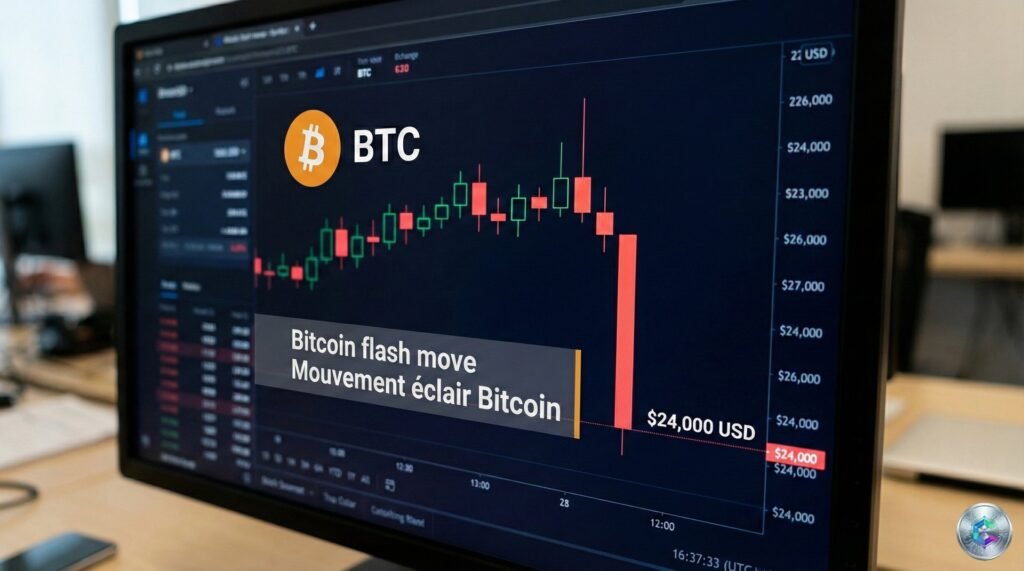
On December 24, 2025, the cryptocurrency market witnessed an event as spectacular as it was unexpected: Bitcoin briefly plummeted to $24,111 on Binance’s BTC/USD1 trading pair before instantly rebounding to over $87,000. This 72% flash crash, occurring on Christmas Eve, immediately triggered a wave of concern among investors. However, this anomaly reveals more about the structural vulnerabilities of low-liquidity markets than weaknesses in Bitcoin itself.
A Spectacular Yet Isolated Flash Crash
On the evening of December 24, around 5:00 PM (Central European Time), screenshots showing Bitcoin’s price at $24,111 on Binance began circulating massively on social media. This dizzying 70% drop from the normal market price of approximately $87,000 immediately sowed panic among traders.

However, in-depth analysis of the incident reveals several characteristics that clearly distinguish this flash crash from a genuine market collapse. First, the crash was strictly limited to the BTC/USD1 pair – other major pairs like BTC/USDT remained perfectly stable around $87,000 throughout the incident. Second, the price anomaly lasted only a few seconds before the price instantly recovered to normal market levels.
More reassuringly, no leveraged positions were liquidated. Changpeng Zhao (CZ), founder of Binance, quickly confirmed that « the pair was not included in the indices » used to calculate margins and trigger liquidations. Finally, other exchanges and cryptocurrencies recorded no similar anomalies during this period, confirming the complete absence of systemic impact.
USD1: The Stablecoin at the Heart of the Incident
To understand this flash crash, it’s essential to grasp the nature of USD1, the stablecoin involved in this trading pair. USD1 is a recent stablecoin launched in March 2025 by World Liberty Financial (WLFI), a decentralized finance (DeFi) project backed by U.S. President Donald Trump and his family.
USD1 is designed as a conservative stablecoin, fully backed by high-quality assets: short-term U.S. Treasury bonds, U.S. dollar deposits, and cash equivalents. BitGo Trust Company, a regulated entity based in South Dakota, provides custody of reserves with monthly attestations published by independent accounting firms following AICPA standards.
USD1 gained considerable visibility through its use in MGX’s historic investment, an Abu Dhabi sovereign wealth fund, in Binance. In March 2025, MGX announced a $2 billion investment in Binance, entirely settled in USD1 stablecoins – the largest institutional investment ever made in a crypto company.
Anatomy of the Flash Crash: A Perfect Storm
The flash crash resulted from a complex combination of structural and circumstantial factors. The initial catalyst was an aggressive promotion launched by Binance on December 24 at midnight UTC, offering up to 20% annual return (APR) on flexible USD1 products. This offer, limited to 50,000 USD1 per user and valid until January 23, 2026, triggered a rush to buy USD1.
Within hours, USD1’s circulating supply increased by more than 45.6 million tokens, bringing total market cap to over $2.79 billion. This explosive growth illustrates the powerful attraction of a 20% yield in a traditionally low interest rate environment.
The promotion created a major structural imbalance on the BTC/USD1 pair. Traders rushed to acquire USD1 to benefit from the yield, some even using their Bitcoin holdings as collateral. This buying pressure progressively drained the sell-side order book on the BTC/USD1 pair.
Strong demand pushed USD1’s price above its $1 peg. According to Catherine Chan, Head of Business Development at Solv Protocol, USD1 reached a premium of 0.2% to 0.39% relative to the dollar – a considerable gap for a stablecoin supposed to maintain strict parity. This premium created an arbitrage opportunity: traders borrowed USD1 on DeFi platforms like Lista DAO at rates around 0.5% APY, then gradually sold it on the spot market to capture the premium.
The Fatal Market Order
In this context of already weakened liquidity, a trader (or group of traders) decided to sell a significant quantity of Bitcoin via a market order on the BTC/USD1 pair. Catherine Chan explains the mechanism: « Someone thought: ‘Why not just sell via BTC/USD1?’ They used a market order. Problem: BTC/USD1 has very low liquidity. This market order exhausted most buy orders, briefly causing a very low price. »
The order book had extremely shallow depth, with few stacked buy orders. The timing was particularly unfavorable: Christmas Eve, late evening in the United States, with very few active traders. Moreover, BTC/USD1 was a recently listed pair without established liquidity history. The market order literally « swept through » the order book, executing sales at increasingly lower prices until reaching $24,111.
Instant Reaction and Market Efficiency
The beauty and efficiency of modern crypto markets manifested immediately after the crash. Algorithmic arbitrage bots detected within milliseconds the massive price gap between BTC/USD1 and other pairs. They then massively bought Bitcoin at $24,111 on the BTC/USD1 pair and instantly resold it on other platforms at $87,000, capturing an arbitrage profit of over $60,000 per Bitcoin.
This intervention by arbitrageurs brought the price back to normal levels within seconds, creating the characteristic « wick » visible on charts – a long downward wick followed by an immediate return to the starting price.
CZ’s Response and Absence of Liquidations
Changpeng Zhao quickly intervened to clarify the situation. In a statement on X, he emphasized: « This actually shows that the exchange is NOT involved in the transactions. Low liquidity on new pairs means a large market order can cause a price spike, but arbitrageurs quickly corrected it. No liquidations occurred, as this pair was not included in the indices. »
CZ thus refuted any theory of exchange manipulation. The most reassuring point is that no leveraged positions were liquidated during the incident, as the BTC/USD1 pair was not included in the price indices used to calculate margins. Traders with leveraged positions on other pairs were therefore not affected.
Lessons and Implications for the Crypto Ecosystem
This flash crash offers several valuable lessons. First, it highlights the inherent dangers of recently listed trading pairs, particularly those involving new stablecoins. Liquidity depth takes time to build, and market orders on low-volume pairs can execute at extremely unfavorable prices.
Second, high-yield promotions can create significant market distortions: liquidity drainage, premium creation on stablecoins, and herd behaviors amplifying imbalances. Third, the most positive aspect of this incident is the demonstration of arbitrage mechanisms’ efficiency in the crypto ecosystem, proving that markets are interconnected and liquidity can reconstitute quickly.
Future Perspectives
Despite this revealing flash crash, USD1 continues its expansion. Binance has progressively added new trading pairs involving USD1, including DOGE/USD1, SUI/USD1, and XRP/USD1. As of December 27, 2025, the 24-hour trading volume for the BTC/USD1 pair stood at $24.66 million. USD1’s market cap has crossed $3 billion, consolidating its position among significant market stablecoins.
This type of incident nevertheless raises important questions for regulators and platform operators: should exchanges impose minimum liquidity thresholds before listing new pairs? What additional mechanisms could protect traders using low-liquidity pairs? Should high-yield incentives be accompanied by more explicit warnings about risks?
Conclusion
Bitcoin’s flash crash to $24,000 on Binance’s BTC/USD1 pair on December 24, 2025, constitutes a striking example of vulnerabilities that can emerge in low-liquidity markets. However, several reassuring elements emerge: the absence of systemic impact, the efficiency of arbitrage mechanisms, and the transparency of explanations provided by Binance.
For investors and traders, this event recalls the importance of deep understanding of market mechanisms, caution with new trading pairs, and rigorous use of risk management techniques. Crypto markets, despite their growing maturity, retain volatility characteristics that demand vigilance and discipline from all participants.

