


The launch of OpenAI’s GPT-5.6 is more than a technical upgrade; it’s the first documented case of the White House directly restricting a commercial AI release on national security grounds, potentially closing the chapter on unrestricted frontier model deployment.
🔑 Key Takeaways
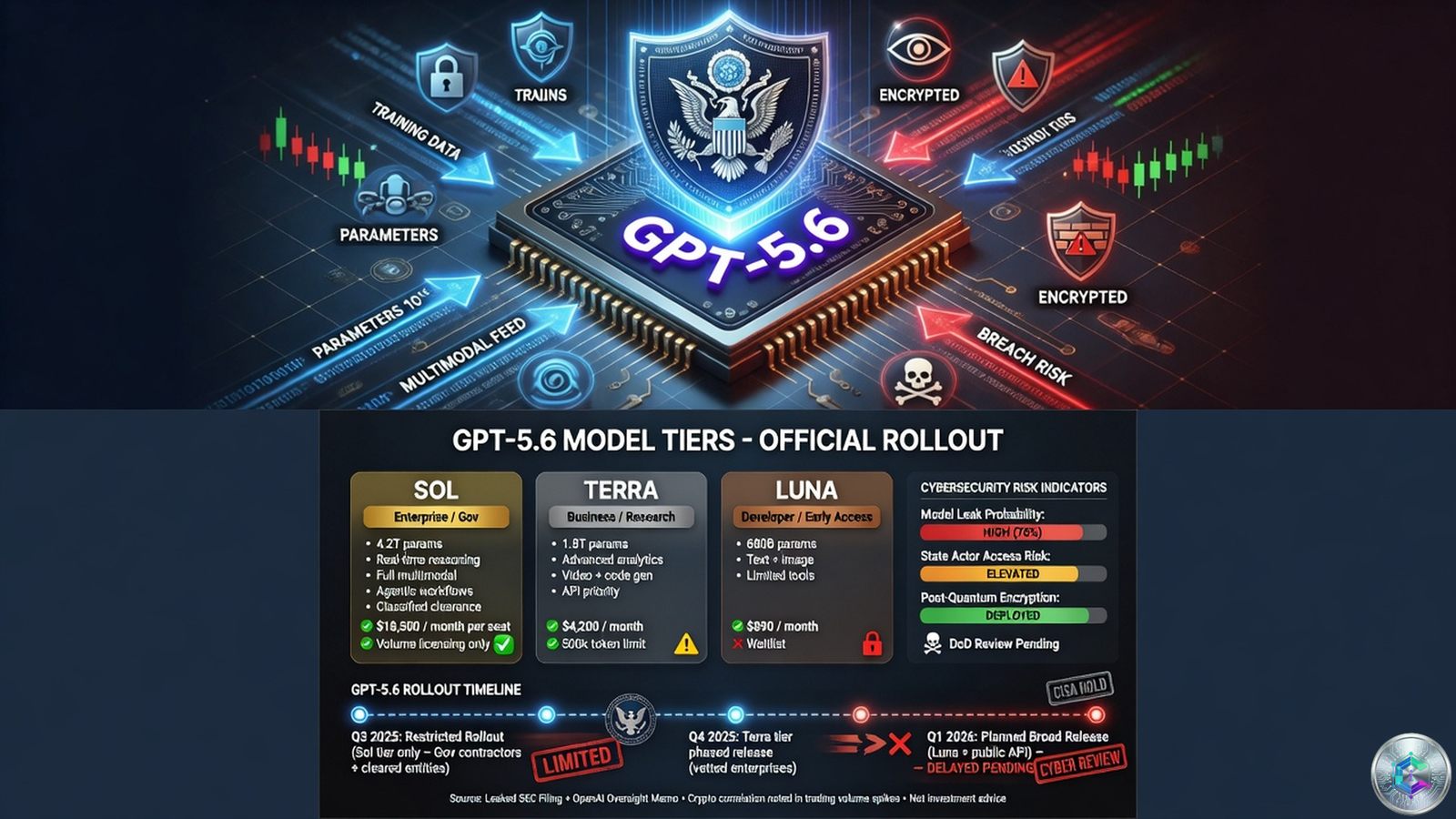
- OpenAI launched three models under GPT-5.6 on June 26, 2026: Sol (advanced reasoning), Terra (balanced performance), and Luna (light, cost-effective).
- The rollout is restricted to approximately 20 US government-vetted partners following a presidential executive order on cybersecurity.
- OpenAI publicly stated it does not believe this government access process should become the long-term default.
- Industry critics, including Alex Stamos, warn the policy could handicap US competitiveness against China.
- A government deadline in August 2026 will define the regulatory framework for « covered frontier models. »
The Executive Order That Rewrote the Rules
The immediate trigger was an executive order signed by President Donald Trump in early June 2026. It established a framework requiring federal agencies to assess the national security implications of advanced AI models before public release. Companies developing frontier models were asked to submit their most powerful systems for a government review process lasting up to 30 days prior to commercial release. Although formally voluntary, OpenAI and others treated it as mandatory due to the reputational and regulatory consequences of defying a direct White House request.
According to Axios, CEO Sam Altman met with Commerce Secretary Howard Lutnick in early June. The administration ultimately supported OpenAI’s broad release plans in principle but requested the initial preview period be limited to trusted partners—a compromise the company accepted while publicly disagreeing with the approach. By August 2026, the administration must establish a classified process to evaluate AI models’ cybersecurity capabilities and determine which qualify as « covered frontier models, » triggering mandatory pre-release review.
The Cybersecurity Concerns Driving Restrictions
The government’s specific concern centers on GPT-5.6’s cybersecurity capabilities. OpenAI acknowledges in its documentation that Sol is its most capable model for vulnerability research, multi-agent coordination, and network defense orchestration. It carries a « high » risk level in cybersecurity and biological/chemical categories under OpenAI’s own preparedness framework.
Sol can identify and exploit software vulnerabilities, coordinate complex multi-step attack sequences across parallel sub-agents, and assist in discovering flaws in hardened systems. Internal testing involved approximately 700,000 hours of GPU compute for automated penetration testing to identify potential jailbreaks. The model was trained to refuse prohibited cyber operations. Controlled tests against hardened versions of Chromium and Firefox browsers did not yield a functional critical exploit, which OpenAI cites as evidence of effective safety measures. The company emphasizes that Sol is significantly better at defensive cybersecurity tasks than offensive end-to-end operations.
This situation follows closely on the heels of Anthropic’s ordeal. In late May 2026, Anthropic released Fable 5 (a secured version of Mythos 5) for sensitive cybersecurity tasks. Within days, the Trump administration ordered the removal of access for foreign nationals, effectively taking the model offline, as part of a broader campaign that included a federal ban on government agencies using Anthropic’s Claude models. Notably, Amazon, Anthropic’s primary cloud backer, conducted its own review and reportedly found no risks beyond those present in other publicly available models—including those developed in China.
« We don’t believe this kind of government access process should become the long-term default. It keeps the best tools from users, developers, enterprises, cyber defenders, and global partners who need them. »
OpenAI, in its public statement on June 26, 2026
The Three Models: Sol, Terra, and Luna
Despite unusual launch circumstances, GPT-5.6 represents a genuine step forward, organized around a tiered architecture.
| Model | Description | Pricing (Input/Output per million tokens) | Target Use Case |
|---|---|---|---|
| Sol | Flagship model with advanced reasoning. Features « Max » (intensive reasoning) and « Ultra » (multi-agent orchestration) modes. | $5 / $30 | Complex tasks, agentic coding, cybersecurity, biological research. |
| Terra | Mid-tier, offering near GPT-5.5 performance at roughly half the cost. | $2.50 / $15 | « Best value » option for enterprises needing high-quality reasoning without premium pricing. |
| Luna | Most affordable option, designed for speed and volume. | $1 / $6 | High-throughput applications, cost optimization. |
OpenAI states Sol slightly outperforms Anthropic’s Claude Mythos 5 in coding workflows while using approximately one-third of the output tokens—a significant efficiency advantage. All three models carry the « high » risk classification in cybersecurity, the technical reason cited for access restrictions. Safety guardrails are built directly into the model’s core behavioral responses, avoiding the separate filtering layer approach that plagued Anthropic’s Fable 5 with false positives.
A New Era of Government-Gated AI Deployment
GPT-5.6’s launch is the first documented case of the White House directly restricting a commercial AI release on national security grounds. The new staged release model—where access is determined by identity, institutional affiliation, and government clearance—departs from the open distribution model since ChatGPT’s 2022 launch. It creates a two-tier ecosystem where the most powerful AI capabilities flow preferentially to large, well-connected organizations, while independent developers, researchers, and international users face access barriers.
The Competitive Dimension: China and the AI Race
The most politically charged aspect concerns implications for US competitiveness. The Trump administration argues its framework ensures American AI leadership over China. Critics, including prominent cybersecurity experts and former officials, contend the actual effect is to slow US companies without providing meaningful strategic advantage.
« If the goal is maintaining American AI supremacy over China, the government’s actions are pretty much the dumbest thing they could possibly do. Independent technical review found no meaningful distinction between Fable’s cybersecurity capabilities and those of other publicly available models, including models developed in China. »
Alex Stamos, Director of the Stanford Internet Observatory
Restricting model access to government-approved US entities does nothing to prevent state actors—including adversaries—from developing their own capabilities or accessing open-source models with comparable functionality. The policy may therefore impose significant costs on legitimate US companies and researchers while providing only marginal security benefits.
The August Deadline and What Comes Next
The executive order requires the administration to establish a classified process by August 2026 to assess AI models’ cybersecurity capabilities. This process will shape the long-term regulatory landscape. Narrow standards and an efficient review could make the GPT-5.6 disruption a transitional anomaly. Broad standards and a slow, opaque process could lock the US into a regulatory structure systematically disadvantaging its own AI industry relative to less regulated competitors.
OpenAI’s roadmap includes broader GPT-5.6 availability through ChatGPT, the API, and Codex, along with improved prompt caching. The planned launch of Sol on Cerebras hardware in July, with inference speeds potentially reaching 750 tokens per second, could reshape real-time AI economics. Whether these plans proceed on schedule depends heavily on the extended government review. More broadly, the GPT-5.6 launch clarifies that the era of unrestricted commercial AI deployment for the most powerful frontier models is ending. The question is no longer if governments will control access to advanced AI, but how that control will be exercised, by whom, and with what consequences for innovation and competition. OpenAI’s reluctant acceptance of government-mandated access restrictions is a symptom of a larger realignment just beginning to unfold.
Conclusion: Navigating Security vs. Digital Sovereignty
The constrained launch of GPT-5.6 illustrates the fundamental dilemma democracies face with revolutionary technologies: how to balance national security imperatives with maintaining a competitive edge in a global innovation race. OpenAI’s reluctant acceptance of government-imposed restrictions is a symptom of a larger realignment just beginning. The coming weeks, with the definition of the August regulatory framework and the effective expansion of model access, will be decisive in determining whether the US strikes a balance or embarks on a process of self-limitation that benefits its rivals.
Sources
- CoinAcademy – GPT-5.6: OpenAI Reserves Sol, Terra and Luna for US Government-Validated Clients
- TechCrunch – OpenAI limits GPT-5.6 rollout after government request, says restrictions shouldn’t be the norm
- Axios – OpenAI releases powerful new GPT-5.6 model under restrictions
- Associated Press – OpenAI and Anthropic limit new AI models to Trump-approved customers during cybersecurity review
- Business Insider / MacRumors – OpenAI Launches GPT-5.6 Sol, Terra, and Luna in Limited Preview
This article is published for informational and educational purposes only. It does not constitute investment advice. Do your own research (DYOR) before making any decisions.

