


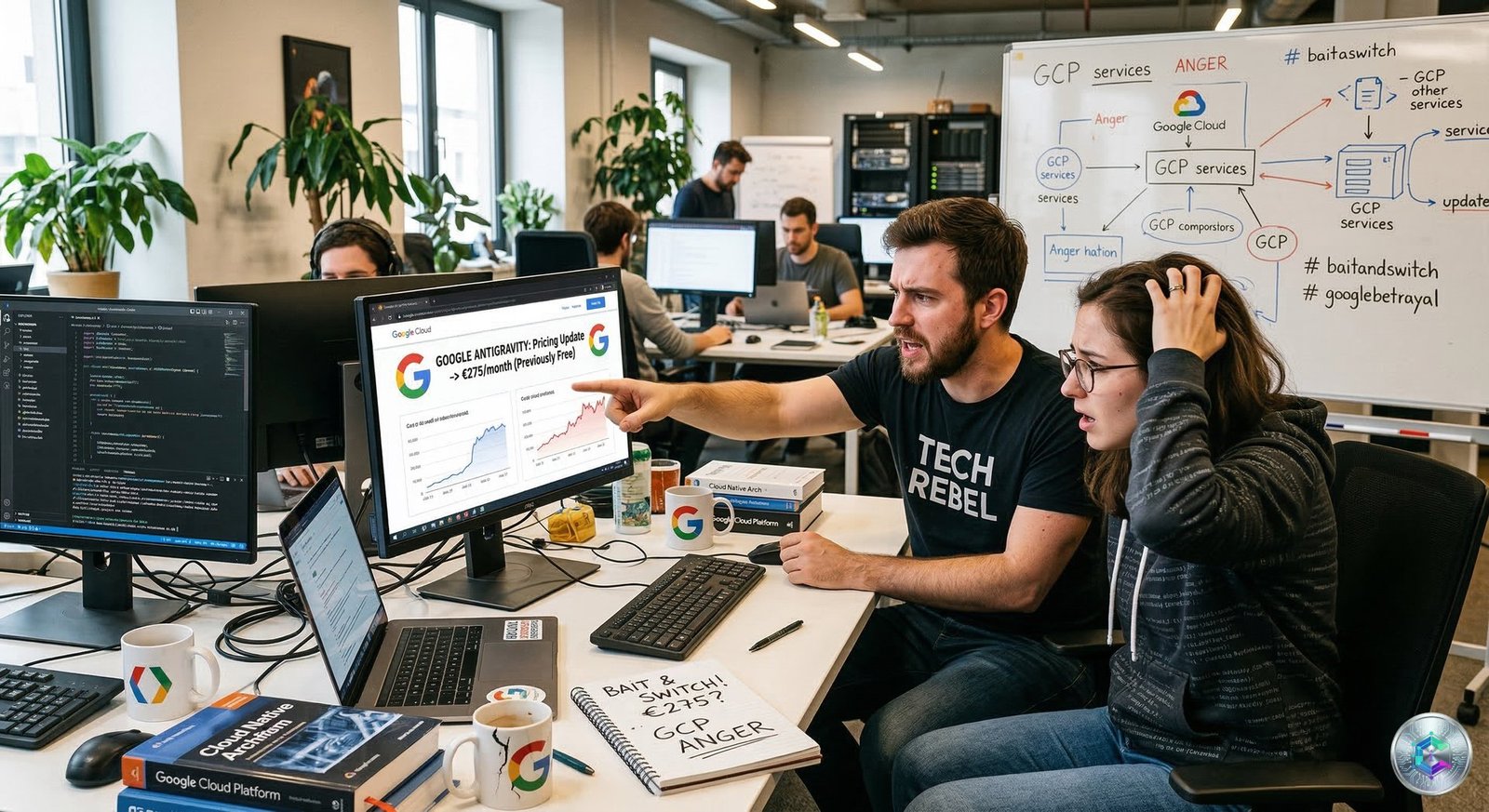
In less than a quarter, Google has managed an unwilling feat: turning a celebrated agentic IDE into a symbol of distrust and anger across the developer community. Google Antigravity, launched in November 2025 as a free and revolutionary tool, has transformed into a service billed at up to €275/month — with no clear warning, no transparency on quotas, and a user experience thousands of developers have called fundamentally broken. The result? A mass exodus toward Claude Code and other alternatives that actually keep their promises.
From « Free and Generous » to €275/Month: The Feeling of Betrayal
When Google launched Antigravity in November 2025, the message was clear: a fully free agentic IDE, with quotas described as « high », « generous », and « meaningful », with seamless integration of models like Gemini Pro, Claude Sonnet, Claude Opus, and GPT-OSS. The goal was obvious — win over developers, get them to adopt the tool, and rapidly colonize professional workflows.
The fundamental problem, identified in hindsight by many users, is that these promises were never backed by specific numbers. No defined threshold, no token limit disclosed — only reassuring adjectives. This deliberate vagueness opened the door to what followed: a drastic, rapid reduction of quotas with no contractual basis to challenge it.
A Three-Act Pricing Escalation
In barely four months, the price hike unfolded as follows:
- November 2025: Antigravity is entirely free, with quotas presented as very generous — no numerical limit ever communicated.
- Mid-January 2026: Introduction of the AI Pro plan at approximately €21.99/month, described as offering quotas « high, refreshed every five hours until weekly limit reached » — still just as vague.
- Early March 2026: To restore genuinely professional usage, users must now subscribe to the AI Ultra plan, priced at €249–275/month — a more than tenfold increase in just one quarter.
What outrages developers is not the price hike alone. It’s the combination of deliberately vague marketing language around quotas and an ultra-fast timeline — going from « free and generous » to « €275/month or you’re throttled » within a single quarter. For many, this is a textbook bait-and-switch: lure developers with a generous offer, encourage them to build their workflows around the tool, then brutally spring the pricing trap once they’re captive.
Collapsing Quotas: The Feeling of Being Trapped
The emotional tipping point — the one that pushes developers from disappointment to open rage — is the vertiginous collapse of actual quotas. On Reddit and official Google AI forums, testimonials are multiplying, and some are particularly striking.
One developer who carefully tracked their usage documents a drop from over 300 million input tokens per week to under 9 million following the March changes — a ratio of 1 to 33, with zero prior warning. Meanwhile, many users find themselves locked out for several days in the middle of a workweek, unable to understand why they’re in a « cooldown » state while paying for a subscription.
Forum testimonials describe a concrete and frustrating reality:
- Lockouts lasting 3 to 10 days on Antigravity, while official documentation had promised a refresh every 5 hours.
- Completely unpredictable quota resets: what worked fine for « 2 days of heavy use » suddenly becomes « quota blown in 2–3 heavy requests. »
- « Agent execution terminated » errors on loop — the agent restarts from scratch, re-scans the entire project, burns more tokens, and accelerates the exhaustion of the weekly quota.
The typical scenario experienced by professional developers: you plan a sprint, rely on the agent for a major refactoring job. After a few prompts, the agent starts looping, burns through the entire quota, and you’re locked out for several days — right in the middle of a critical deliverable.
To add insult to injury: Google subsequently quietly modified its terms of service to remove the mention of the 5-hour refresh, as if that promise had never existed. This silent rewriting of the rules fuels a deep sense of lost trust. Many users feel that Google is leveraging opacity to adjust its margins in real time, at the expense of users who built their work around the product.
A User Experience Deemed Toxic for Professional Use
If quota issues crystallize the anger, they compound structural flaws in the agent itself that make it barely usable in production. On Google AI forums and Reddit, experienced system engineers and developers describe several « token leaks » inherent to the very design of Antigravity.
Structural Inefficiencies That Burn Through Quotas
- Duplicate « Thinking / Planning » logs displayed simultaneously in both the main window and the agent window — doubling the token cost with zero added value.
- Forced verbosity: endless « Technical Research & Planning » phases that cannot be disabled, saturating the context before a single useful line of code is even produced.
- Agents that loop on simple tasks (a basic search/replace, fixing a single JSON line), end up corrupting the target file, then consume all remaining quota attempting to repair their own mistakes.
- Frequent state loss: on any crash, the agent must rescan the entire repository, massively consuming available tokens all over again.
The concrete testimonials speak for themselves: a well-documented Python project handed to Antigravity ends up with corrupted files, deleted functions, a failed Git restoration attempt, and a timeout after 2–3 minutes of repair attempts. A simple « read these files and summarize them » request turns into off-topic code generation modifying parts of the project that were never supposed to be touched. Fixes to 100-line files where, instead of changing one line, the agent deletes nearly everything and spends multiple iterations « fixing » what it just destroyed.
For a tool marketed as a « professional agentic IDE, » these behaviors are unacceptable. The agent massively consumes quota on noise — redundant logs, unnecessary re-scans, error loops — instead of delivering useful work. With the new AI Pro quotas, these structural inefficiencies lead directly to lockout. Some developers now openly describe the product as « functionally unusable for professional workflows. »
Migration to Claude Code: Voting With Their Feet
Faced with this explosive combination — brutal price hikes, opaque quotas, and a failing UX — many developers are starting to « vote with their feet. » And the most frequently cited destination, on Reddit and across specialized forums, is unambiguous: Anthropic’s Claude Code.
Several reasons explain this appeal:
- A subscription around €20/month, comparable to Antigravity’s original AI Pro pricing before the pricing drift.
- Clearly documented quotas from the start, with no ambiguous marketing language.
- A solid reputation for models (Sonnet, Opus) in code tasks, with far fewer erratic behaviors on large-scale refactors and big project reads.
- Predictability that allows users to genuinely plan their work, where Antigravity imposes constant uncertainty.
Direct comparisons are flourishing on Reddit: « I haven’t seen Claude generate code when I ask it to investigate — Antigravity starts modifying off-topic files. » And: « I can plan my week with Claude Code because I know exactly what to expect from quotas — which is simply impossible with Antigravity’s dynamic limiters. »
In the same competitive landscape, Cursor (€20/month) and Windsurf (€15/month) maintain stable pricing and quota policies considered more consistent. The big question animating the community: will these players resist the temptation to reproduce the « Google playbook » (free → mass adoption → quota tightening) as their user bases grow? In the short term, the message from the community is crystal clear: « If I have to pay a lot, I at least want transparency and reliability. »
A Textbook Bait-and-Switch in the Age of AI
What’s unfolding around Antigravity goes far beyond the case of one particular IDE. It’s a textbook case of what the tech community fears most about generative AI: a business model built on opacity and user capture.
Every element of the « playbook » is present:
- Launch with a free or near-free offer, presented as generous, to rapidly colonize professional workflows.
- Vague quotas, described only through adjectives (« high », « meaningful ») with no actionable figures.
- Marketing communications emphasizing agentic power and productivity, without disclosing the real token cost of these agents over the medium term.
- Once the tool is embedded in team pipelines: drastic quota reduction, introduction of dynamic lockouts, and brutal repricing toward a much more expensive « pro » tier.
- Silent retroactive modification of terms of service — removing the 5-hour refresh mention — reinforcing the perception of a completely one-sided power relationship.
Adding to this is a regulatory dimension that some European users are beginning to raise: a possible violation of EU Directive 2019/770 on digital content and services, in relation to bait-and-switch practices and consumer rights. Without making a legal determination, the community’s moral verdict is unequivocal: you don’t play with developers’ time and resources like this, especially when they’re paying for a professional service.
Claude Code: The Counter-Model the Community Has Been Asking For
In this landscape, Anthropic’s Claude Code stands out as the exact counter-model many developers have been calling for: clear pricing, announced and respected quotas, a priority on reliability over agentic showmanship, and a basic respect for the promise made to the user.
The underlying movement is clear and well-documented. The anger toward Antigravity is not limited to a few isolated Reddit posts — it’s spreading across X (formerly Twitter), official Google forums, and specialized tech media, fueling an announced migration wave toward Claude Code and other AI IDEs perceived as more honest. Google is not just losing subscribers: it is feeding a structural shift in trust toward players seen as more respectful of developers’ time and wallets.
In the AI industry, trust is a rare and fragile resource. Once lost, it is infinitely harder to rebuild than any quota to restore.
Sources: Reddit r/ClaudeAI, Reddit r/GoogleGeminiAI, Reddit r/google_antigravity, Google AI Developer Forums, Korben.info, CoinAcademy.fr, JournalDuNet, dev.to

