


When Poker Meets the Blockchain
Online poker has always suffered from a fundamental problem: you have to trust the operator. Trust that the card shuffle is fair, that your funds are safe, and that the rules won’t change overnight. Since the first online poker sites appeared in the early 2000s, this asymmetric trust relationship has never truly evolved — until now.
Fast Poker (available at fast.poker) is a fully decentralized poker room built on the Solana blockchain. Launched in May 2026 in Mainnet Beta, the platform represents a major technological breakthrough in the online gaming industry. It’s no longer a centralized operator holding your funds and controlling the cards — it’s the protocol itself, deployed as smart contracts on Solana, that manages every aspect of the game, from bets to card distribution.
Fast Poker is a permissionless infrastructure: the rules of poker are code deployed on a public blockchain, accessible to anyone who wants to build a room, run a dealer, or simply play.
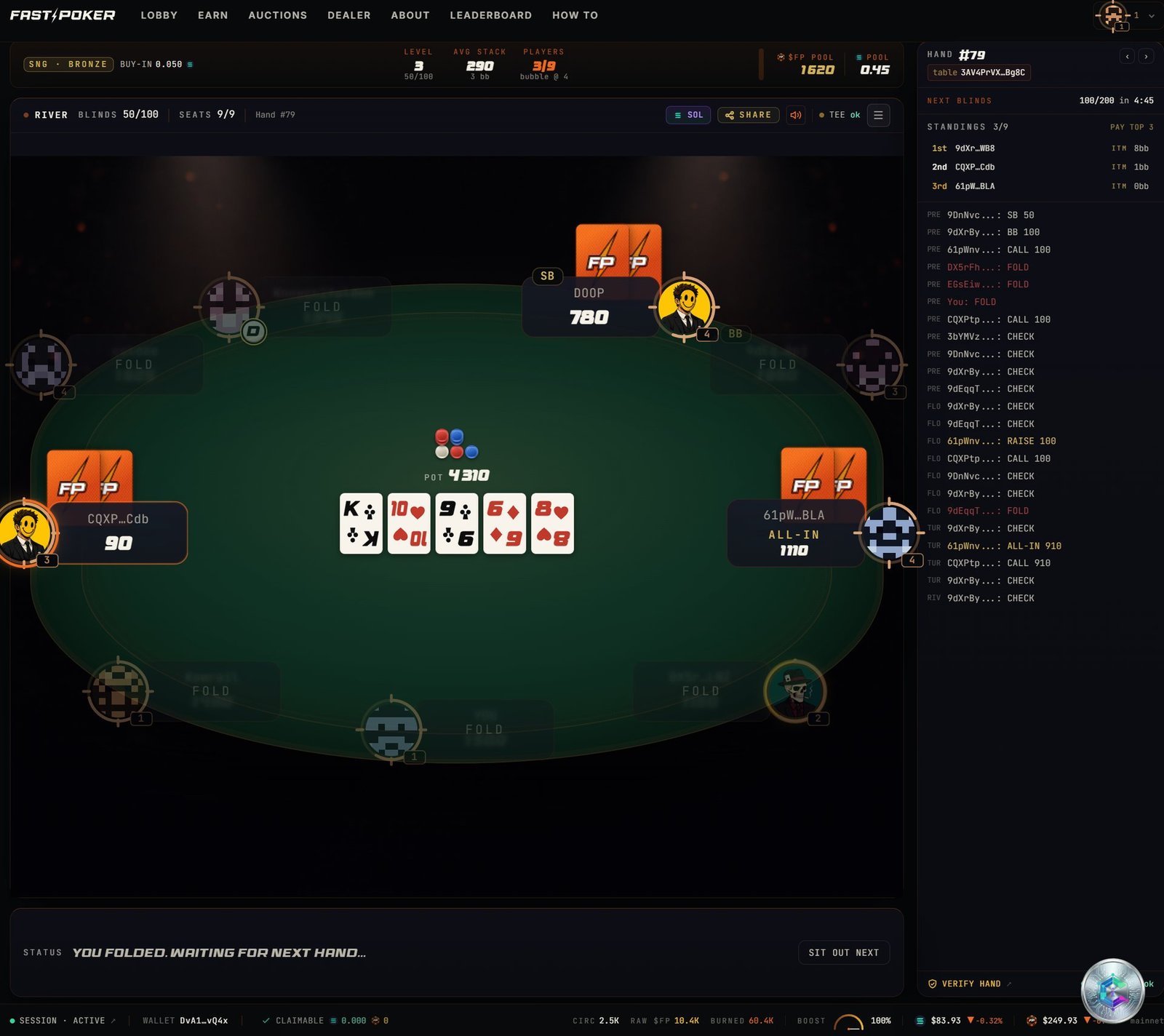
Why Fast Poker Outclasses Traditional Poker Rooms
On a traditional poker site, when you make a deposit, your funds enter the operator’s balance sheet. You no longer own your money — you have a claim against the company running the site. If that company goes bankrupt, disappears, or is blocked by regulators, you lose everything. Furthermore, the card shuffle is run by private servers you cannot audit.
Fast Poker overturns this model radically:
| Traditional Poker | Fast Poker |
|---|---|
| Deposit into operator’s balance sheet | Deposit into protocol’s on-chain vault |
| Operator controls the shuffle | Deck is committed before reveal, verifiable afterward |
| Staff can see player cards | Private cards are sealed in a TEE |
| You trust the site to pay out | Payment rules execute on-chain |
| Mutable off-chain loyalty points | XP and $FP rewards live on-chain |
« There is no team wallet holding player funds. No admin key choosing cards or rewriting hands. »
— Fast Poker founding team
Technical Architecture: A Three-Layer Innovation
Fast Poker’s real innovation lies in its three-layer architecture, which solves a problem long considered unsolvable in decentralized gaming: how to achieve instant, fee-free transactions while maintaining the security and transparency of the blockchain.
🔷 Solana L1: The Source of Truth
The base layer is Solana Layer 1. All permanent data lives here: tables, seats, vaults, reward distributions, $FP token minting, rake accumulators. All critical financial operations — deposits, withdrawals, prize settlement — are finalized on Solana L1. Solana’s extremely low transaction fees and capacity to process thousands of transactions per second make it the ideal blockchain for a game requiring numerous micro-transactions.
⚡ MagicBlock Ephemeral Rollups: The Real-Time Game Engine
For live gameplay, Fast Poker uses MagicBlock Ephemeral Rollups — a technology that reduces transaction latency from 500-600ms down to approximately 10ms. You sign a single transaction to join a table, then all your in-game actions (bet, raise, fold) are gasless — zero fees during play. The game state is temporarily delegated to the Ephemeral Rollup, enabling millisecond confirmations, then re-synchronized with Solana L1 once the hand is complete.
🔐 TEE (Trusted Execution Environment): Card Privacy Guaranteed
The third component is the most sophisticated: a Trusted Execution Environment (TEE), a hardware-attested computing environment that seals players’ private cards. This is the solution to the « superuser » problem: how to ensure that no one — not dealers, not the Fast Poker team, not other players — can see your cards during a hand. Cards are dealt inside the TEE. During the hand, your cards are visible only to you and the TEE.
Provable Fairness: Mathematical Transparency
One of Fast Poker’s most important promises is provable fairness. In classic online poker, you must trust an external audit to guarantee that the Random Number Generator (RNG) is honest. Fast Poker replaces that trust with direct mathematical verification.
The mechanism works through cryptographic commitment: before cards are revealed, the protocol commits to the full deck. Each revealed card is accompanied by a cryptographic proof linking it to that initial commitment. After the hand, anyone can verify that the revealed cards exactly match the committed deck.
- The dealer cannot choose the cards — distribution is determined by the cryptographic commitment, not a human decision.
- The team cannot see private cards — the TEE seals hole cards until showdown.
- Any cheating attempt would be detectable — if the protocol revealed cards not matching the commitment, verification would fail.
Game Modes
Cash Games
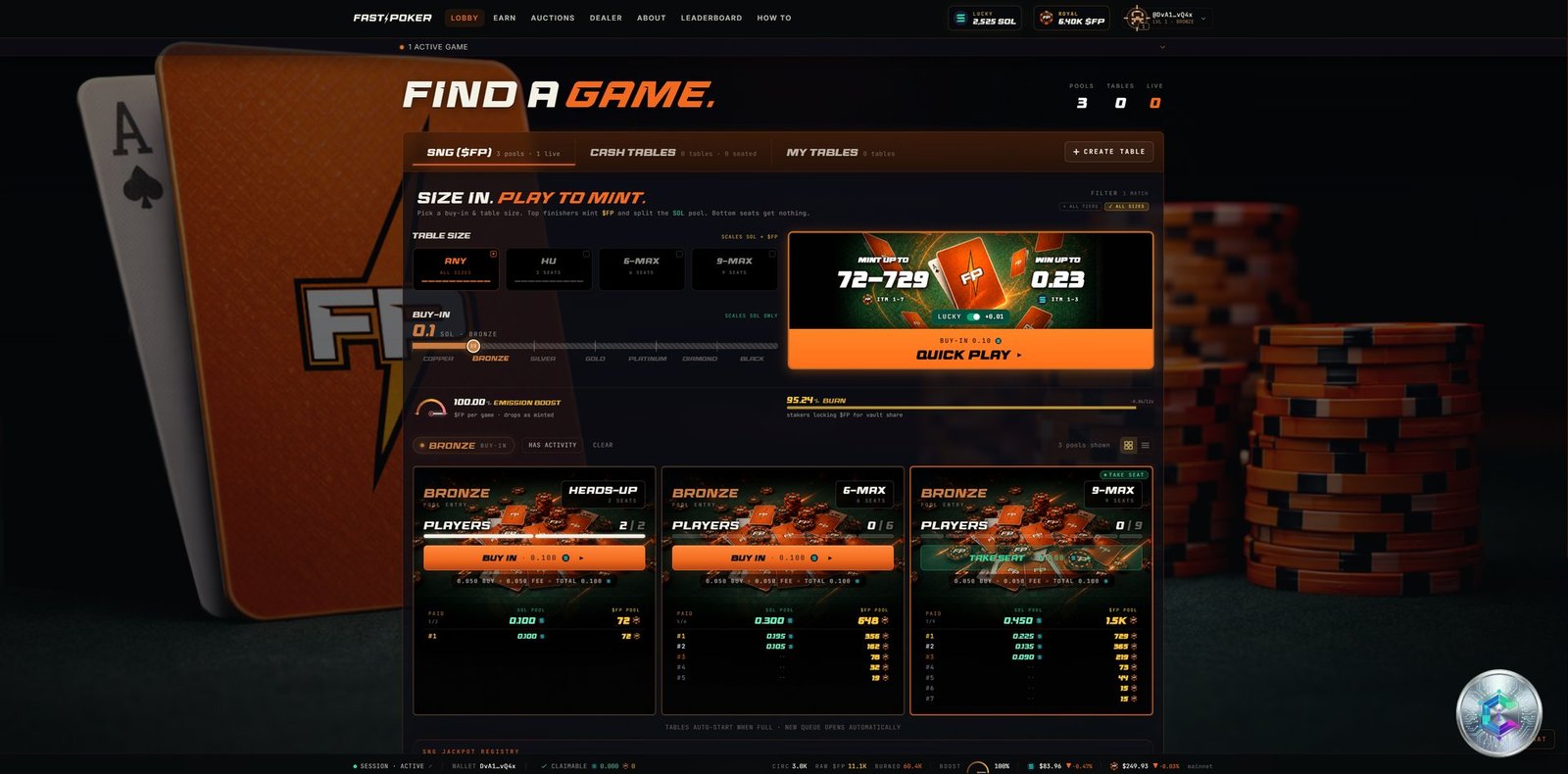
Cash games are classic open tables where you can sit down and leave at any time. The rake is set at 5% when the hand reaches the flop — no flop, no rake. Table creators earn 50% of their table’s rake for its entire lifetime, creating a powerful incentive for operators to build active tables.
Sit-and-Go (SNG)
Sit-and-Go tournaments have a fixed number of seats and start as soon as they fill up — available in Heads-Up, 6-max, and 9-max formats. SNGs offer SOL prizes based on tournament prize structure, Raw $FP emissions (only SNGs create new $FP), and Lucky and Royal Jackpots for extraordinary hands.
Tokenomics: The $FP Token and Protocol Economy
Fast Poker’s economy is built around the $FP token and a circular system linking gameplay, rewards, and indirect protocol governance.
Rake Distribution
| Recipient | Cash Rake Share |
|---|---|
| Table Creator | 50% |
| Dealer | 20% |
| Burned $FP Stakers | 20% |
| Treasury | 10% |
The Three States of the $FP Token
- Raw $FP — Created exclusively by playing SNGs. This raw token cannot be transferred, traded, or burned until it’s been « refined. »
- Liquid $FP — The refined, transferable $FP. It can be held, sold, used, or burned.
- Burned $FP — Permanently burned $FP that confers proportional rights to protocol revenue. This is the Burn to Earn mechanism: by burning your liquid tokens, you gain a permanent claim to future protocol revenue streams.
Notably, the founders state there is no team-reserved supply and no VC tokens — a radical decision that strongly contrasts with the vast majority of DeFi projects.
The Permissionless Model: The Uniswap of Poker
What fundamentally distinguishes Fast Poker from other platforms is its fully permissionless approach. Fast Poker is not a service run by the team — it’s a protocol, a set of poker rules deployed as code on Solana. In practice:
- Anyone can create a cash table: you choose the token, blinds, seat count, and access rules. In return, you earn 50% of that table’s rake forever.
- Anyone can run a dealer: the Dealer Service is the permissionless crank that advances games, rewarded with a share of rake fees.
- Anyone can build a room: rooms, leagues, alternative frontends, indexers — anything can be built on the Fast Poker protocol.
This architecture mirrors Uniswap’s in DeFi: the founding team is not the bottleneck. They built the rails, but the entire economy can grow independently.
Risks and Limitations to Know
- Smart contract bugs — like any on-chain program, vulnerabilities may exist
- TEE or RPC failures — reliance on a specific MagicBlock validator for the TEE creates an attack surface
- Solana network conditions — congestion or network issues can affect the gaming experience
- $FP token market risk — token value is subject to crypto volatility
- Player collusion — the protocol can prove cards are fair, but it cannot prevent two players from sharing their cards outside the app
How to Start Playing
- A Solana wallet — Phantom, Solflare, Backpack, and other compatible wallets
- Some SOL — for buy-ins, fees, and Solana network rent
- Access the app — at fast.poker
No account registration, no KYC required at the protocol level, no deposit to a centralized account. Connect your wallet and play. Funds remain under your control in on-chain vaults until you wager them on a hand.
Conclusion: A Turning Point for Online Poker
Fast Poker represents a genuine breakthrough in the evolution of online poker. By combining non-custodial fund custody on Solana L1, sub-second gameplay speed via MagicBlock Ephemeral Rollups, and cryptographic card privacy via the TEE, the platform solves for the first time the three fundamental challenges of decentralized poker: fund security, game speed, and private card confidentiality.
At a time when the online poker industry faces growing regulatory pressure and persistent player distrust of centralized operators, Fast Poker offers a compelling alternative: a poker room where trust is not a promise, but a mathematical guarantee written in code.
Fast Poker is currently in Mainnet Beta. Only use funds you are prepared to risk. This article is based on Fast Poker’s official documentation (docs.fast.poker) and publicly available information as of May 2026.

