


The Ethereum Foundation, the Switzerland-based nonprofit funding core protocol development for Ethereum, has announced a 20% workforce reduction and a reorganization into five specialized clusters, marking a major shift in the governance of the second-largest blockchain’s development.
🔑 Key Takeaways
- The Foundation cuts 20% of staff and restructures into five clusters: Protocol, ZK Research, Security, Developer Experience, and Ecosystem Coordination.
- Several senior technical leaders have departed, including Barnabe Monnot, Tim Beiko, and Alex Stokes.
- An ideological mandate titled ‘CROPS’ has been introduced, causing internal tensions.
- Ethereum co-founder Joe Lubin defends the restructuring as a necessary evolution toward more distributed governance.
- The technical roadmap includes Glamsterdam and Hegota upgrades, with deferrals on account abstraction and FOCIL.
The Five-Cluster Architecture
The Ethereum Foundation moves away from the traditional model where a centralized R&D team handled broad protocol concerns. The new structure distributes responsibilities across five specialized clusters, each operating with greater autonomy and clearly defined mandates.
The most significant change involves the Protocol Research and Development team, now simply called Protocol. Under the new architecture, Protocol is one of five clusters, with three new co-leads — Will Corcoran, Kev Wedderburn, and Fredrik Svantes — replacing the departed Barnabe Monnot, Tim Beiko, and Alex Stokes. The five clusters break down as follows: Protocol handles base-layer consensus and execution; a separate cluster focuses on zero-knowledge research and the zkEVM roadmap; others address security initiatives like the Trillion Dollar Security project, developer experience, and ecosystem coordination.
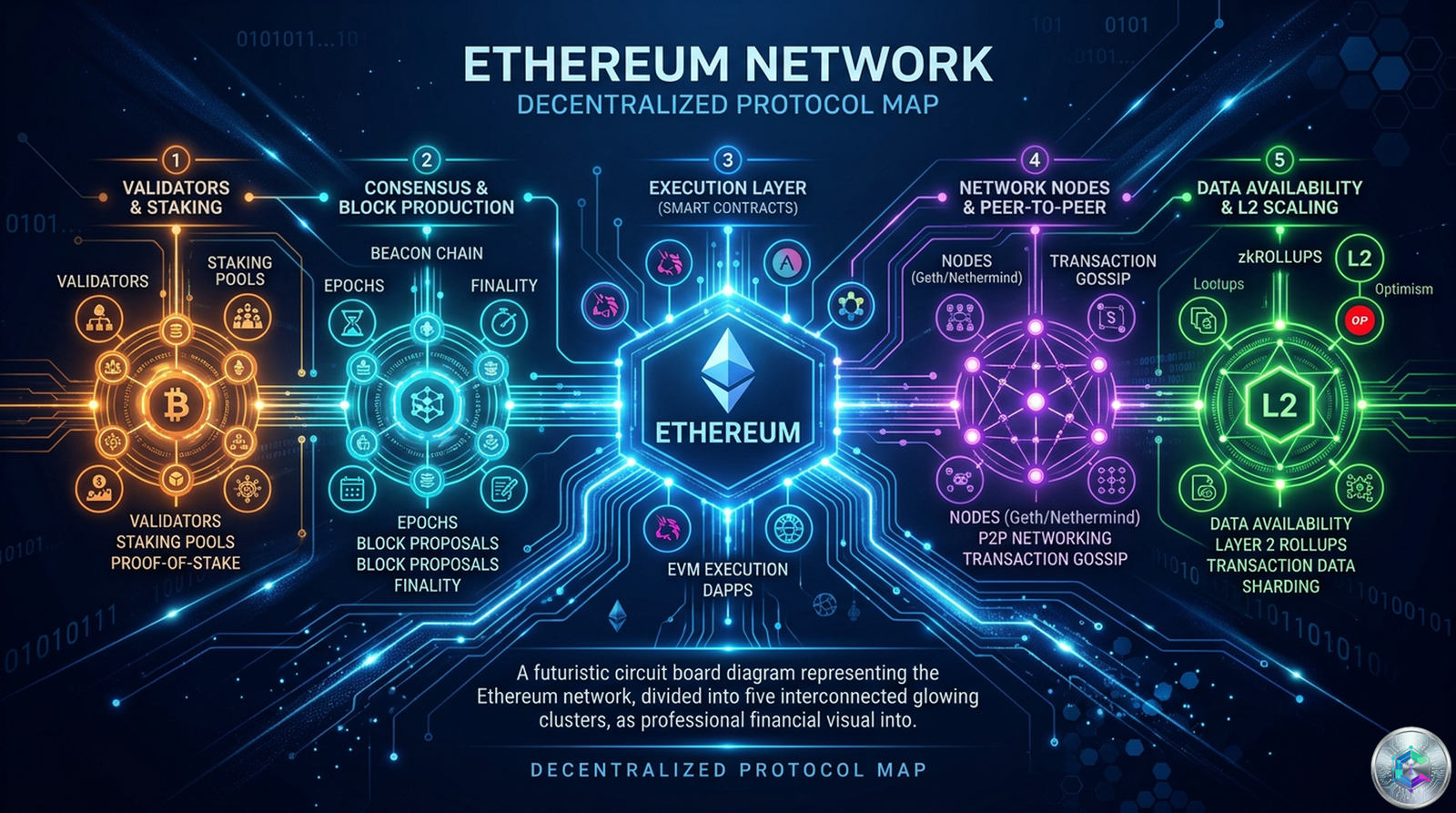
This restructuring aims to allow each cluster to move faster without centralized approval for every technical decision. The Foundation acknowledged that Ethereum’s technical challenges have grown too diverse for a single team to handle effectively.
| Cluster | Primary Responsibilities | New Co-Leads |
|---|---|---|
| Protocol | Base-layer, consensus, scalability, blob space, advanced cryptography | Will Corcoran, Kev Wedderburn, Fredrik Svantes |
| ZK Research | Zero-knowledge research, zkEVM roadmap | Not specified |
| Security | Trillion Dollar Security project, economic security model | Not specified |
| Developer Experience | Tools, documentation, developer support | Not specified |
| Ecosystem Coordination | Ecosystem coordination, operational roles | Not specified |
Workforce Reductions and Departures
The 20% workforce reduction did not happen in isolation. It follows a wave of departures starting in February 2026 and accelerating through spring. Between mid-February and mid-May, six senior contributors stepped back from full-time roles, with Dankrad Feist moving to a part-time advisory role in the previous October.
The departing talent includes Tomasz Stanczak (co-executive director), Josh Stark (co-chair of the Trillion Dollar Security initiative), Trent Van Epps (Protocol Guild contributor), and co-leads Barnabe Monnot and Tim Beiko. Carl Beek, key contributor to the Beacon Chain, and Julian Ma, researcher behind the FOCIL proposal, also left in May.
Reasons for departures include disagreements over governance philosophy, frustration with an increasingly rigid organizational culture, and the unexpected introduction of a mandatory ideological document.
The Mandate and CROPS Controversy
In March 2026, the Ethereum Foundation published a 38-page document titled « The Promise of Ethereum: Introducing the EF Mandate, » outlining core principles summarized by the acronym CROPS: Censorship resistance, Resistance to coercion, Open source values, Privacy, and Security.
Its implementation proved contentious, with staff effectively required to sign the mandate or face termination, according to DeFi Prime. This marked a shift from the Foundation’s historically permissive internal governance.
« This protocol shipping process is complicated because it requires us to proactively respond to requests that are hard to articulate and even harder to satisfy. »
Ethereum Foundation
Joe Lubin: A Necessary Evolution
Ethereum co-founder and Consensys CEO Joe Lubin defended the restructuring, arguing it was a healthy evolution rather than a crisis. He emphasized that the Foundation’s role should be deliberately narrower, focusing on core technology and values, while other organizations handle adoption and ecosystem growth.
« It is important that the Ethereum Foundation be credibly neutral above reproach. The opportunity for conflicts of interest between the business side and the builders is just not a credibly neutral way to run your decentralized protocol ecosystem. »
Joe Lubin, Ethereum co-founder and Consensys CEO
Lubin identified autonomous AI agents conducting onchain transactions, or « agentic commerce, » as the next major growth wave for Ethereum’s infrastructure, positioning scaling improvements as a foundation for a « hybrid human-machine economy. »
Technical Roadmap: Glamsterdam, Hegota, and Beyond
The restructuring arrives at a critical juncture. The Foundation is preparing the Glamsterdam network upgrade, a significant hard fork introducing enshrined proposer-builder separation, EIP-7623 to reduce Call Data costs, and the EOF upgrade for smart contract modernization.
Notably absent from Glamsterdam are account abstraction and FOCIL, both deferred to future upgrades. The longer-term roadmap includes Hegota, which will bring FOCIL and native account abstraction, and Strawmap for research on statelessness and state growth.
| Upgrade | Key Elements | Status |
|---|---|---|
| Glamsterdam | Proposer-builder separation, EIP-7623, EOF | In preparation, possible delay to Q4 2026 or early 2027 |
| Hegota | FOCIL, native account abstraction | Planned for longer term |
| Strawmap | Research on statelessness and state growth | On agenda, not yet assigned |
Financial Context: ETH Markets and Treasury Management
At the time of the June restructuring announcement, ETH was trading near $1,730, down approximately 13% over the preceding twelve months. The Foundation sold between 20,000 and 25,000 ETH in 2026, raising over $45 million in stablecoins to fund operations, consistent with its 2025 Treasury Policy.
These sales into a weak market have contributed to ETH’s underperformance relative to Bitcoin and other digital assets, according to some analysts. The Foundation has not directly addressed concerns about financial stress.
Competitive Landscape and the Road Ahead
Ethereum faces arguably its most challenging competitive environment since launch in 2015. Alternative layer-1 blockchains have made significant technical strides, and zero-knowledge rollup technology has become a competitive battleground. The layer-2 ecosystem, while crucial for scalability, introduces new competitive dynamics.
The Foundation’s restructuring is a bet on a leaner organization, clearer principles, and a more distributed institutional model for a blockchain that must increasingly compete with the broader traditional financial system.
Conclusion
The Ethereum Foundation has undergone a strategic shift with mass layoffs and a reorganization into specialized clusters. This evolution addresses internal tensions and competitive pressures but also imposes new technical and governance challenges. The Foundation’s ability to execute the technical roadmap while maintaining financial stability and credible neutrality will determine Ethereum’s future in a rapidly changing cryptographic landscape.
Sources
- The Block – Ethereum Foundation cuts 20% of its workforce
- CoinDesk – Joe Lubin defends restructuring
- DeFi Prime – Ethereum Foundation departures and mandate
- Ethereum Foundation Blog – Protocol update May 2026
- Yahoo Finance – Ethereum Foundation lays off staff
- Cointribune – The Ethereum Foundation lays off and renames its core team
This article is published for informational and educational purposes. It does not constitute investment advice. Do your own research (DYOR) before making any decisions.

