


Introduction: Ethereum’s Historic Divergence
In late March 2026, the Ethereum ecosystem is navigating a period of unprecedented structural tension. The asset is trading in a volatile range between $1,980 and $2,150 — a correction of more than 55% from its all-time high in August 2025 — yet the underlying network is posting record utilization metrics.
This fundamental disconnect between market valuation and intrinsic network utility demands rigorous investigation. This report synthesizes macroeconomic data, the 2026 technology roadmap, institutional ETF flows, and a granular multi-timeframe chart analysis to provide an institutional-grade reading of Ethereum’s current market structure.
1. Macroeconomic Framework: Persistent Inflation and Liquidity Contraction
1.1 The Strait of Hormuz Energy Shock
In March 2026, geopolitics violently disrupted risk asset pricing models. Escalating tensions in the Middle East — including threats by Iran’s Revolutionary Guard to close the Strait of Hormuz — sent shockwaves through global energy markets. This strategic chokepoint, through which approximately 20% of global oil consumption flows, saw Brent crude surge past $110/barrel, with fleeting peaks at $119.
The transmission to financial markets was immediate. Investors rotated massively into traditional safe havens: gold surpassed $5,600/oz, while Ethereum and Bitcoin suffered cascading liquidations. ETH’s correlation with the Nasdaq strengthened to the downside, confirming that in a panic environment, Ether is treated as a pure risk asset. The Crypto Fear & Greed Index plunged to a score of 10–15 (Extreme Fear).
1.2 Core PCE and the Fed’s Hawkish Stance
On March 27, 2026, the release of the Core PCE index — the Federal Reserve’s preferred inflation gauge — confirmed the worst: a 3.1% year-over-year increase, exceeding expectations and drifting further from the 2% target. In response, the FOMC revised its projections upward (Q4 2026 PCE: 2.7%) and virtually eliminated any probability of rate cuts in H1 2026. The « higher for longer » regime is now entrenched. Directly consequential: the 5-year Treasury yield touched 4.10%, mechanically draining liquidity from crypto markets by raising the opportunity cost of holding non-yield-bearing assets.
1.3 Ethereum Spot ETF Outflow Hemorrhage
Ethereum spot ETFs, initially expected to catalyze institutional adoption, have revealed their fragility in the face of macroeconomic deterioration. As of March 27, 2026, ETH spot ETFs recorded an eighth consecutive day of net outflows, totaling $48.54 million in a single day. BlackRock’s ETHA fund alone saw withdrawals exceeding $70.8M in one session. February 2026 saw net outflows approaching $370 million total.
A notable divergence: while the traditional ETHA fund bleeds capital, BlackRock’s new ETHB (iShares Staked Ethereum Trust), which distributes staking yield on underlying tokens, attracted $155 million at launch. This proves institutions aren’t rejecting ETH per se — they now demand yield to justify holding it in an environment where risk-free rates exceed 5%.
2. On-Chain Fundamentals: The Growth Paradox
2.1 Record Adoption Metrics
Ethereum’s infrastructure has never been more utilized. In Q1 2026, weekly active addresses crossed 3.64 million (+97% year-over-year), setting an all-time high. Daily interactions with smart contracts regularly exceed 40 million. These figures reflect an ecosystem in full expansion, driven by DeFi, Real World Asset (RWA) tokenization, and continuous Layer 2 integration.
Yet value capture by the ETH token has stalled. Ethereum’s modular architecture — amplified by EIP-4844 (blobs) — has shifted the bulk of economic activity to L2s (Arbitrum, Optimism, Base, Polygon), drastically compressing mainnet fee revenues. Over the last 30 days, Ethereum generated only approximately $10 million in fees, ranking behind Tron and Solana. ETH supply is now inflating at an annualized rate of roughly 0.23%, undermining the « ultra-sound money » narrative that powered previous bull cycles.
2.2 Liquid Supply Compression
While nominal supply inflation is positive, liquid supply is experiencing a rare compression. ETH reserves on centralized exchanges have fallen to 16 million units — the lowest level since 2016. Over three years, more than 7 million ETH (≈ $13.7 billion) has left order books to flow into cold storage or staking contracts.
Approximately 37 million ETH (>30% of total circulating supply) is locked in staking contracts. The validator entry queue stands at nearly 2.87 million ETH awaiting activation, versus only 40,000 in the exit queue. This structural imbalance means any resurgence in demand — such as a Fed pivot — could trigger parabolic price appreciation due to a shortage of marginal sellers.
2.3 NVT Signal: Relative Overvaluation
The NVT ratio (Network Value to Transactions) — Ethereum’s equivalent of a price-to-earnings ratio — has shown a concerning trajectory: rising from 48 in mid-February to a peak of 64 on March 17, stabilizing around 60 by month-end. An elevated NVT with a stagnant or declining price means ETH’s market cap remains too high relative to actual economic activity transiting the blockchain. This signal confirms that recovery will require not only improved macro sentiment, but a genuine explosion of on-chain financial activity on the base layer.
3. The 2026 Technology Roadmap: Glamsterdam and Hegotá
The Ethereum Foundation has reorganized its R&D efforts around three cardinal axes for 2026: Scale, Improve UX, and Harden the L1. Two major hard forks embody this vision.
3.1 Glamsterdam (H1 2026): The Execution Revolution
Targeted for May/June 2026 and currently in intensive testing on developer networks, Glamsterdam rests on two foundational EIPs:
- EIP-7732 — ePBS (Enshrined Proposer-Builder Separation): Natively inscribes block construction/proposal separation into the consensus protocol, eliminating dependency on third-party relays (Flashbots). Result: stronger censorship resistance and an estimated 70% reduction in predatory MEV extraction at users’ expense.
- EIP-7928 — Block-Level Access Lists (BALs): Enables parallel processing of independent transactions within a block, paving the way for a massive gas limit increase (from 60M toward 100–200M), projecting throughput toward 10,000 TPS while reducing hardware requirements for validator nodes.
Glamsterdam will also lay the groundwork for native account abstraction (EIP-7702), allowing traditional wallets (EOAs) to temporarily leverage smart contract functionality — dramatically improving user experience without requiring complex fund migrations.
3.2 Hegotá (H2 2026): Post-Quantum Preparation
Planned for late 2026, Hegotá addresses the network’s long-term viability. Beyond state storage optimization (State Expiry, Verkle trees), the focus is on post-quantum cryptography. The Foundation has created a dedicated PQ team, and Hegotá is expected to introduce the foundations of quantum-resistant signature algorithms (via EIP-7932 iterations), securing the integrity of Ethereum’s ledger for decades to come.
4. Multi-Timeframe Technical Analysis
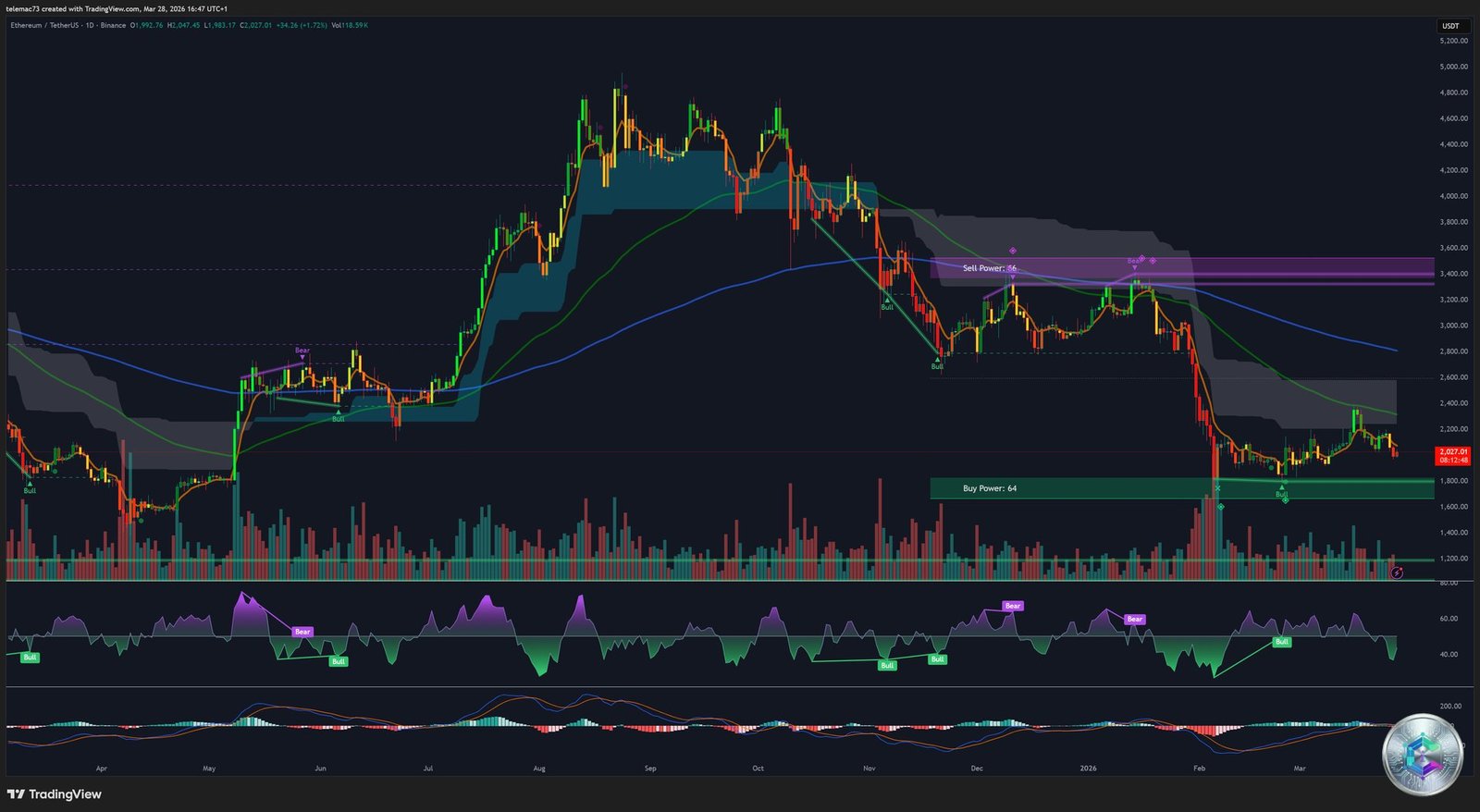
4.1 Daily Chart (1D): Death Cross and Head & Shoulders
The daily chart presents a heavily deteriorated technical configuration. Since April 2025, price action has meticulously drawn a massive bearish reversal pattern — a Head and Shoulders. The all-time high at $4,950 forms the head; aborted bounces in autumn 2025 and early 2026 constitute a weakened, asymmetric right shoulder.
The critical neckline rests at $1,790–$1,800. A daily close below this level would trigger the theoretical projection toward the $1,320 capitulation zone. The most alarming signal remains the Death Cross (MA50 crossing below MA200) — interpreted by institutional trading algorithms (CTAs, quant funds) as a bear market confirmation that triggers systematic selling at each bounce toward the MA50 (now acting as crushing dynamic resistance around $2,100–$2,150). The daily RSI oscillates between 40 and 46 — a controlled bearish trend with no extreme oversold readings. The MACD remains deeply below zero.
4.2 4-Hour Chart (4H): Bearish Channel and Bullish Divergence
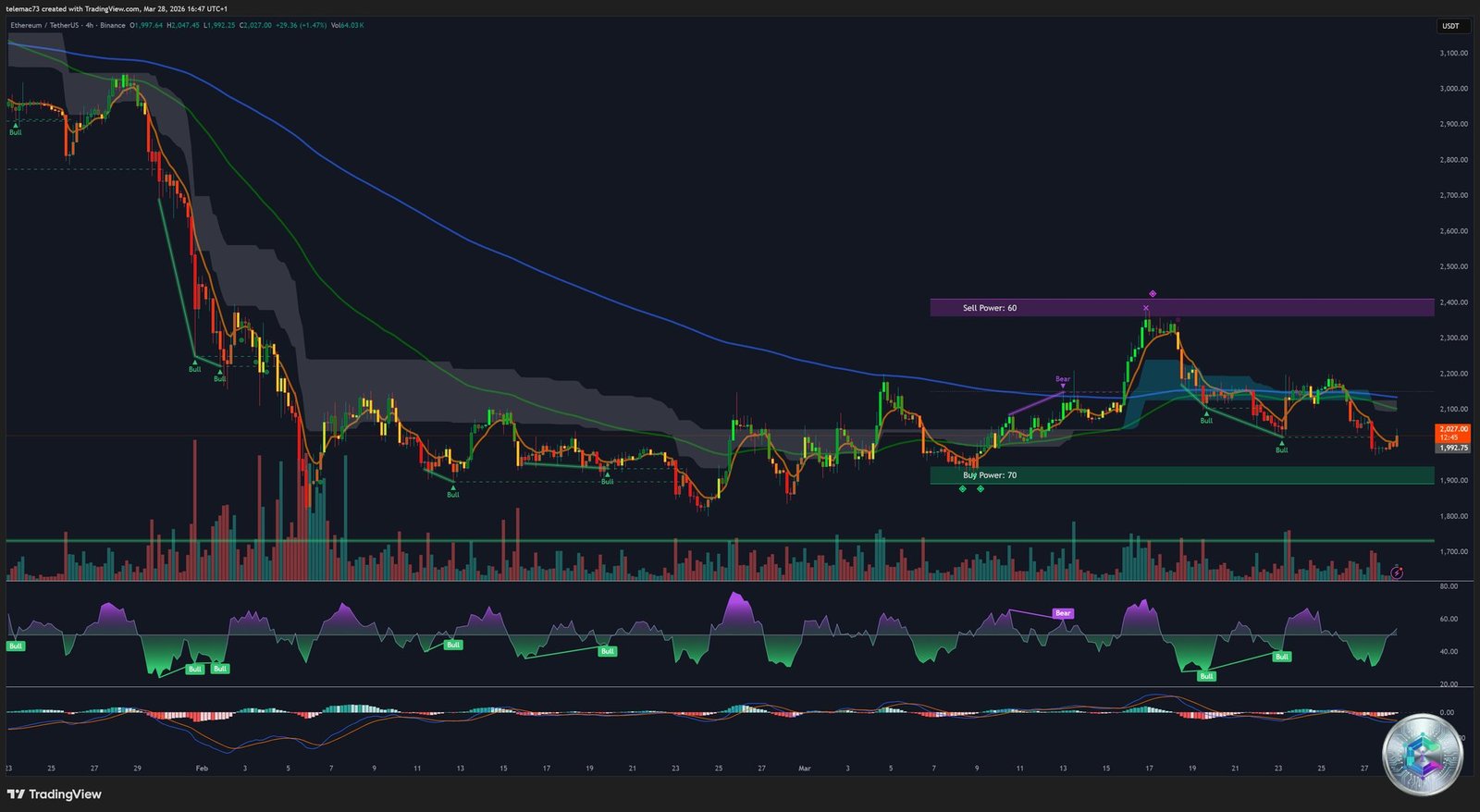
Zooming into the 4H chart, the mechanics of the downtrend become explicit. Since losing the $2,400 level in mid-March, Ethereum has evolved within a descending channel with perfectly respected boundaries, studded with repetitive Bear Flags: consolidation toward the EMA50 4H → rejection → new local low.
However, a Bollinger Squeeze (extreme tightening of the 20-period bands) signals kinetic energy accumulation around the SMA20 at $2,116. This phenomenon invariably precedes a violent directional expansion. More encouraging: a bullish RSI divergence is emerging — price is printing lower lows (toward $1,950) while the RSI is forming higher lows. If buyers manage to break the channel resistance around $2,180–$2,200, this divergence could catalyze a move back toward the EMA200 4H (≈ $2,220).
4.3 15-Minute Chart (15m): Algorithmic Warfare
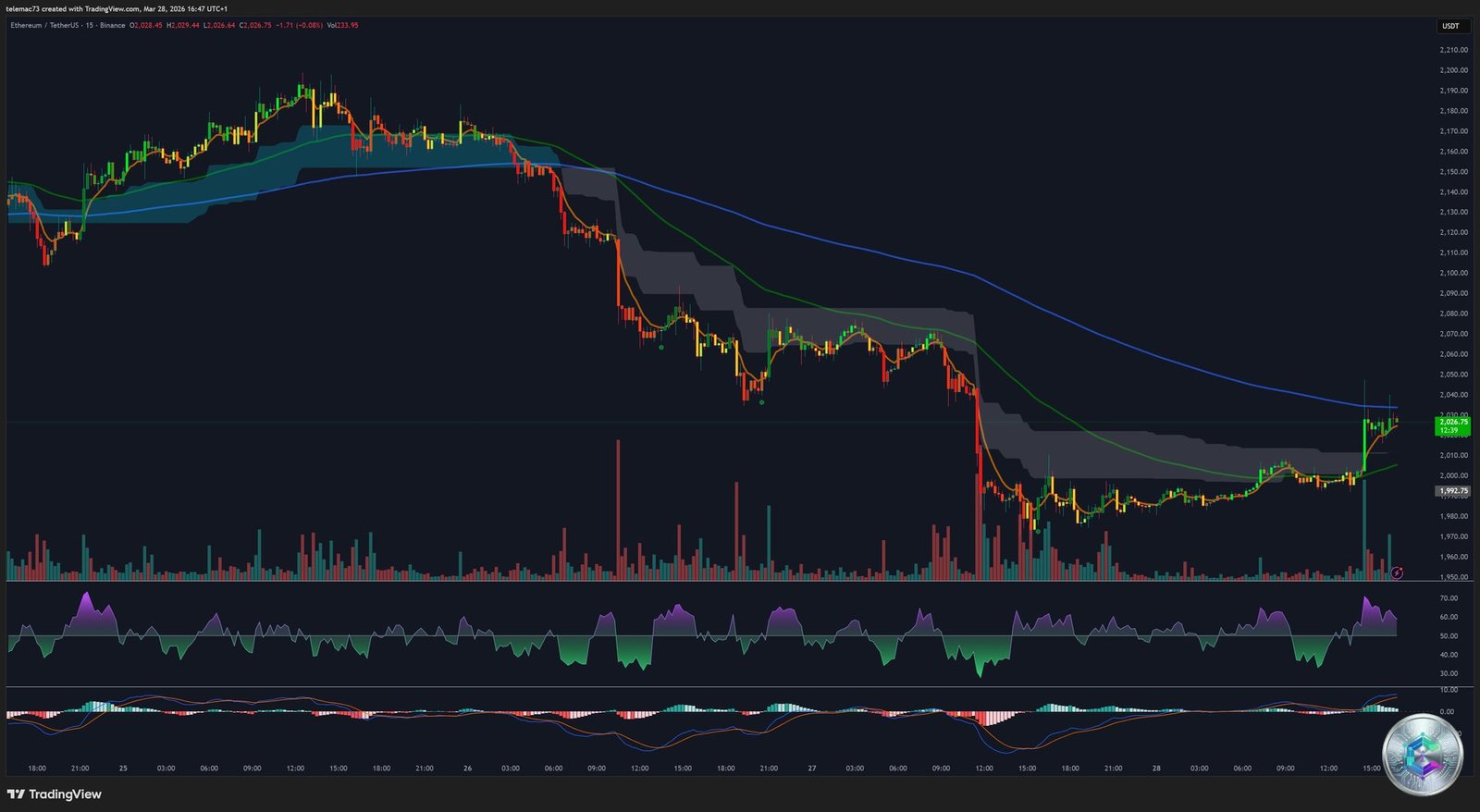
On the 15-minute timeframe, price action is erratic, driven by US macro releases and ETF flows. The microstructure is dominated by fakeouts and liquidity sweeps. Candles frequently display long wicks — engineered by institutional players and market makers to trigger retail stop-losses before violently reversing. A fake break above $2,100, for example, attracts breakout buyers who are immediately trapped.
The 15m RSI oscillates between extremes: plunging below 20 during geopolitical panic (intraday capitulation), and spiking above 80 during short-covering rallies. Rapid EMA9/EMA21 crossovers generate a succession of false signals (whipsaws) that are systematically destructive to low-amplitude trend-following algorithms.
5. Liquidity Heatmap: X-Raying the Breaking Points
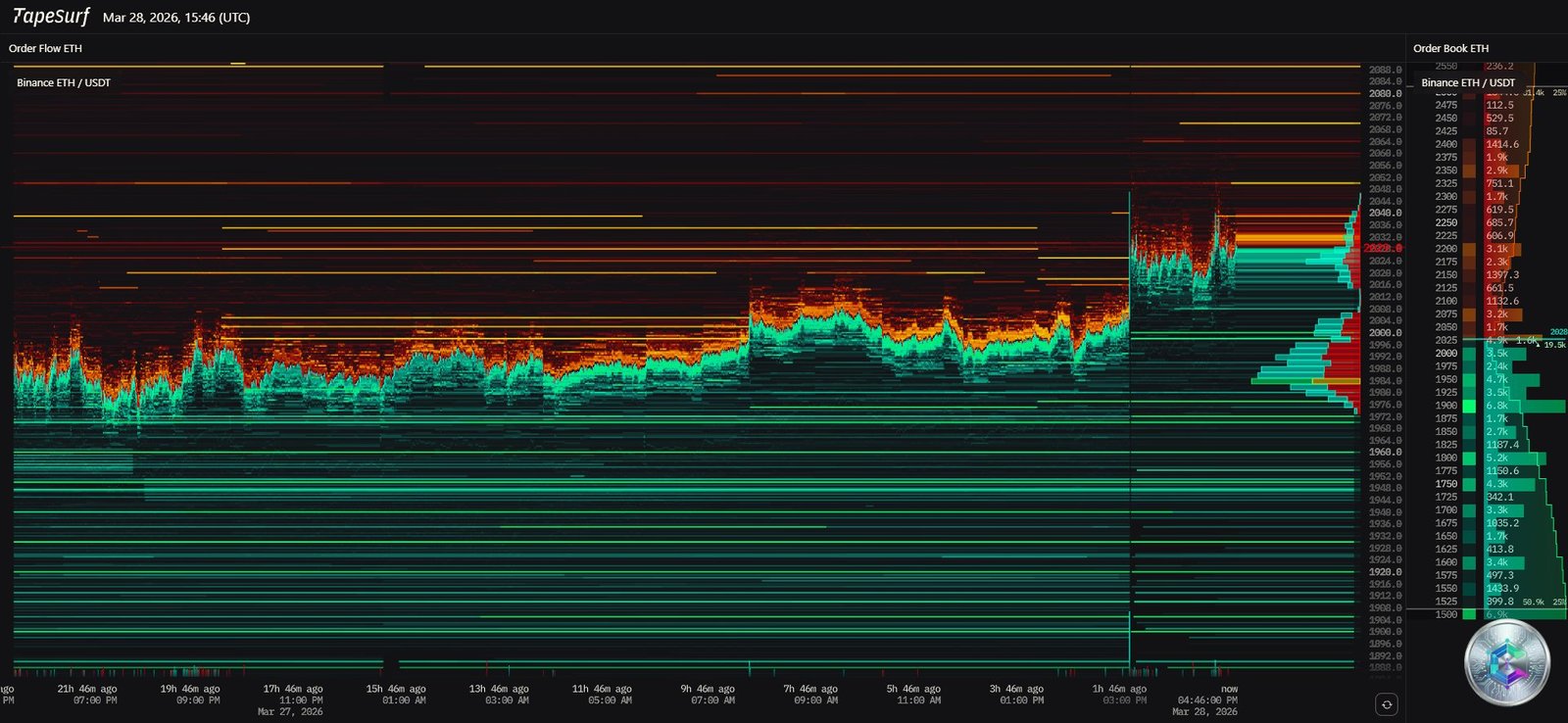
Traditional chart analysis finds its limits without deep order book context. Liquidation heatmaps reveal a strong short bias on ETH. Billions of dollars in short positions have stacked their stop-losses and liquidation levels in dense layers above key resistance zones:
- First cluster: $2,150 – $2,230
- Second massive wall: $2,400 – $2,870
Negative funding rates across multiple platforms confirm the dominant bearish bias. This asymmetry creates an extreme vulnerability for short sellers: if ETH convincingly breaks $2,150, cascading liquidations would force the market to buy ETH to cover positions, propelling price toward $2,400 or even $2,800 in a mechanical Short Squeeze.
Conversely, below $1,950 and especially below $1,800, long stop-losses and algorithmic liquidation thresholds would create a domino effect — a Long Flush cascade toward $1,600 or $1,320 in the absence of order book depth. A vital nuance: during recent dips toward $1,950–$2,000, substantial passive buy orders have been observed methodically absorbing panic sell flow — suggesting furtive smart money accumulation building an invisible support wall below spot price.
6. Key Technical Levels Matrix
| Level | Zone (USD) | Justification |
|---|---|---|
| R3 — Major Resistance | $2,700 – $2,808 | EMA 200D (Daily), macro trend reversal, massive short liquidation cluster |
| R2 — Intermediate Resistance | $2,378 – $2,400 | Classic Pivot R1, EMA 50D (Daily), historical fakeout zone |
| R1 — Critical Resistance | $2,135 – $2,150 | Bearish channel ceiling, EMA 20D, 4H Bollinger Squeeze upper bound |
| P — Central Pivot | $2,060 | Intraday gravitational balance point, HFT decision level |
| S1 — Immediate Support | $1,950 – $2,000 | Furtive accumulation zone, smart money order book absorption |
| S2 — Structural Support | $1,790 – $1,800 | H&S Neckline — last line of defense before capitulation |
| S3 — Capitulation Zone | $1,320 – $1,647 | Classic Pivot S1 ($1,647), H&S projected target ($1,320), total leverage flush |
7. Scenario Modeling
🔴 Bearish Scenario — The Purge
The Fed maintains restrictive policy, inflation remains elevated, ETF outflows continue. Selling pressure overwhelms order book absorption. ETH loses $1,950, pierces the $1,800 neckline and triggers the cascade liquidation mechanism. Target: $1,320 – $1,600.
🟡 Neutral Scenario — Atrophying Consolidation
Geopolitical and macro status quo. ETF flows balance out between ETHA outflows and ETHB staking inflows. On-chain illiquidity prevents a full collapse. ETH grinds in a long compression range between $1,850 and $2,200, systematically liquidating leveraged traders through repeated algorithmic fakeouts.
🟢 Bullish Scenario — Volatile Expansion
Geopolitical de-escalation → oil price decline → inflation relief → ETF flows reverse to net inflows. Anticipation of Glamsterdam (ePBS + massive gas limit increase) catalyzes the developer narrative. The 4H RSI divergence materializes in a convincing attack on $2,150. The Short Squeeze ignites, sweeping through billions in stacked short liquidity. H&S invalidation and recapture of the EMA200D. Target: $3,000.
Conclusion: An Existential Inflection Point
Ethereum finds itself at an existential crossroads. Its technological robustness and the extraordinary resilience of its on-chain metrics collide with the brutality of a restrictive monetary environment and a severely damaged price structure. The market is in a state of extreme tension, illustrated by the Bollinger Band compression and the density of liquidation clusters.
The exit from the current $1,800 – $2,150 range will trigger a massive algorithmic and liquidation-driven move, forcing a fundamental reassessment of the asset by institutional players for 2026. The informed observer must monitor deep order book absorption and US monetary policy announcements as the exclusive compasses for the market’s next directional move.
⚠️ Disclaimer: This article is written for exclusively educational and informational purposes. It does not constitute investment advice, a buy or sell recommendation, or any solicitation to engage in financial transactions. Cryptocurrency markets are highly volatile and speculative. Any investment carries a risk of capital loss. Please consult a licensed financial advisor before making any investment decision.

