

As we enter 2026, gold is reaching historic heights, surpassing $5,600 per ounce, pulling along Tether Gold (XAUt), its digital counterpart backed 1:1 by physical gold. This spectacular ascent is not mere chance, but the result of an unprecedented convergence of macroeconomic, geopolitical, and technological factors.
Macroeconomic Context: A Perfect Storm
The Federal Open Market Committee (FOMC) meeting on January 27-28, 2026, acted as a powerful catalyst. Although the Federal Reserve maintained interest rates in a range of 3.50% to 3.75%, the accompanying discourse, described as a « Hawkish Hold » by analysts, generated historic volatility. The market interprets this pause not as the end of a cycle, but as a defensive reaction to persistent inflation between 2.7% and 2.8%, well above the 2% target.
Physical gold and its tokenized derivatives like XAUt directly benefit from the degradation of confidence in the US dollar, which has reached its lowest level in four years. This erosion is exacerbated by White House signals suggesting a preference for a weak dollar to stimulate exports in a context of increasing regionalization of global trade blocs.
Tether: A « Private Central Bank » for Gold

Tether has established itself as a central player in the global reserve infrastructure. With reserves exceeding 140 tons of physical gold stored in Switzerland, the XAUt issuer ranks among the top 30 global gold holders, surpassing nations like Greece, Qatar, or Australia. This massive accumulation, at a rate of 1 to 2 tons per week, underpins the credibility of the XAUt token and ensures a strict 1:1 parity with physical gold.
Innovation doesn’t stop there. The launch of the « Scudo » unit, representing 0.001 troy ounces, has democratized access to gold for micro-transactions. Integration on Layer 2 networks like Mantle has reduced transaction costs by 70%, facilitating adoption in DeFi protocols.
Multi-Timeframe Technical Analysis
Daily Chart: The Parabolic Curve
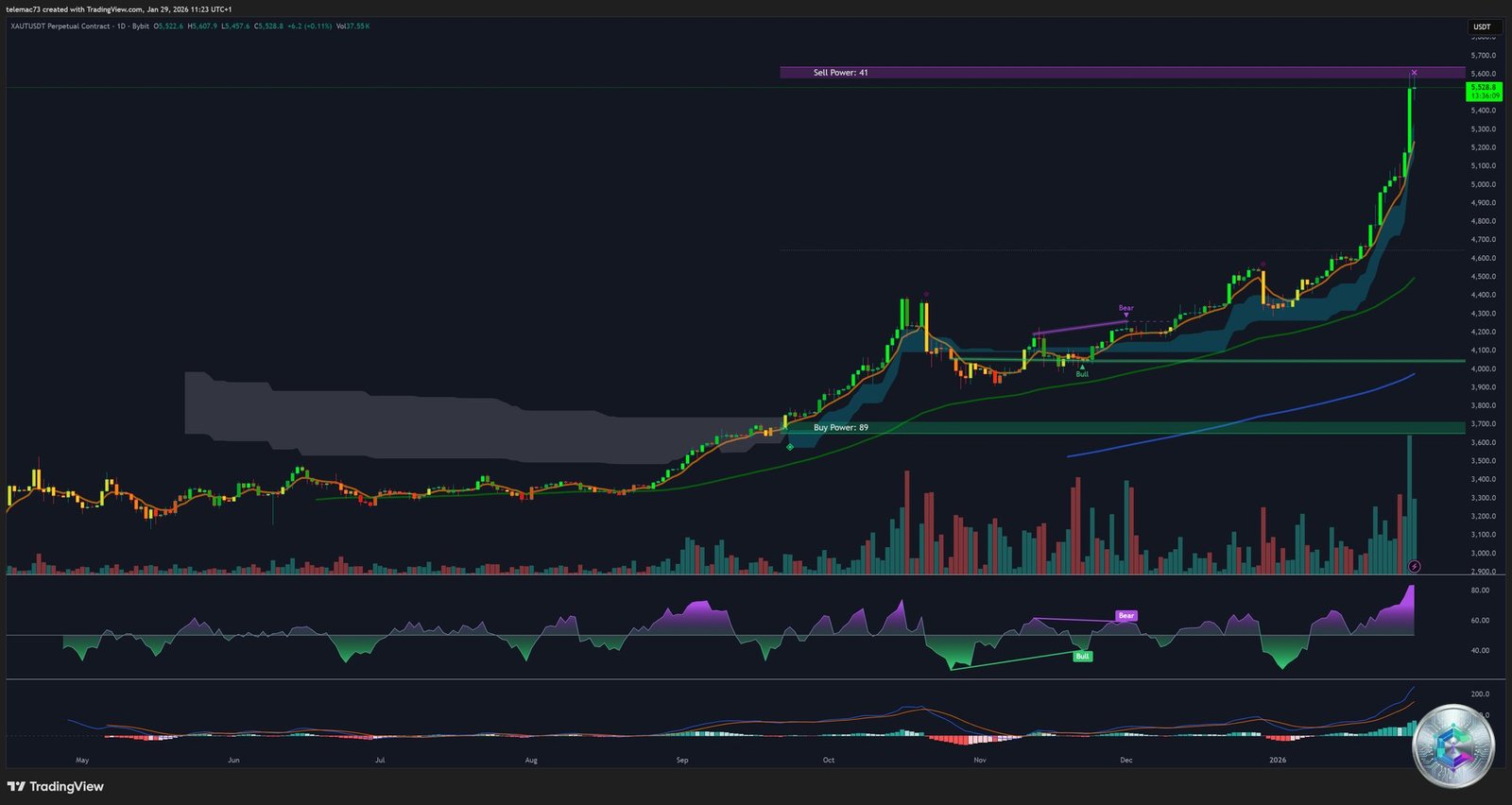
On the daily timeframe, XAUt presents an aggressive uptrend that has broken all historical resistances. The price crossed the psychological level of $5,000 on January 26, triggering a wave of short position liquidations and acceleration toward $5,600.
Technical indicators confirm the strength of the movement:
- RSI (14): 84.36 – Extreme overbought zone
- MACD: 92.84 – Powerful bullish momentum
- ADX (14): 66.25 – Extremely strong trend
- ATR (14): 50.37 – High volatility
4-Hour Chart: Signs of Exhaustion

The 4-hour timeframe reveals a more nuanced picture. While price continues to print new highs, we observe a bearish divergence on the stochastic oscillator and RSI. This configuration suggests that buying strength is waning as prices approach the $5,600 resistance zone.
15-Minute Chart: Intraday Volatility
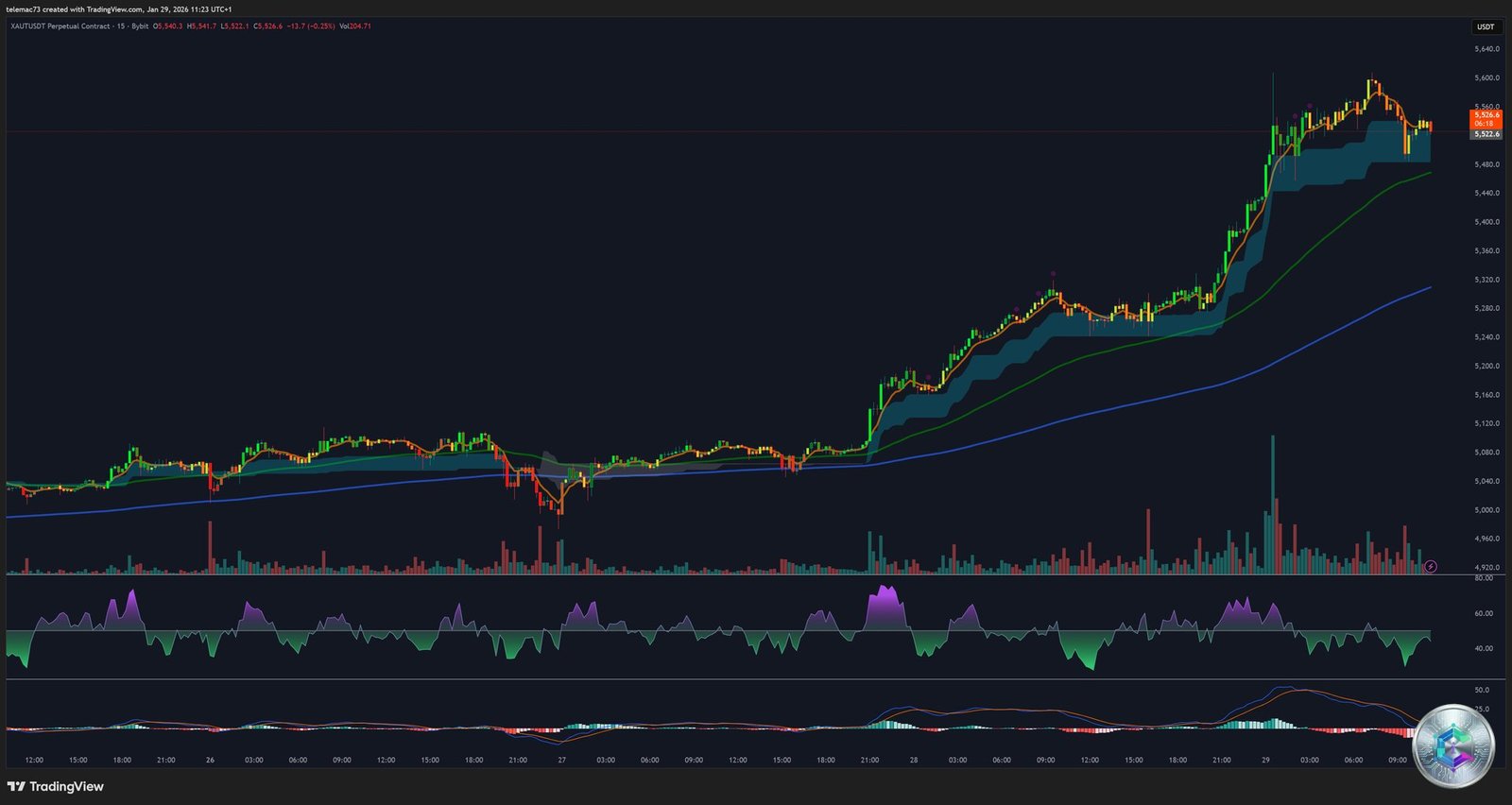
The 15-minute chart is marked by extreme intraday volatility, with swings of $50 to $100 becoming the norm. The central pivot point for the January 29 session is at $5,536.67. A break below this pivot could trigger a quick test of support at $5,520.74.
Key Levels and Pivot Points
Resistance Zones:
- $5,600 – $5,627: Current all-time high, zone saturated with sell orders
- $5,630: A close above would validate an extension toward $6,000
Support Zones:
- $5,000: Major psychological pivot support
- $5,344: Short-term support (former ceiling)
- $4,920: Capitulation zone for « buying the dip »
Market Dynamics and Sentiment
Tether Gold dominates the gold-backed token market with a 50% market share and a capitalization of $2.89 billion. On-chain data reveals a significant movement: on January 27, whales withdrew approximately $14.33 million in XAUt from exchanges to store in cold wallets, signaling long-term accumulation.
24-hour trading volume jumped 100%, reaching approximately $830 million. Bybit dominates as the leading platform with 15.75% of global volume, followed by Bitget and OKX.
Perspectives and Price Scenarios
Analysts at J.P. Morgan and Goldman Sachs have revised their targets upward, forecasting an average price of $5,055 for Q4 2026, with potential peaks at $5,400 by late 2027. « Stress-case » models even suggest gold could reach $6,000 if central bank diversification accelerates.
For the near term (February 2026), algorithmic forecasts suggest consolidation around $5,070, reflecting necessary digestion of January’s rally.
Risk Analysis
Despite the bullish bias, several risks could slow the ascent:
- Prolonged high rates: If the Fed maintains rates at 3.5% longer than expected, gold’s opportunity cost will increase
- Dollar strengthening: A resolution of trade tensions could strengthen the greenback
- Technical saturation: Extreme overbought conditions (RSI > 84) make the market vulnerable to flash crashes
Operational Recommendations
Exposure Management: For institutional portfolios, a 5% to 10% allocation in tokenized precious metals like XAUt is recommended as a stabilizer against volatility.
Entry Strategy: Avoid impulsive purchases at current levels ($5,550 – $5,600). Prefer staggered entries at support levels, particularly the pivot at $5,344 and psychological support at $5,000.
Signal Monitoring: A close below the pivot at $5,537 on the 4-hour timeframe would constitute the first signal of a deeper correction. Conversely, a confirmed break above $5,630 would validate continuation toward $6,000.
Conclusion
Tether Gold has transcended its status as a simple stablecoin to become a premier reserve instrument. Its ability to offer the advantages of physical gold with blockchain speed makes it the pivotal asset of the 2026 digital economy. However, vigilance remains essential: the extreme volatility recently observed requires rigorous discipline in position management and stop-losses.
XAUt remains the barometer of global financial system health: as uncertainty grows, its shine intensifies.
Disclaimer: This article is provided for informational and educational purposes only. It does not constitute investment advice, a recommendation to buy or sell, or an incentive to invest in any asset. Cryptocurrency and tokenized precious metals markets are extremely volatile and carry significant risks of capital loss. Before making any investment decision, we strongly recommend consulting a professional financial advisor and conducting your own thorough research. The author and publisher disclaim all responsibility for losses or damages resulting from the use of information contained in this article.

