

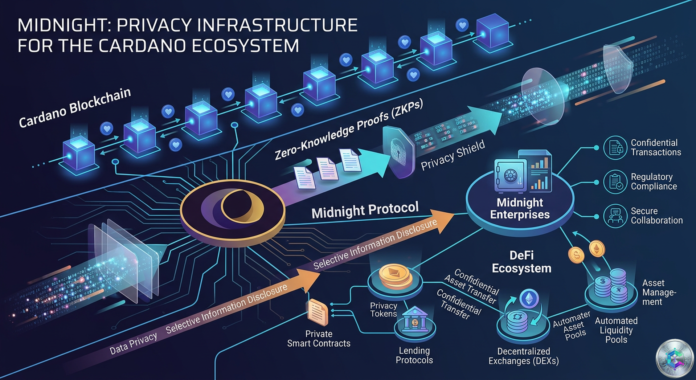
Cardano: The $9B Network with Little Real Activity — Midnight Aims to Fix That
With a market cap exceeding $9.1 billion and 672 active developers, Cardano remains surprisingly quiet on the on-chain activity front. The Midnight Foundation just launched a new system meant to attract institutions and solve this fundamental problem.
A Troubling Gap Between Valuation and Activity
Cardano finds itself in a paradoxical position. With a market capitalization above $9.1 billion and 672 active developers according to Electric Capital data, the network shows on-chain figures that strongly contrast with this imposing valuation. DefiLlama reveals approximately $134 million in total value locked (TVL), including $47 million in stablecoins, and less than $2,000 in daily chain fees.
This gap between market expectations and real activity has persisted for a long time. Charles Hoskinson, Cardano’s founder, has always argued that public blockchains cannot reach regulated finance, identity, and business use cases unless the infrastructure itself embeds privacy and compliance from the start. Midnight is Cardano’s answer to this problem.
Midnight: The Privacy-First Solution
The Midnight Foundation declared its network live on March 29, 2026, with the genesis block dated March 17. This launch gives the Cardano community its first production test of Hoskinson’s argument that public blockchains cannot serve regulated finance and enterprises without infrastructure that places privacy and compliance at the protocol’s core.
Aleo’s 2025 Privacy Gap Report reveals that institutional stablecoin volume reached $1.22 trillion, but only 0.0013% settles on private rails. RWA.xyz tracks approximately $26.67 billion in distributed tokenized assets, and McKinsey projects that tokenized financial assets could reach around $2 trillion by 2030.
An Architecture Designed for Institutions
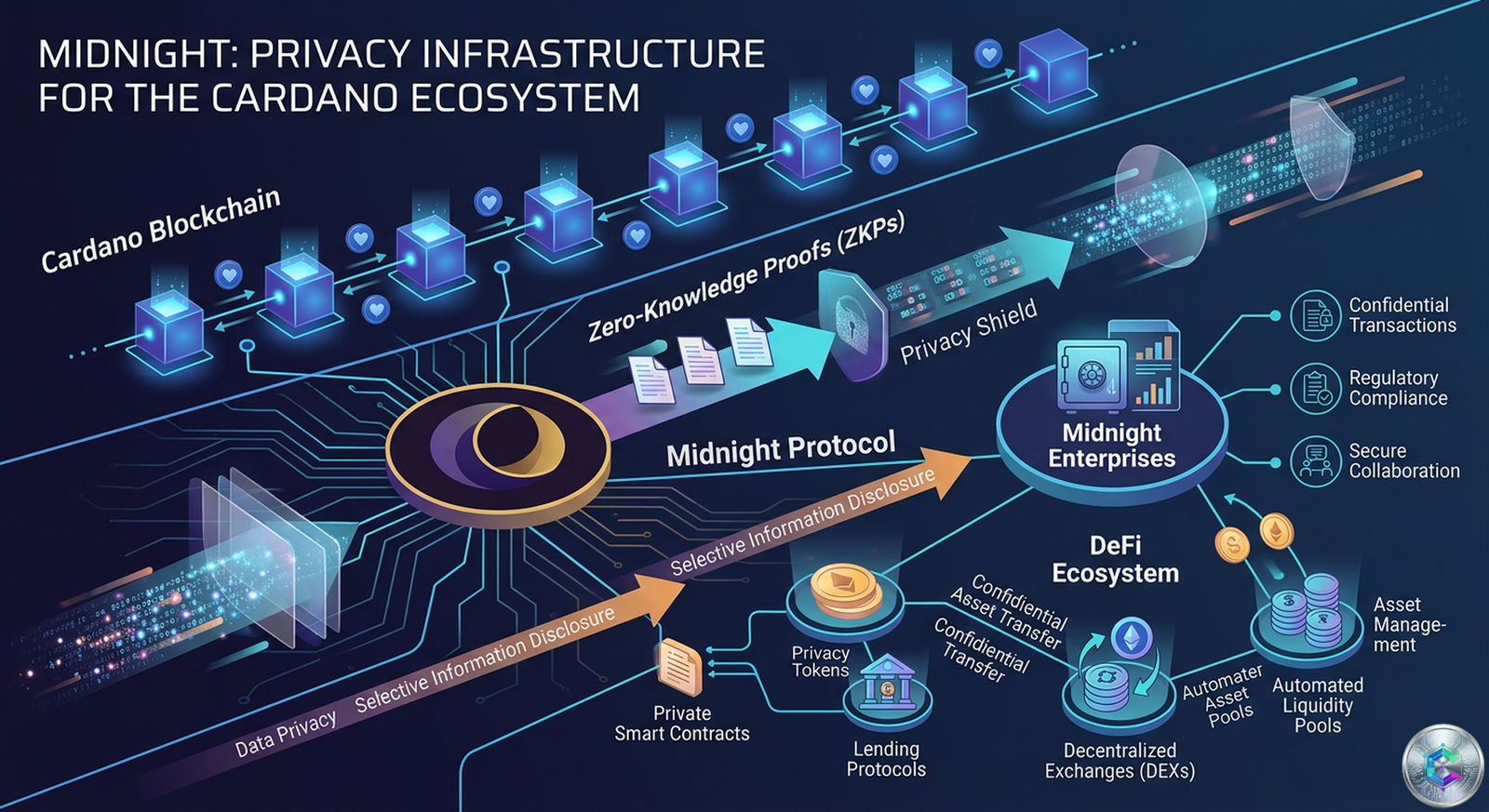
Midnight’s architecture directly targets these frictions. Its essential building blocks allow institutions to demonstrate compliance or solvency without exposing sensitive data that would make transparent on-chain participation commercially untenable.
Compact, a TypeScript-influenced smart contract language, provides enterprise developers already familiar with TypeScript with a direct onboarding path to the network. The dual-token NIGHT/DUST model adds further structural logic: separating governance and security (NIGHT) from transaction costs (DUST) provides enterprises with predictable operating economics.
This token model eventually abstracts crypto exposure away from end users entirely, a feature that compliance-driven buyers often value over cryptographic architecture alone.
Premier Operators On Board
The network opens with a federated operator model including prestigious names: Google Cloud, Blockdaemon, MoneyGram, Pairpoint by Vodafone, eToro, Worldpay, and Bullish. This configuration lowers the trust bar for regulated institutions that can verify who operates the network before committing to sensitive workflows.
Google Cloud’s role includes infrastructure and node operation. MoneyGram is exploring confidential payment network settlement with regulatory trust, acting as both a node operator and active collaborator in the network’s early phase.
Monument Bank: First Concrete Use Case
Monument Bank represents the clearest near-term product case: the bank wants to bring up to £250 million in tokenized retail deposits onto Midnight in a first phase, drawing from £7 billion in deposits managed for more than 100,000 customers.
Worldpay is running a stablecoin payments proof of concept using USDG, while Bullish is building proof-of-reserves tooling on the privacy layer. Each of these arrangements sits at the proof-of-concept stage.
Increasing Competition in Privacy
Other protocols are also betting on the privacy-plus-compliance pitch. Aztec combines public and private smart contract state with client-side proving. Namada advances selective disclosure and privacy for viewing keys. Aleo recently announced USAD, a privacy-by-default stablecoin built on the same institutional gap rhetoric.
Midnight’s edge lies in a specific combination: Cardano-linked validator selection that accounts for SPO stake delegation, NIGHT’s initial launch on Cardano mainnet, and Lace wallet support added in early March.
Outlook and Stakes
In the bull case, Monument publishes visible issuance milestones over the next 90 days, and at least one of Worldpay, Bullish, or MoneyGram publishes a production milestone or public demo.
In the bear case, the application pipeline stays thin through mid-2026. Enterprise commitments result in announcements before live application deployment. The federated launch draws more criticism from participants focused on decentralization.
Broader community-driven block production is scheduled for later in 2026, giving decentralization skeptics a clear opening: the network is asking observers to trust a curated launch environment before it has proved decentralized demand.
Conclusion
Midnight begins to function as the first credible bridge between Cardano’s infrastructure and regulated on-chain finance, pulling in builders and institutions that transparent ledgers have never served. Hoskinson can now point to a full stack running from Cardano’s governance and interoperability layer to Midnight’s identity and privacy layer.
The verdict will come later, from the applications builders deploy, the deposits Monument actually tokenizes, and the workflows the institutional operators commit to past the launch window.

