

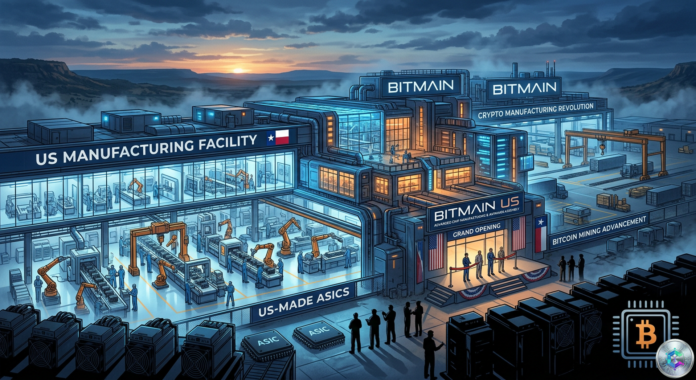
Bitmain Opens First US-Based ASIC Chip Factory: A Historic Turning Point for the Bitcoin Mining Industry
The Chinese Bitcoin mining hardware giant Bitmain officially launched production at its first US-based ASIC (application-specific integrated circuit) chip factory in early 2026, marking a historic turning point for the cryptocurrency mining industry. This strategic decision, long in the making, responds to several converging factors: the reciprocal tariffs imposed on China, regulatory issues encountered with US authorities, and the Trump administration’s stated goal of making the United States the world leader in Bitcoin mining. This new milestone reached by Bitmain perfectly illustrates the profound transformations currently underway in the mining hardware sector, with potentially considerable consequences for the entire cryptocurrency value chain.
Bitmain’s Dominance in Mining Chip Sector
Bitmain unquestionably stands as the undisputed leader in the Bitcoin mining ASIC chip market, controlling approximately 82% of global production according to a study published by the University of Cambridge in April 2025. This dominant position allows the company to benefit from considerable economies of scale and maintain a significant technological lead over its direct competitors, particularly MicroBT which represents 15% of the market and Canaan with 2%. The concentration of production in the hands of a few main players makes Bitmain’s decision to establish part of its manufacturing capacity on American soil all the more significant, breaking with decades of exclusively Chinese production.

Irene Gao, Bitmain’s global business development chief, highlighted in an interview with Bloomberg that the move to the United States represents « a unique opportunity » in the context of America’s quest for dominance in the Bitcoin space. This statement perfectly illustrates Bitmain’s strategy of transforming regulatory and geopolitical constraints into commercial opportunities, positioning itself as a privileged partner for the development of the American mining ecosystem. The company announced its intention to hire 250 local workers in the first phase of its rollout, with roles including training in manufacturing and facility maintenance.
Tariffs as a Catalyst for Reshoring
Bitmain’s decision to open a US factory fits into a context of US-China trade war marked by the imposition of particularly high reciprocal tariffs on Chinese products. These tariff measures have made exporting mining hardware from China to the United States significantly more expensive, creating a powerful economic incentive for production reshoring. The three main Bitcoin mining hardware manufacturers, namely Bitmain, Canaan and MicroBT, have all announced their intention to transfer part of their production to the United States, demonstrating a deep sectoral trend that could durably reshape the geography of the cryptocurrency mining industry.
The financial impact of these tariffs on the economic model of American mining companies has been considerable. American Bitcoin miners, who previously depended exclusively on hardware imports from China, had to absorb significant additional costs that dented their profitability in an already challenging context of declining mining revenues. The ability to source locally produced hardware now allows American miners to reduce their delivery times, optimize their logistics costs and benefit from more responsive technical support, all competitive advantages that amply justify the initial investments required to establish these new production capacities.
Regulatory Problems Solved Through Local Production
Beyond tariff considerations, Bitmain’s decision to establish operations in the United States also responds to complex regulatory problems that have affected the company in recent years. In November 2024, the US Customs and Border Protection Agency intercepted the delivery of thousands of Bitmain ASIC chips, as part of an investigation into alleged business relationships between Chinese chip designer Xiamen Sophgo and sanctioned Chinese company Huawei. This seizure created a critical situation for many American miners who were waiting for essential equipment for their operations.
The Xiamen Sophgo chip designer also provides technical support for Bitmain’s ASIC activities, which led US authorities to expand their investigation to the entire supply chain involving these two Chinese companies. However, US authorities began releasing the seized equipment as early as March 2025, but this experience demonstrated starkly the vulnerability of American companies in case of increased geopolitical tensions between the two economic powers. By establishing local production capacity, Bitmain offers its American customers an additional guarantee against the risk of future disruptions to their supply chain.
The Strategic Framework of the Trump Administration for Bitcoin Mining
Bitmain’s US implantation fits perfectly within the strategic framework defined by the Trump administration to make the United States the world leader in Bitcoin mining. This political priority has been clearly expressed through several initiatives, including the possible creation of a national strategic Bitcoin reserve and tax incentives targeted toward mining companies operating on American soil. In this context, Bitmain’s decision to localize production in the United States appears as a mutually beneficial strategic choice for the company and for American public policy objectives.
Bitmain’s new facility will be based in Texas or Florida, with an official inauguration expected before the end of the third quarter of 2025 for the company’s new US headquarters. This geographic proximity to the large Bitcoin mines in Texas, a state that concentrates a significant portion of global mining power thanks to its renewable energy resources, will allow Bitmain to offer exceptional proximity services to its American customers. The combination of local production, high-performance technical support and direct physical presence in the American market positions Bitmain as an essential player in the next stage of development of the Bitcoin mining industry in the United States.
Implications for the Future of the Mining Industry
Bitmain’s US factory entering production in early 2026 presages structural changes for the entire Bitcoin mining industry. This trend toward reshoring hardware production to Western markets could ultimately reduce the industry’s dependence on Chinese supply chains, thereby strengthening the sector’s resilience to geopolitical risks. Moreover, this evolution could foster the emergence of new local players capable of competing with established giants in the mining hardware manufacturing field.
The consequences of this transformation for Bitcoin miners are also significant. The ability to source locally produced hardware makes it possible to reduce delivery times, optimize logistics costs and benefit from more responsive technical support in case of problems. These competitive advantages could translate into improved profitability of mining operations for American companies, thereby strengthening their competitiveness in the global market. In the longer term, this evolution could also contribute to greater geographic diversification of the mining industry, reducing the current concentration of Bitcoin hashrate in certain regions of the world.
Sources:
- Bloomberg
- University of Cambridge, Digital Mining Industry Report (April 2025)
- Cointelegraph

