


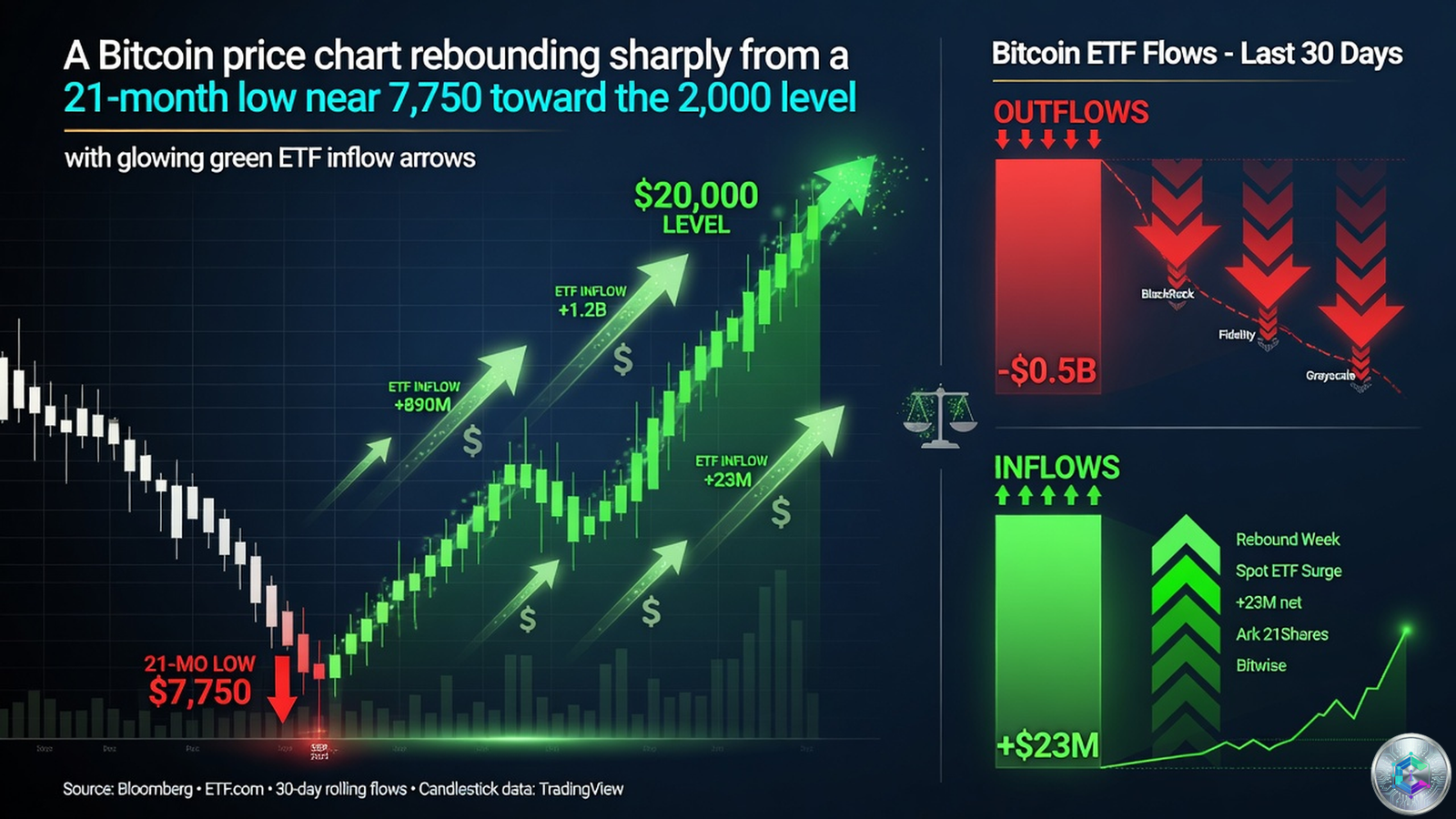
Bitcoin rebounded 7.3% to reclaim $62,000 after a US jobs report badly missed forecasts at 57,000 positions created in June. Spot ETFs logged $223M in inflows — their largest single-day figure since May — following $2.73B in outflows over ten consecutive sessions.
🔑 Key takeaways
- BTC jumps from $57,750 to $62,000 (+7.3%) in under 48 hours
- US jobs: 57,000 positions created in June, half of consensus (100-120k)
- Spot BTC ETFs: +$223M Thursday, after $2.73B in outflows over 10 days
- Cumulative ETF outflows since May: ~$8.5B (Santiment)
- Fed/inflation tension remains the dominant short-term factor
The Jobs Report That Shifted the Calculus
June’s nonfarm payrolls figure landed like a bomb on financial markets. Economists had been expecting somewhere between 100,000 and 120,000 job creations — a level consistent with a labor market cooling gradually rather than collapsing. The US added just 57,000. The miss was not a rounding error; it was a signal.
The Bureau of Labor Statistics revised April and May payrolls lower by a combined 74,000 jobs, which means the hiring trend that had appeared moderately resilient was, in fact, considerably weaker than initially reported. The unemployment rate dipped to 4.2%, but only because the labor force shrank: roughly 720,000 people left the labor force in June, pushing the participation rate down to 61.5% from 61.8%.
The household survey told the same story: employment fell by 507,000. Hiring was concentrated in a narrow slice of the economy — education, health care and social assistance added 69,000 jobs, more than the overall payrolls increase — while leisure and hospitality declined and government payrolls rose by just 8,000.
Rick Rieder, BlackRock’s chief investment officer of global fixed income, described the report as « more fizzle than fireworks, » arguing that the broader picture still suggests gradual cooling rather than widespread job destruction. That assessment may be technically accurate, but it did not stop markets from reacting as though something had fundamentally shifted.
Before the report, traders had been pricing in a meaningful probability of a Federal Reserve rate hike as soon as September, with expectations for additional tightening by year-end firmly in place. The combination of sticky inflation, elevated wage growth and a Fed led by Kevin Warsh — who had done nothing to signal a dovish pivot — kept the rate-hike trade alive and pressing down on every risk asset in sight.
« We think this job report is enough to keep the Fed on hold at its July meeting. Looking ahead, there is more room for the economy to grow as headwinds continue to subside. »
Tuan Nguyen, economist at RSM US LLP
The repricing had cascading effects across markets. The two-year Treasury yield slipped to around 4.11%, the dollar weakened, gold extended its rebound. Bitcoin, which had been under pressure for weeks, surged from $57,750 to $62,000 in under 48 hours.
ETF Flows: A Brief Reprieve or a Structural Shift?
The $223M inflow ended a 10-day streak of consecutive outflows. According to SoSoValue, the outflows that preceded the rebound had removed $2.73B from US spot Bitcoin ETF products — a figure that had shaken confidence in the institutional adoption thesis that had been the dominant narrative since the ETFs were approved in early 2024.
According to Santiment, Bitcoin ETFs have now recorded nearly $8.5B in net outflows since early May. That is a staggering figure in relative terms, representing a large fraction of the total net inflows the products had accumulated since launch. It suggests the institutional adoption story was in fact highly sensitive to price action and macro conditions — and that when those conditions turned hostile, institutions exited as quickly as they had entered.
Glassnode data confirms the picture: spot ETF balances have been declining since their autumn 2025 peak, with newer whale wallets — a cohort that overlaps heavily with institutional money that entered through ETFs — realizing roughly $2.5B in losses as Bitcoin dropped from the high $70,000s toward $60,000.
| Bitcoin ETF Indicator | Value | Source |
|---|---|---|
| Single-day inflow (Thursday) | +$223M | SoSoValue |
| 10-day outflows | -$2.73B | SoSoValue |
| Cumulative outflows since May | ~-$8.5B | Santiment |
| Realized losses (recent whales) | ~-$2.5B | Glassnode |
| May 2026 peak inflow | +$630M (May 1) | SoSoValue |
| Mid-May 2026 outflows | -$2.7B | SoSoValue |
The experience of May 2026 offers a cautionary template. On May 1, Bitcoin ETFs captured $630M in a single session, briefly pushing the price toward $81,000. Two weeks later, $2.7B flowed back out. The lesson: institutional money has no loyalty, only logic. It follows price and macro signals, and it moves fast in both directions.
The Macro Backdrop: Fed Risk Persists
The weakness in the June jobs report does not remove Federal Reserve risk from the Bitcoin equation. It defers it.
The Fed’s core mandate remains getting inflation back to its 2% target, and wage growth is still running above the level policymakers consider consistent with price stability. The US-Iran war and ongoing tariff debates have added fresh uncertainty to the inflation outlook. If inflation proves sticky — or if the labor market deterioration proves transitory — the rate-hike trade can quickly reassert itself.
Ole Hansen, head of commodity strategy at Saxo Bank, noted that lower energy prices, easing inflation expectations, softer yields and a weaker dollar have helped stabilize precious metals. Bitcoin benefited from the same shift. But the relief is contingent on the macro backdrop remaining benign — and on the Fed genuinely pausing its tightening cycle rather than merely delaying it.
For Bitcoin, this means the macro environment remains treacherous territory. Higher interest rates reduce the appeal of speculative assets by raising the yield on cash and short-term government debt. The opportunity cost of holding a non-yielding asset like Bitcoin rises with rates, putting downward pressure on its price through standard portfolio allocation models. And a stronger dollar — which typically accompanies higher rates — further pressures Bitcoin’s inverse correlation with the US currency.
Technical Picture: Bitcoin at a Crossroads
Bitcoin’s price recovery now depends critically on whether ETF demand continues and whether the cryptocurrency can hold key technical levels around $60,000 and $62,000.
Bitwise Europe noted that investor stress remains elevated, with only 47% of Bitcoin supply held at a profit and aggregate paper losses of approximately $281B across the market. The firm also observed that realized losses have declined with each successive move lower — a sign that selling pressure may be easing near current levels, as holders who have not yet sold have largely decided to wait.
| Technical Level | Signal | Implication |
|---|---|---|
| 7-day MA | Above (short term) | Modest positive signal |
| 30-day MA | Below | Broader trend under pressure |
| Negative gamma | $60,000 / $55,000 | Amplifies downside if momentum fades |
| Positive gamma | ~$62,000 | Stabilizes if demand holds |
| Supply in profit | 47% | Elevated stress, partial capitulation absorbed |
Crypto research firm 10x Research offered a mixed technical assessment. Bitcoin has moved above its seven-day moving average — a short-term positive signal — but remains below its 30-day moving average, leaving the broader trend under pressure. A sustained break above the 30-day moving average would be a more meaningful bullish signal than the current position.
Exchange-flow data adds another layer of caution. Bitcoin’s decline below $58,000 earlier this week coincided with heavier transfers to trading platforms, including moves by larger holders. The 49,000 BTC that whales sent to exchanges as the price tried to hold $60,000 is a reminder that the next wave of selling is never far away when leverage and stress build in the market.
Long-Term Holders Step In as ETF Investors Step Out
One of the more notable developments of the recent selloff is that long-term Bitcoin holders have been absorbing the supply that ETF investors have been dumping.
Data from multiple on-chain analytics firms shows a divergence between the behavior of short-term ETF-driven holders and the older cohort of Bitcoin investors who have maintained their positions through multiple cycles. While newer entrants through the ETF wrapper have been selling at a rapid clip — realizing losses and redeeming their shares — long-term holders have been buying, treating the drawdown as an opportunity rather than a signal to exit.
This pattern — institutional and newer retail money exiting while experienced holders accumulate — is consistent with late-stage bear market dynamics. It suggests the recent price action reflects a rotation rather than a wholesale rejection of Bitcoin as an asset class. Ownership is shifting from those who entered near the top of the cycle toward those with a longer time horizon and higher conviction.
Bernstein, in a research note, argued that this « boring cycle » does not undermine Bitcoin’s store-of-value thesis despite the $2.6B in ETF outflows. The firm characterized the current period as a natural phase of consolidation after a period of explosive growth — one that is necessary for the next leg up rather than a sign of permanent damage.
Conclusion: Macro Relief, Structural Questions
The near-term picture for Bitcoin is cautiously constructive. The jobs report has reduced immediate macro pressure, ETF demand has shown at least a temporary revival, and the price has reclaimed levels that had been under serious assault. For a market that had been staring at the possibility of a deeper slide toward $50,000 or below, the relief is real.
But the structural questions remain unanswered. ETF outflows of nearly $8.5B since early May represent a significant reallocation away from Bitcoin by the institutional community that was supposed to be the backbone of its next bull market. The jobs report has given the market breathing room, but it has not resolved the fundamental tension between a Federal Reserve still fighting inflation and an economy showing signs of meaningful cooling. The next test is whether ETF inflows continue: a second consecutive day of strong demand would strengthen the case that investors are treating the drawdown as an entry point rather than a trap; a quick return to outflows would suggest that the recent rebound was a rate-trade relief rally rather than the beginning of a durable recovery.
Sources
- CryptoSlate — Bitcoin ETFs see biggest inflow since May after weak US jobs report sparks BTC price rebound
- CNBC — U.S. job creation cools in June with payrolls growth of just 57,000
- IG Group — Bitcoin hits $62,000 after soft US jobs data
- Yahoo Finance / The Block — Bitcoin Faces Record Institutional Outflow as Spot ETFs Bleed
- CryptoSlate — Bitcoin and Ethereum ETF outflows expose rotation into HYPE, XRP and Solana
- SoSoValue — US Bitcoin ETF Flow Data
This article is for informational and educational purposes only. It does not constitute investment advice. Do your own research (DYOR) before making any decision.

