

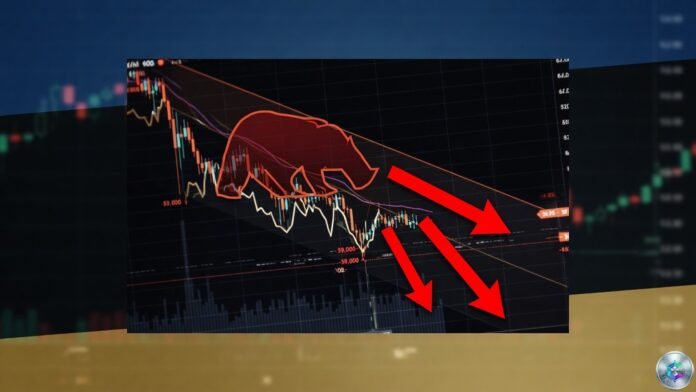
Bitcoin has entered a dangerous technical phase. The confirmation of a bear flag breakdown on June 24 officially ended the corrective bounce from early June, opening the door for a sustained downtrend. Analysts now point to $59,000 as the immediate critical support, with bearish extensions targeting $54,000 or even $40,000 if selling pressure intensifies.
🔑 Key Takeaways
- A bear flag broke down on June 24, confirming the end of the June corrective rally.
- The options market prices a near-term drop to $52,000, while long liquidations dominate trading activity.
- Cumulative outflows from U.S. spot Bitcoin ETFs have reached ~$6 billion over six weeks, draining institutional demand.
- Capital rotation into AI and a hawkish Federal Reserve are creating significant macro headwinds.
Bear Flag Breakdown: What the Charts Are Saying
On June 24, Bitcoin fell more than 2%, confirming a bear flag pattern on the daily chart. This classic continuation pattern is defined by a sharp initial decline (the pole), followed by a consolidation bounce (the flag). A break below the flag’s lower boundary indicates the initial downward move is poised to extend by a similar magnitude.
This breakdown was confirmed precisely as Wintermute, a leading crypto market maker, released its assessment. According to its June 24 report, Bitcoin’s 24-hour options range was bounded between $61,242 and $63,563, implying a potential move of ~1.9% in either direction. Wintermute identified $59,000 as the critical bearish target, describing it as its bear market low projection for the current cycle.
Analysts tracking the pattern are growing concerned. Pseudonymous analyst Doctor Profit, noted for correctly calling Bitcoin’s bull-market peak at $126,000, suggests the formation points toward an initial decline to the $54,000-$56,000 region before any meaningful consolidation. On X, he stated: « Bitcoin is now forming a massive bearish flag on the daily timeframe. My target is a dump to 54-56k region first before we move sideways once again and afterwards another leg down and the bottom is close in the region between 40-50k in my opinion. »
The June 5 low of approximately $61,165 already represented a staggering 30% decline year-to-date. The relief bounce to near $68,000 has now been fully reversed. Traders purchased put options signaling expectations of a slide to $52,000. Open interest in Bitcoin futures has fallen 18.72% to $45.62 billion, with 83% of liquidations coming from long positions—indicating flushed leverage but conspicuously absent institutional demand.
Deteriorating Fundamental Backdrop
Beyond the technical picture, the fundamental backdrop has deteriorated markedly. Summer historically brings reduced liquidity, and 2026 is no exception. This thinning liquidity is occurring against a backdrop of structural changes in how Bitcoin is priced and traded.
Wintermute highlighted a critical observation: no fresh institutional bid is visible in ETF flows. After six consecutive weeks of net outflows from U.S. spot Bitcoin ETFs—representing approximately $6 billion in aggregate redemptions—the marginal buyer is no longer the retail investor, but the ETF allocator or corporate treasury. These players are far more sensitive to macro conditions. Outflows on June 22 alone reached $68.3 million. Over 30 days, total ETF outflows stand at ~$5.96 billion, removing a key source of demand.
Hostile Macro Environment
The Euro/Yen (EUR/JPY) cross has fallen to its lowest level since May 6, down 1.44% over seven days. The U.S. Dollar Index (DXY) climbed to 101.57 on June 24—its highest since May 2025. These moves are classic risk-off signals. As analysts at CoinDesk note, fiat currencies derive value from government bond yields, while Bitcoin generates no such inherent yield. In a rising-rate environment, its opportunity cost increases.
Economists at Deutsche Bank now expect the Fed to raise interest rates twice in 2026. Analyst Marion Laboure summarized the situation: « Bitcoin is not disappearing; it is maturing into an institutional asset whose price is set by fund flows, Fed expectations, competing risk themes, and legislative outcomes. » The marginal buyer now faces heightened competition, particularly from artificial intelligence.
« Bitcoin is not disappearing; it is maturing into an institutional asset whose price is set by fund flows, Fed expectations, competing risk themes, and legislative outcomes. »
Marion Laboure, Analyst, Deutsche Bank
AI Capital Rotation and Strategy’s Historic Sale
The emergence of AI as a dominant destination for speculative capital is the most structurally significant development of 2026. U.S. tech giants are expected to spend over $700 billion on AI infrastructure in 2026, drawing institutional capital away from digital assets. Mati Greenspan, founder of Quantum Economics, argues the current price weakness is not a fundamental loss of faith, but a simple result of this capital competition.
Compounding this is the unprecedented decision by Strategy (formerly MicroStrategy)—the corporate entity built around Bitcoin holdings—to sell a portion of its BTC, its first disposal since 2022. This symbolic breach of its « never sell » commitment has had a disproportionate psychological impact, suggesting even the most committed corporate holders are reevaluating their exposure.
A rare positive note came from the U.S. House passing a four-year CBDC ban, a legislative victory for Bitcoin’s decentralized ethos. However, this development has done little to arrest the short-term price decline amid overwhelming macro and technical headwinds.
Key Levels and Outlook
The most critical support zone is currently $60,000-$62,500. A break below $60,000 could trigger further forced selling toward $58,000, $57,000, and eventually the $55,000-$54,000 zone. Resistance is formed by a cluster of moving averages (50-day and 100-day) converging between $65,500 and $67,180.
| Indicator | Level / Value | Interpretation |
|---|---|---|
| Critical Support | $60,000 – $62,500 | Structural floor; break could accelerate selling |
| Bearish Target 1 | $59,000 | Primary bearish projection from Wintermute |
| Bearish Target 2 | $54,000 – $56,000 | Technical target per Doctor Profit |
| Weekly RSI | 34 | Below 41.5 threshold (bear territory) |
| Fear & Greed Index | 24 | Extreme Fear, historically sometimes contrarian |
| 30-Day ETF Outflows | ~$5.96B | Sustained institutional redemption pressure |
The Fear and Greed Index reads 24 (Extreme Fear). Key catalysts to watch this week include the stability of the U.S.-Iran peace deal, the June PCE inflation print (the Fed’s preferred measure), and the quarter-end options expiry, which could amplify volatility.
Perspectives and Scenarios
The bear flag confirmation marks a critical juncture. The convergence of a hawkish Fed, record ETF outflows, AI-driven capital rotation, and thinning summer liquidity has created an environment where the path of least resistance is lower. The immediate target is $59,000, but a break of current support levels opens the way to $54,000, and potentially a deeper extended decline toward $40,000-$50,000 in the most bearish scenario. The CBDC ban is a long-term ideological positive for Bitcoin, but does nothing to counteract the prevailing short-term technical and fundamental headwinds. Investors should closely monitor the $60,000 level as a critical inflection point.
Sources
- CoinDesk – « Live Markets: Bitcoin Could Drop to $59,000 as Liquidity Dries Up »
- CoinDesk – « Bitcoin Price May Be Headed to $54,000, Says Analyst Who Forecast October’s All-Time High »
- CoinDesk – « Bitcoin’s June Fall Below $60,000 Signals Fed, ETF and AI Pressures: Deutsche Bank »
This article is published for informational and educational purposes. It does not constitute investment advice. Conduct your own research (DYOR) before making any decisions.

