


As Bitcoin navigates through a period of intense geopolitical volatility marked by the Trump administration’s tariff tensions, the crypto market reveals fascinating technical signals. This comprehensive analysis decrypts the underlying mechanisms of BTC price action and outlines perspectives for the end of January 2026.
The Geopolitical Context Shaking Markets
The third week of January 2026 will be remembered for President Trump’s ultimatum regarding Greenland and his threats of punitive 10% tariffs on eight European nations. This announcement triggered an immediate « Risk-Off » environment, unleashing a cascade of liquidations that sent Bitcoin down approximately 9% from local highs, testing the critical $87,600 zone.
However, the subsequent retraction of these threats led to a spectacular V-shaped recovery. The market demonstrated remarkable resilience, with BTC bouncing firmly to reclaim the $94,000 – $95,000 pivot corridor. This demand elasticity suggests that significant institutional liquidity was waiting in the $80,000 zone to accumulate, treating the geopolitical event as a tactical buying opportunity rather than an invalidation of the bullish thesis.
Multi-Timeframe Technical Analysis: The Squeeze is Building
Daily View: Major Volatility Compression
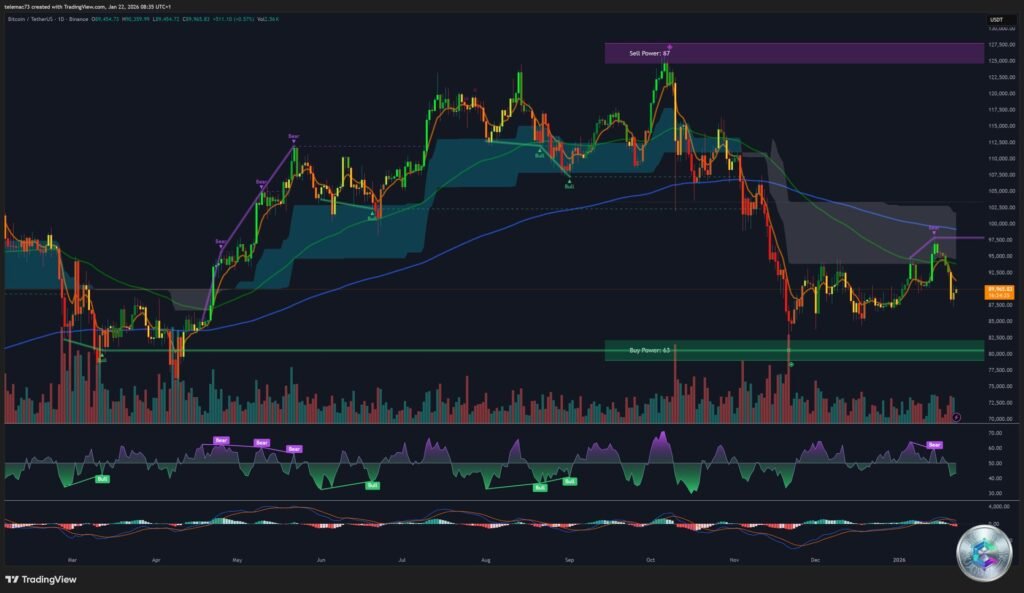
The daily chart reveals a critical technical phenomenon: Bollinger Bands have compressed to a historically low width (less than $3,500 spread). This compression almost invariably precedes a violent expansion of volatility. The price is currently evolving around the 100-day Exponential Moving Average, positioned near $99,500, acting as immediate dynamic resistance.
Maintaining price above the recent lows of $87,600 has validated a « higher low » compared to the late-2025 structure, preserving the integrity of the long-term bullish trend. The ultimate obstacle remains the $100,000 – $102,000 cluster, a major supply zone where previous upward attempts were rejected. A daily close above $102,000 would technically validate a resumption of the primary bull market, exposing targets at $109,000 and $116,000.
4-Hour View: Bullish Reversal in Progress

The 4-hour chart offers the clearest evidence of a short-term trend reversal with a market structure break above $94,820. Power indicator analysis shows a marked transition: while previous peaks were accompanied by bearish signals, the recent structure reveals the emergence of bullish signals with « Buy Power » at 71 versus declining « Sell Power » at 59.
The critical level to watch sits at $95,622, identified as an « Electric Fence » – a fractal level where institutional algorithms place their orders. A candle close above this precise level would constitute the trigger for acceleration toward $98,000. A classic bullish divergence on the 4H RSI accompanies recent lows, indicating that selling momentum had exhausted before price even reversed.
15-Minute View: The Intraday Battle
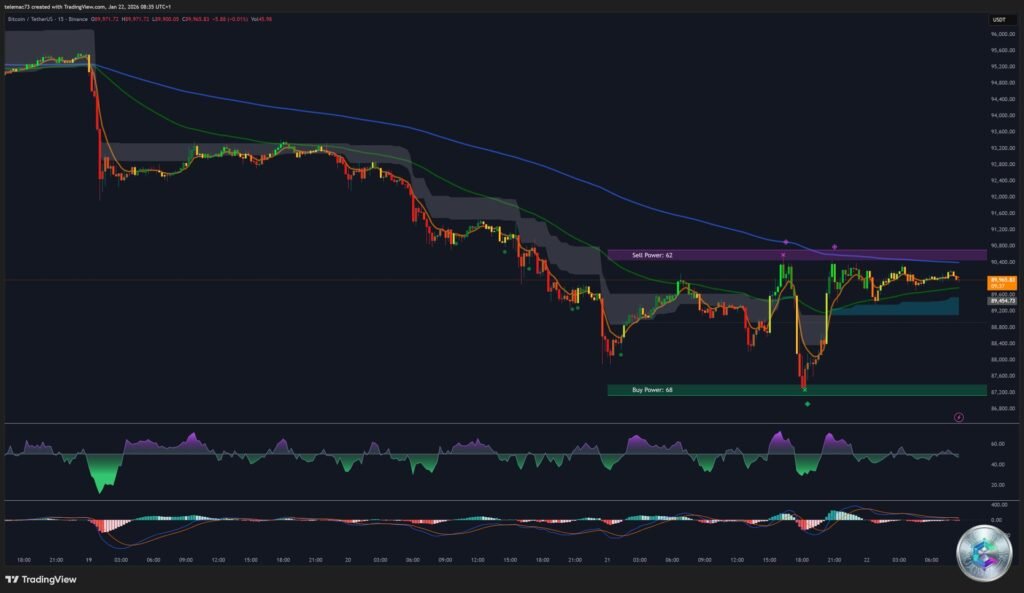
In the very short term, volatility remains elevated with « Sell Power » at 62 versus « Buy Power » at 68, giving buyers a slight advantage. Rapid « wicks » downward, testing local supports, are characteristic of High-Frequency Trading (HFT) algorithms seeking to trigger stop-loss orders from over-leveraged retail traders before pushing price back up.
The $94,500 level acts as the intraday control point. As long as 15-minute candles close above this level, scalping strategies should favor long positions.
Order Book Analysis: The Treasure Map

The liquidation heatmap reveals « pain points » for leveraged traders. A significant cluster of short position liquidations accumulates above $96,000 and extends to $98,000. If price breaks the $95,622 resistance, these liquidations could act as explosive fuel, propelling price rapidly in a « vacuum move » toward $98,000.
Examination of the Binance order book shows a market currently « squeezed » between a solid institutional buy wall at $90,000 and an algorithmic sell wall at $95,600. Massive blocks of buy orders (thick green bands) reside in the $89,000 – $90,000 zone, acting as a « soft floor » that gives traders confidence that a retest will result in a technical bounce.
The Sentiment Paradox: Fear and Opportunity
The Crypto Fear & Greed Index currently displays a reading of 32-34, indicating a state of « Fear. » This low reading occurs while Bitcoin trades near $95,000 – a level that would have been considered euphoric just months ago. The rapid drop of the index from a recent high of 61 to 32 suggests a rapid « sentiment purge » without corresponding collapse of market structure.
Historically, buying Bitcoin when the index is in the « Fear » zone while price remains in a macro bullish trend offers the highest risk-adjusted returns. This spike in negative sentiment often marks a local floor, as « weak hands » have already capitulated.
The Institutional Flow Mutation: Major Bullish Signal
January 2026 data highlights a fundamental shift in institutional behavior. Spot ETFs recorded over $1.2 billion in net inflows during January 2026, despite volatility. The continued inflows into ETFs (like Fidelity’s FBTC) despite compression of the spread between futures and spot prices confirms that institutions are now taking directional long positions.
They no longer systematically hedge their ETF purchases with shorts on Futures in a neutral « Cash-and-Carry » strategy. This evolution constitutes a structurally more bullish configuration than the purely speculative volumes observed previously.
Key Technical Levels to Monitor
| Level | Price Zone | Significance |
|---|---|---|
| Major Resistance | $100,000 – $102,000 | The Century Barrier – Break = parabolic phase |
| Immediate Resistance | $95,622 | The « Ghost » Wall – Acceleration trigger |
| Pivot Point | $94,000 – $94,800 | Flip Zone – Must be defended by bulls |
| Critical Support | $92,000 | Bull/Bear Line – Loss = opening toward 87k |
| Institutional Support | $90,000 | The Floor – High density of buy orders |
| Macro Support | $87,600 – $88,000 | Swing Low – Ultimate defense line |
Forecast Scenarios for End of January
Scenario A: The Bullish « Squeeze & Break » (Probability: 65%)
De-escalation of geopolitical tensions combined with a « Fear » sentiment (weak hands out) creates a « Wall of Worry » that Bitcoin could climb. The technical trigger would be a confirmed 4-hour close above $95,622, followed by acceleration into the short liquidation cluster above $96,000.
Momentum would then carry price to test the $99,500 and $100,000 zones, fueled by continued inflows into ETFs and a potential catch-up trade vis-à-vis Gold. End-of-month target: $102,000 – $103,500.
Scenario B: Rejection and Retest (Probability: 35%)
The « Sell Wall » at $95,600 proves too thick for current volume, with potential return of macro anxiety. The trigger would be a clear rejection at $95,600 followed by loss of the Pivot at $94,000. Price would then slide to test liquidity at $92,000, with a potential « double bottom » toward $87,600 if this level gives way.
Conclusion: Market Remains in « Buy the Dip » Regime
The comprehensive analysis depicts an asset that has successfully absorbed a major geopolitical shock and is positioning for structural continuation of its primary bullish trend. The Bollinger Band squeeze predicts an imminent move, the order book shows clear battlefield definition, and ETF flows confirm that « Smart Money » is directionally positioned to buy.
Final verdict: the market remains in a « Buy the Dip » regime as long as price maintains above the critical $92,000 support. Immediate attention should focus on the $95,622 resistance – breaking this level is the essential prerequisite for a run toward the psychological six-figure barrier.
Traders must closely monitor the $94,000 pivot: strength maintained here confirms that the path of least resistance remains upward.
Disclaimer: This article is provided for educational and informational purposes only. It does not constitute financial advice or investment recommendation. Cryptocurrency markets are highly volatile and carry significant risks. You must conduct your own research and consult a professional financial advisor before making any investment decisions. The author and cryptoinfo.ch cannot be held responsible for financial losses resulting from the use of information contained in this article.

