


Bitcoin is currently navigating a critical consolidation phase around $95,000-$97,000, a pivotal moment that could determine its short and medium-term trajectory. Between record institutional pressure and American regulatory uncertainty, the market finds itself in a « coiled spring » situation ready to release violently in either direction.
A Nuanced Macroeconomic Context
The macroeconomic environment of January 2026 presents a contrasted picture for Bitcoin. On one hand, American inflation continues its deceleration with CPI at 2.7% and Core CPI stable at 2.6%, figures theoretically favorable to risk assets. However, the surprise comes from the PPI (Producer Price Index) which unexpectedly jumped to 3.0%, pushing back expectations for Fed rate cuts to mid-2026.
This divergence creates a temporary headwind for Bitcoin. Rates maintained between 3.50% and 3.75% reinforce the attractiveness of Treasury bonds and the dollar, increasing the opportunity cost of holding non-yielding assets. Yet, BTC’s resilience above $95,000 in the face of this hawkish context demonstrates progressive decoupling and growing maturity of the asset.
The CLARITY Act Regulatory Uncertainty
The most disruptive short-term factor remains the American « CLARITY Act » bill. Designed to establish a clear regulatory framework for digital assets, the text has sparked opposition from industry leaders like Brian Armstrong of Coinbase, particularly concerning provisions on stablecoin yields and jurisdiction between SEC and CFTC.
The postponement of the vote by the Senate Banking Committee has created a temporary legal void that encourages short sellers to aggressively defend the $97,000-$100,000 zone. Nevertheless, the very existence of an advanced legislative debate confirms a fundamental trend toward global financial integration of cryptocurrencies.
Massive Institutional Flows
Counterbalancing the headwinds, institutional demand acts as a solid floor under Bitcoin’s price. Spot Bitcoin ETFs recorded net inflows exceeding $1.7 billion over three days in mid-January, with a record day at $760 million (including $351 million for Fidelity FBTC alone).
These flows are not speculative but come from wealth management advisors, pension funds, and strategic allocators buying for the long term. In parallel, Strategy Inc. (formerly MicroStrategy) finalized the purchase of $1.3 billion in BTC, further reducing the « free float » available on exchanges and exacerbating the asset’s scarcity.
Multi-Timeframe Technical Analysis
Daily View: Bullish Structure Intact
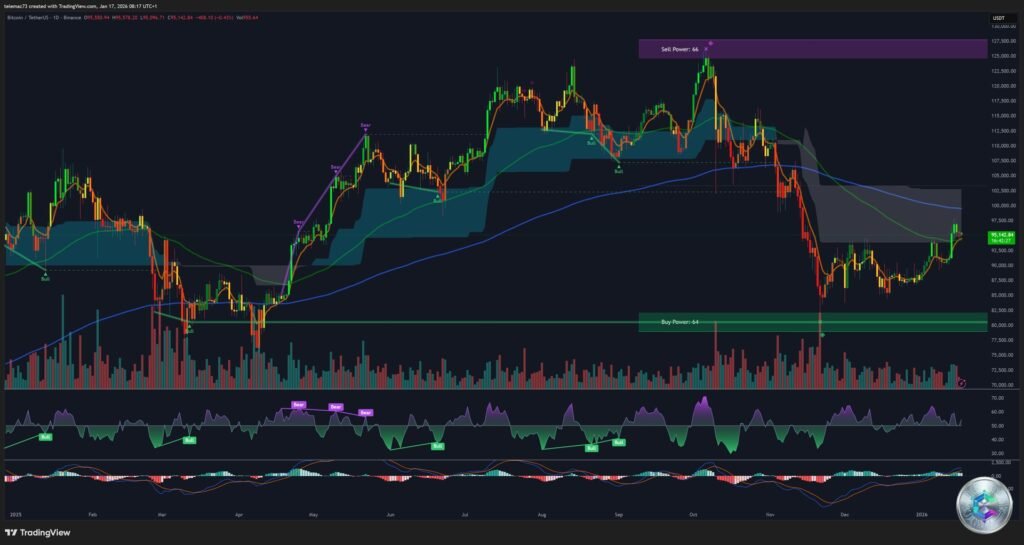
On the daily timeframe, Bitcoin presents a vast ascending triangle with clear horizontal resistance between $98,000-$100,000 and a bullish trend line connecting successive lows from $80,000 in November to recent supports around $92,000. Statistically, this pattern in a bullish trend has a 63-70% probability of upward breakout.
Price maintains above the 50-day EMA (approximately $89,735), confirming that the intermediate trend remains technically bullish. Critical zones are:
- Major Resistance: $99,000-$102,000 (sellers’ defense zone)
- Major Support: $85,000-$88,000 (zone tested multiple times successfully)
4-Hour Chart: Volatility Compression

On 4 hours, the market is trapped in a horizontal range between $94,000 (local support) and $97,500 (local resistance). The numerous wicks on both sides indicate that no camp has total control. Buyers systematically intervene below $95,000, while sellers absorb demand near $97,000.
This Bollinger Bands compression historically precedes a violent 5-10% movement. Given the bullish daily trend, statistical probability leans toward an upward breakout, but the risk of a fakeout remains high.
Microstructure and Liquidation Heatmap

Heatmap analysis reveals critical liquidity zones that could dictate upcoming movements:
Bearish Liquidity ($87,000-$89,000): A massive concentration of long position stop-losses resides in this zone. If the $94,000 support breaks, algorithms could push the price to $87,000 to sweep this liquidity in a « Long Squeeze, » allowing major players to fill massive buy orders without pushing the price up.
Bullish Liquidity (above $95,000): A dense cluster of short position liquidations accumulates up to $100,000. If price breaks through $97,500 with volume, these short sellers will be forced to buy back their positions, creating artificial buying pressure that could propel the price vertically in a « Short Squeeze. »
Sentiment and Behavioral Divergences
The Fear & Greed index dropped from 61 (Greed) to 49 (Neutral) in 24h, while the price only declined marginally. This sentiment « reset » without price crash is a hidden bullish signal – the market has digested regulatory fear.
More revealing still, on-chain data shows that small wallets (<1 BTC) are selling while "Whales" (>100 BTC) and « Sharks » (10-100 BTC) are accumulating. Historically, following Whales and betting against retail proves to be a winning strategy.
Probabilistic Scenarios
Scenario A – The Bullish « Squeeze » (55%): Additional 24-48h consolidation, then breakout above $97,500 triggering a cascade of short liquidations toward $100,000 and potentially $110,000-$114,000.
Scenario B – The Liquidity Purge (35%): Break of $94,000 support leading to a rapid drop toward $87,000-$89,000 where institutions massively absorb, marking a definitive bottom before rally.
Scenario C – Stagnation (10%): Extended range between $94-97k for several weeks, pushing traders toward altcoins.
Conclusion
Bitcoin finds itself in a bullish maturation phase, with healthy consolidation within a strong trend. Fundamentals (ETFs, corporate treasuries, disinflation) support continuation toward new all-time highs. Current volatility represents less a weakness than a transfer of hands from short-term speculators to long-term holders.
Key supports at $94,000 and especially $88,000 represent strategic intervention zones. The $100,000 resistance will likely fall through continuous erosion of supply against insatiable institutional demand.
Disclaimer: This article is provided for educational and informational purposes only. It does not constitute financial, investment, or trading advice. Cryptocurrency markets are extremely volatile and carry significant risks of capital loss. Always conduct your own research (DYOR) and consult a qualified financial advisor before making any investment decisions.

