


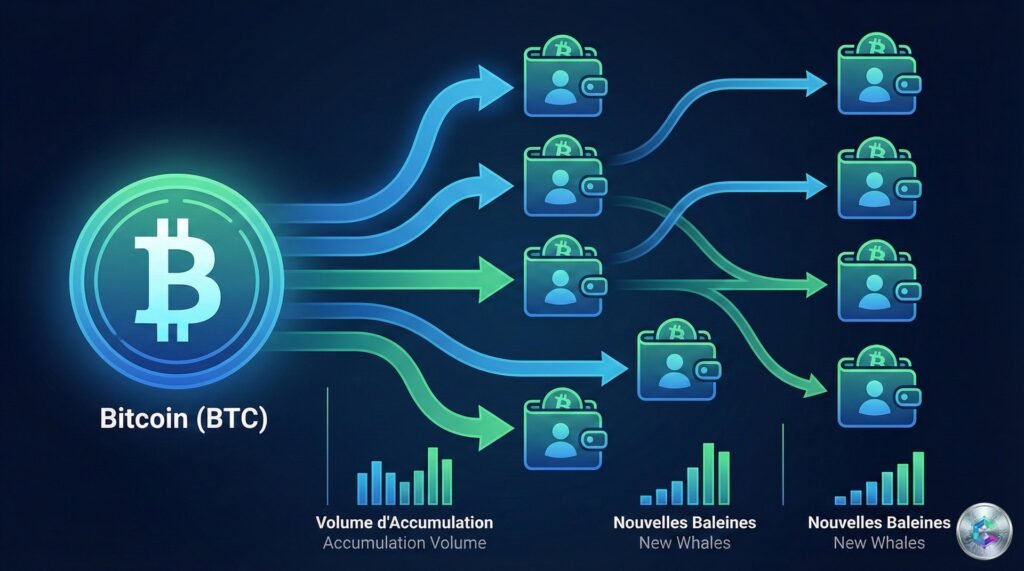
At the beginning of 2026, a bold claim spread across crypto social media: new whales are accumulating Bitcoin at an unprecedented rate. According to data shared by Cointelegraph citing CryptoQuant, over 100,000 BTC were allegedly added to whale addresses, representing more than $120 billion. This information triggered a wave of optimism among investors, suggesting an imminent new bullish phase.
But what’s the real story? An in-depth analysis of on-chain data reveals a far more nuanced, even contradictory reality. Let’s dive behind the scenes of this controversy shaking the crypto market.
The Illusion of Massive Accumulation
The euphoria surrounding this presumed accumulation is based on a superficial reading of blockchain data. Julio Moreno, CryptoQuant’s Head of Research, quickly tempered the enthusiasm by highlighting a crucial fact: the majority of movements interpreted as accumulation actually come from internal exchange consolidation.
Trading platforms regularly consolidate their Bitcoin holdings dispersed across thousands of small deposit wallets into a reduced number of large cold storage addresses. This common practice creates the illusion of massive accumulation by new whales.
« No, whales are not buying large amounts of Bitcoin. Most of the BTC whale data has been ‘influenced’ by exchanges consolidating a significant portion of their assets into fewer addresses with larger balances »
Julio Moreno, CryptoQuant
When all exchange addresses are excluded from calculations, the data reveals that whale balances are actually decreasing, rather than increasing.
The Reality of Large Holders
CryptoQuant’s adjusted data shows that addresses holding between 100 and 1,000 BTC, including ETF-linked wallets, are also experiencing a decrease in their balances. This trend corresponds to the continuous outflows observed in Bitcoin ETFs.
In November and December 2025, U.S. spot Bitcoin ETFs recorded record net outflows of $4.57 billion, marking their worst two-month period since their launch in January 2024. A concerning signal for the market.
A Signal of Hope: Long-Term Holders
Despite this seemingly negative picture, an encouraging development emerges from on-chain data: long-term holders (LTH), defined as those who hold their bitcoins for more than 155 days, have become net buyers again after an intense selling phase throughout 2025.
Over the past 30 days, these patient investors have accumulated approximately 33,000 BTC, potentially signaling the end of major selling pressure. This transition is significant because long-term holders represent the market’s « strong hands »—experienced investors who strategically accumulate during periods of uncertainty.
Glassnode data reveals that long-term holders now control a record 14.7 million BTC. Even more remarkable, the realized capitalization of new whale holders now represents nearly 50% of Bitcoin’s total realized cap, a level never reached in previous cycles.
Institutional Adoption: The True Market Driver
The year 2026 marks a fundamental transition in Bitcoin’s market structure. Traditional financial institutions—hedge funds, banks, and pension funds—now treat digital assets as a strategic asset class rather than a speculative opportunity.
This maturation manifests through several structural developments:
- Regulatory clarity: The GENIUS Act passed by the U.S. Senate in July 2025 mandates 100% stable reserves and provides a clear roadmap for institutional participation. In Europe, the MiCA regulation has created an evolving environment for cross-border compliance.
- Mature infrastructure: Bitcoin ETFs, led by BlackRock’s iShares product (IBIT) with $67.29 billion in net assets, have democratized institutional access.
Corporate Treasuries: A Double-Edged Sword
Bitcoin treasury companies, led by Strategy (formerly MicroStrategy), collectively hold over one million BTC valued at approximately $96 billion. Strategy alone holds 672,497 BTC (approximately $61.4 billion), representing 77% of its total assets.
However, Bitcoin’s price decline from approximately $126,000 in October 2025 to about $89,000-90,000 in early January 2026 has created a crisis for these companies. At least 37 of the top 100 Bitcoin treasury companies now trade below their net asset value (NAV).
Contracting Supply: A Potential Catalyst
One of the most compelling bullish signals for 2026 comes from supply dynamics. Approximately 20,000 BTC were withdrawn from centralized exchanges over the past week, with net outflows rising from about 16,563 BTC on December 19, 2025 to 38,508 BTC on January 1, 2026—a 132% increase.
Bitcoin reserves held on exchanges dropped to 2.751 million BTC at the end of December 2025, reaching levels not seen since 2018. This migration to self-custody suggests that many investors anticipate future price appreciation.
2026 Outlook: Between Hope and Caution
Forecasts for 2026 vary considerably among analysts:
- Bullish camp: Tom Lee of Fundstrat targets $200,000-250,000 by end of 2026. JPMorgan suggests a theoretical value close to $170,000.
- Cautious camp: Standard Chartered revised its forecast from $300,000 to about $150,000. Citigroup anticipates $143,000 within the next 12 months.
- Bearish camp: CryptoQuant suggests a downside risk to $70,000 in the medium term. Bloomberg Intelligence’s Mike McGlone even forecasts a potential drop to $10,000 in case of deflation.
Bitcoin is currently trading between $85,000 and $90,000, a range that will likely define the trajectory of Q1 2026. Bollinger Bands have contracted to less than $3,500—the tightest range since July—suggesting a significant price movement is imminent.
Conclusion: Real but Nuanced Accumulation
So, are new whales accumulating Bitcoin at a record pace? The answer is nuanced. The initial claims were largely exaggerated, primarily resulting from technical exchange consolidation rather than aggressive accumulation by new large investors.
However, several positive structural signals are emerging: long-term holders have become net buyers again, new institutional holders now represent nearly 50% of total realized capitalization, available supply is contracting with massive exchange withdrawals, and the post-halving context reduces new coin issuance.
The Bitcoin market enters 2026 in a state of precarious balance. The underlying structure suggests medium-term bullish potential if macroeconomic conditions improve and institutional demand resumes. For investors, the message is clear: rather than an easily identifiable « record » accumulation, the market is going through an institutional maturation phase characterized by capital rotation from weak hands to strong hands.
This dynamic, while less spectacular than simplistic narratives of massive accumulation, could prove far more significant for Bitcoin’s long-term trajectory.

