

Binance, the world’s largest cryptocurrency exchange by trading volume, faces a revealing paradox: despite its global dominance, euros account for only about 1% of its spot volume. As the MiCA deadline looms, this data raises critical questions about its actual footprint in Europe.
Key Takeaways
- Binance generates only 1% of its spot volume in euros, typically between $100 million and $250 million daily.
- Binance’s MiCA license application in Greece may be rejected by regulators, with a July 1, 2026 deadline.
- Only about 210 of over 1,200 CASPs obtained MiCA authorization on time, leading to market consolidation.
- Exchanges like Coinbase, Kraken, and Bitvavo already hold MiCA licenses and dominate euro trading.
- Total centralized exchange spot volume has fallen 66% since the late 2024 peak, reflecting a bear market.
Binance’s Euro Volume Problem
According to an analysis by CryptoQuant, euro-denominated trading pairs represent only about 1% of Binance’s total spot volume. This translates to a typical daily volume of $100 million to $250 million, with occasional spikes above $600 million. This low share contrasts sharply with the exchange’s global dominance, where it accounts for approximately 23% of all spot trading across centralized exchanges.
The macro context is marked by a significant volume decline. In April 2026, total centralized exchange spot trading volume fell to $679 billion, the lowest monthly figure since October 2023 and a decline of roughly 66% from the late 2024 peak of approximately $2.6 trillion. Bitcoin was trading around $62,000 in early June 2026, well below its cycle peak above $122,000 in October 2025.
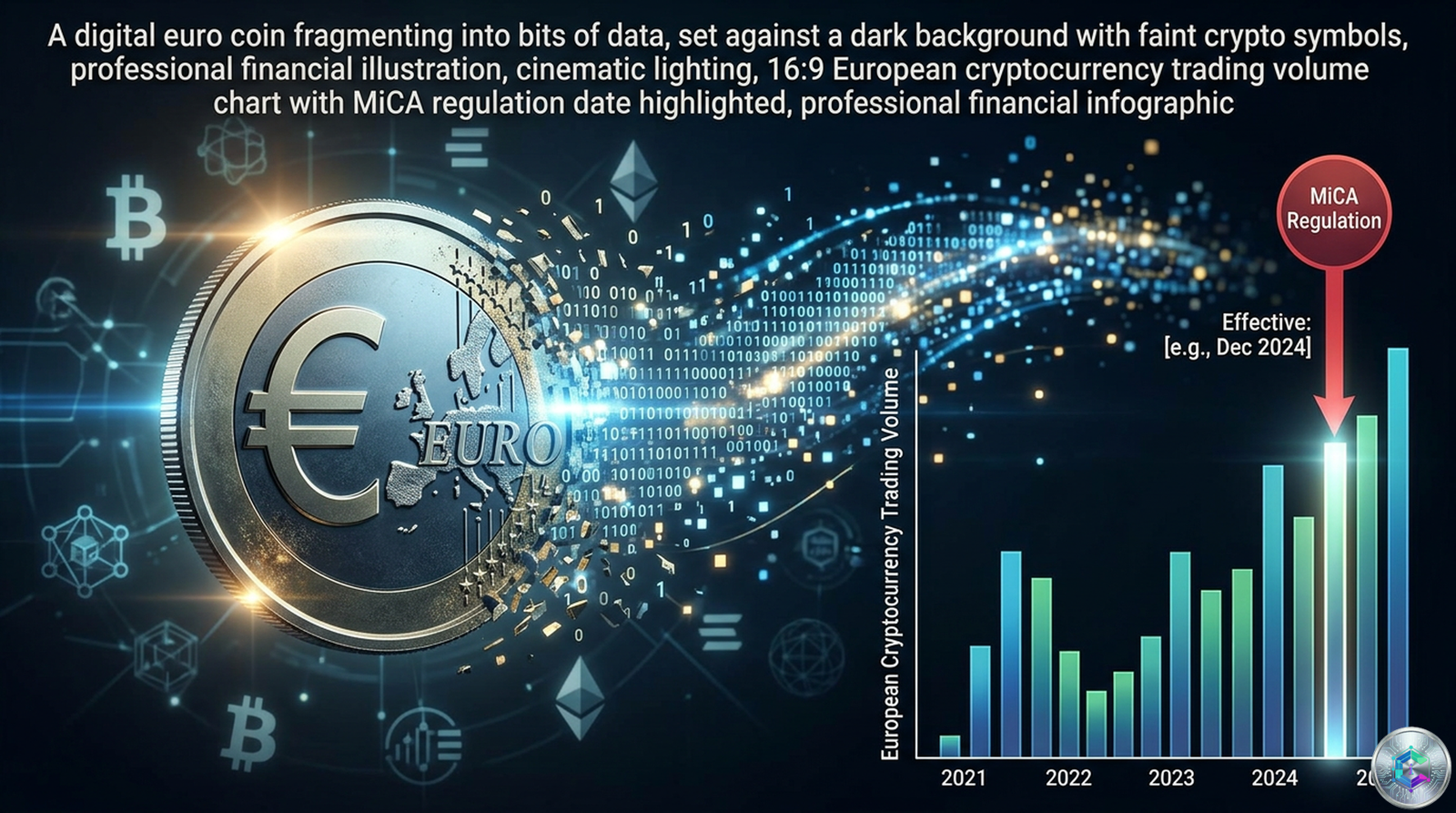
This uneven distribution is not unique to Binance. Data from Kaiko in December 2024 showed that four exchanges—Bitvavo, Kraken, Coinbase, and WhiteBIT—collectively accounted for more than 85% of all euro-denominated crypto trading volume in Europe, despite being individually smaller than Binance in global volume terms. These four exchanges have obtained MiCA licenses, unlike Binance.
Binance’s Race Against the Clock for MiCA
Binance submitted its MiCA license application to Greece’s Hellenic Capital Market Commission (HCMC) in early 2026, establishing a holding company in Athens. Co-CEO Richard Teng praised Greece’s regulatory profile. However, by mid-June 2026, Reuters reported that the HCMC was set to reject the application, citing two sources with direct knowledge.
« We entered the process of pursuing a MiCA license in Europe in good faith, submitted a comprehensive application, and worked constructively with the HCMC over many months. Our understanding is that the HCMC completed its review of the application and considered it compliant with MiCA requirements. »
Binance, in an official blog post
Binance’s ambiguous response—neither a full denial nor confirmation of approval—leaves European users in genuine uncertainty. If the rejection is confirmed, Binance would lose the ability to legally serve EU clients from July 1, 2026, absent some extraordinary last-minute development.
Regulatory Landscape and Market Consolidation
MiCA, introduced in 2023 and entering mandatory implementation in 2026, establishes a comprehensive framework for the authorization and oversight of crypto asset service providers (CASPs). The single-passport model means authorization in one member state allows operation across all 27 EU countries. However, according to figures cited by analyst Merlijn Geurds, only about 210 of over 1,200 firms had obtained full authorization by the deadline, meaning approximately 83% lacked MiCA licenses.
| Metric | Value | Source |
|---|---|---|
| Binance EUR Spot Volume | 1% of total | CryptoQuant |
| Binance Market Share (Spot) | ~23% | CryptoQuant |
| Total CEX Volume (April 2026) | $679 billion | CryptoQuant |
| Decline from Late 2024 Peak | ~66% | CryptoQuant |
| CASPs Authorized under MiCA | ~210 of 1,200+ | ESMA via Merlijn Geurds |
For European users, the implications are immediate. OKX Europe noted that approximately 41% of the 18.5 million downloads of crypto applications in Europe between May 2025 and May 2026 were for exchanges not on the list of registered MiCA providers. This could leave a significant fraction of the user base without legal access from July 1, 2026.
Implications for the Crypto Industry
Binance’s situation is a test case for the entire crypto industry’s relationship with regulated markets. MiCA represents the most ambitious attempt by any major jurisdiction to bring crypto under a formal regulatory umbrella. If consolidation proceeds without major disruption, it will validate the regulatory approach. Conversely, user harm or frozen assets could fuel critics.
The growing institutional participation, with rising average trade sizes since 2025 and traditional assets like gold and oil traded on crypto venues, favors exchanges with deep order books. Gate and Binance together account for roughly two-thirds of traditional futures volume on crypto platforms. This reinforces Binance’s global position but could be hindered by European exclusion.
Conclusion: Scenarios for July 1, 2026
Scenarios for Binance are narrowing. The most optimistic outcome is last-minute approval of its Greek application, as reported by AML Intelligence. A second path involves formal rejection followed by an appeal to ESMA or an attempt in another member state, with significant legal costs. The most likely scenario, for which regulators appear to be preparing, is rejection and an orderly withdrawal from the European market, requiring millions of users to transfer assets to licensed platforms like Coinbase or Kraken.
The concentration of euro-denominated volume in licensed operators, as documented by Kaiko, suggests that regulated exchanges are well-positioned to absorb displaced users. The key is the orderliness of this transition, given the scale of Binance’s European user base and the complexity of moving crypto assets across exchanges.
Sources
- Cointelegraph: « EUR Trading Accounts for 1% of Binance Spot Volume: CryptoQuant » (June 22, 2026)
- Electronic Payments International: « Binance’s EU MiCA Licence Bid Set for Rejection » (June 17, 2026)
- Yahoo Finance / BeInCrypto: « Crypto Spot Volume Hits 2.5-Year Low as the Market Quietly Changes Shape » (June 2026)
- Binance Blog: « An Update on Our MiCA Licensing Journey in Europe » (June 2026)
- Fortune: « Binance Applies to Greek Regulators for MiCA License » (January 22, 2026)
- TradingView: « Binance Says It Remains Fully Committed to Securing MiCA License as EU Exit Risk Looms » (June 2026)
This article is published for informational and educational purposes only. It does not constitute investment advice. Do your own research (DYOR) before making any decisions.

