

Anthropic vs Pentagon: Historic US Sanctions Against AI Company Temporarily Suspended by Federal Judge
A US federal judge has suspended sanctions imposed by the Trump administration on Anthropic, citing a likely violation of the First Amendment. A decision that could redefine the relationship between AI giants and the military-industrial complex.
A Historic Decision in San Francisco Court
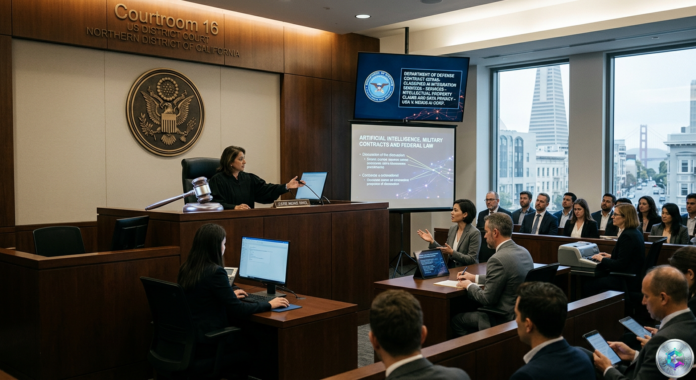
A US federal judge has temporarily suspended sanctions imposed by President Donald Trump’s administration against Anthropic, the company behind Claude, one of the world’s most advanced artificial intelligence models. Judge Rita Lin, from the Northern District of California, granted Anthropic’s request for a preliminary injunction in its lawsuit against the US government, freezing executive measures against the tech company for its ethical stance.
« We’re grateful to the court for moving swiftly, and pleased they agree Anthropic is likely to succeed on the merits, » said a company spokesperson.
The Conflict: AI and Autonomous Weapons at Heart
The dispute erupted last month after Anthropic infuriated Pentagon chief Pete Hegseth by insisting its technology should not be used for mass surveillance or fully autonomous weapons systems without human oversight. Hegseth responded on X: « Anthropic delivered a masterclass in arrogance and betrayal, and a textbook case of how not to do business with the United States Government or the Pentagon. »
This confrontation marks a significant turning point in relations between American tech companies and the military-industrial complex. For the first time, an American technology company has been designated as a national security risk not for cybersecurity reasons, but for its ethical positions on AI use.
Context: Anthropic’s Integration in Defense Contracts
Until this conflict, Anthropic maintained a deep relationship with the Pentagon that benefited both parties. The company’s Claude Gov models were integrated into Palantir’s Project Maven, which assists with data analysis, target selection, and other tasks, reportedly including in the ongoing US-Israel war against Iran.
« The Pentagon thinks Anthropic has the best product for military use so it is applying pressure on the company to continue using it, » explained Aalok Mehta, Director of the Wadhwani AI Center at the Center for Strategic and International Studies.
Tech Stakes: AI Hallucination Concerns
Anthropic’s position rests on solid technical foundations. The company has worked extensively with the Pentagon and understands current AI model limitations. Notably, models can « hallucinate » – produce false information with confidence – representing an unacceptable risk in military applications.
Mary Cummings, professor at George Mason University and Director of the Mason Autonomy and Robotics Center, researched autonomous vehicles in San Francisco, where most are deployed. She found half of all accidents were caused by « phantom braking » – vehicles incorrectly believing an object was ahead.
« We call this phantom braking and it is caused by hallucination, » she told Al Jazeera. « The incorporation of AI into weapons will face similar reliability issues including hallucinations. »
Unexpected Industry Solidarity
The conflict sparked unexpected solidarity in Silicon Valley. Over the past two weeks, tech companies, think tanks, and legal groups filed court briefs supporting Anthropic’s position.
This support includes Microsoft, employees from OpenAI and Google DeepMind, and Catholic Moral Theologians and ethicists. In their brief, engineers from OpenAI and Google DeepMind, filing personally, said the case was « of seismic importance for our industry » and regulation was crucial since AI models « hide their chain of reasoning from operators, and their internal workings are opaque even to developers. And decisions they make in lethal contexts are irreversible. »
Constitutional Dimension: Free Speech at Stake
The most remarkable aspect may be the constitutional implications. At an earlier hearing, Judge Lin said she was concerned the government was « trying to punish Anthropic for criticizing the government’s contracting position in the press, » which would violate the constitutional right to free speech.
In her ruling, she wrote the government’s designation was « likely both contrary to law and arbitrary and capricious. »
« Nothing in the governing statute supports the Orwellian notion that an American company may be branded a potential adversary and saboteur of the US for expressing disagreement with the government, » she added.
Implications for AI Regulation
This case comes at a critical moment as Congress debates limits on AI in military and surveillance applications. « For the first time, the United States is using AI to generate targets in large-scale combat operations in Iran, » as Brianna Rosen, Executive Director of the Oxford Programme for Cyber and Technology Policy, pointed out.
« And lawmakers are still debating whether to draw red lines on fully autonomous weapons. The absence of governance is itself a national security risk, » she stated.
Anthropic’s potential success could open space for stricter AI regulation, explained Robert Trager, Co-Director of Oxford University’s Oxford Martin AI Governance Initiative: « This case is a moment to reflect on what kind of relations we want between government and companies and what rights citizens have. »
Impact on AI Sector
Anthropic’s positioning as an ethical AI company seems to have won public popularity. Claude downloads increased sharply in weeks after the contract cancellation. As Alison Taylor, Clinical Associate Professor at NYU Stern School of Business, noted: « Anthropic is making a risky but good bet that positioning itself as an ethical AI company will give it a hand in shaping regulation when it happens. »
This strategy comes with significant economic costs. « The economics are very challenging for the AI industry. You need a robust public sector business with its billions of dollars in contracts, » Mehta noted.
The PAC and Election Battle
The debate has also amplified the gap between public concern and reluctance to over-regulate AI innovation. This divide has led the AI industry to emerge as a major donor in the 2026 midterm elections.
Leading The Future, a super PAC receiving over $100 million from OpenAI President Greg Brockman, Palantir co-founder Joe Lonsdale, and others, funded advertisements against Alex Bores, a New York assembly member running for Congress. Bores sponsored the RAISE Act requiring AI developers to disclose safety protocols or accidents.
In February, Anthropic announced a $20 million donation to Public First Action, a PAC supporting candidates in favor of AI regulation, including Bores.
What the Future Holds
Last week’s decision suspends sanctions for seven days to allow the government to file an emergency appeal. If Judge Lin’s decision is upheld, it could create a historic precedent for future relations between American tech companies and government.
For now, Anthropic can continue operating normally thanks to this preliminary injunction. « While this case was necessary to protect Anthropic, our customers, and our partners, our focus remains on working productively with the government to ensure all Americans benefit from safe, reliable AI, » the company spokesperson stated.
However, the persistent absence of clear AI governance raises fundamental questions about technology’s future. As Andrew Reddie, Associate Research Professor at UC Berkeley’s Goldman School of Public Policy, noted: « There was hope AI tools would reduce civilian casualties. But that hasn’t really happened because it depends on the data you feed. The challenge isn’t the AI-ness, but what is a legitimate target. »
Conclusion
The Anthropic vs Pentagon case represents far more than a business dispute. It’s a pivotal moment in AI regulation history in the United States. It raises fundamental questions about tech companies’ free speech rights, ethics’ role in defense contracts, and the government’s capacity to regulate rapidly evolving technology.
Whether the decision is upheld or overturned on appeal, it will have lasting implications for the AI industry, military-industrial complex, and American society as a whole. As Charlie Bullock, Senior Research Fellow at the Institute for Law and AI, summarized: « Their stated objectives are not completely backed by the Department of War. » This case may well determine what form AI regulation takes in coming years.

