


Real bond yields across major economies are flirting with multi-decade highs. As AI hyperscalers and governments flood debt markets, the real cost of capital is hardening — casting a credible shadow over equity valuations and global growth.
🔑 Key takeaways
- US 30-year real yields are approaching 3%, their highest level in 18 years.
- Alphabet, Amazon and Meta have issued roughly $220 billion in bonds since January, more than double all of 2025.
- The US Treasury paid 5.22% on a 30-year note last Thursday, the highest borrowing cost since 2001.
- The US budget deficit is set to reach 6% of GDP ($1.9 trillion), France 5%, UK 4%.
- JPMorgan has lifted its S&P 500 earnings forecasts even as real-rate pressures build.
An unprecedented wave of bond issuance
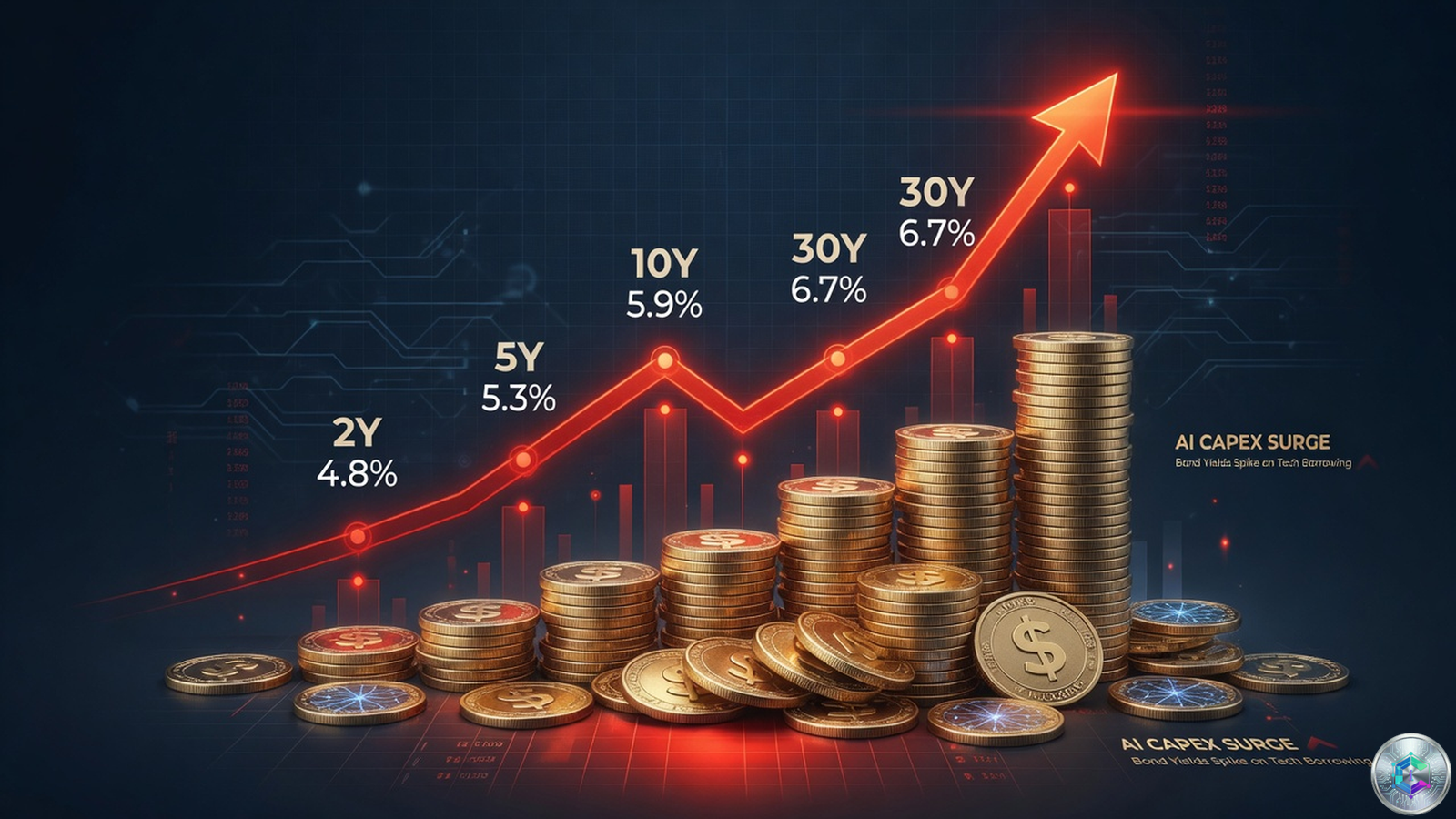
Real yields — the return bond investors demand above inflation — are a key gauge of the true borrowing cost for governments and corporations. In the US, 30-year real yields measured by TIPS (Treasury Inflation-Protected Securities) are nearing 3%, the highest in 18 years. In the UK and Germany, 10-year real yields are trading at decade-plus highs. On Thursday, the US Treasury paid 5.22% on a 30-year bond, the highest borrowing cost since 2001.
The move reflects a fierce competition for capital, fueled by the massive build-out of artificial intelligence infrastructure. “There’s a competition for capital that’s relatively unprecedented in recent times,” says Vivek Paul, chief investment strategist for the UK at the BlackRock Investment Institute. “Because of factors like the ramp-up in AI construction, this dynamic of capital scarcity is accelerating and you see it showing up in bond yields.”
AI hyperscalers at the center of the supply wave
Alphabet, Amazon and Meta have issued close to $220 billion in bonds since the start of the year, already more than double the $108 billion for all of 2025, according to LSEG data. Goldman Sachs notes that the four largest tech companies have issued more than $170 billion in corporate debt since January — exceeding the full-year 2025 tally and quadruple their pre-AI annual average.
| Indicator | Current value | Historical benchmark |
|---|---|---|
| US 30-year TIPS (real yield) | ~3% | 18-year high |
| UK 10-year Gilts (real) | Decade-plus high | — |
| German 10-year Bunds (real) | Decade-plus high | — |
| US 30-year Treasury (nominal) | 5.22% | Highest since 2001 |
| Big Four tech bond issuance (2026) | $170B+ | 4× pre-AI average |
| Alphabet / Amazon / Meta issuance (2026) | ~$220B | 2× full-year 2025 |
Max Lukianchikov of Goldman Sachs Global Banking & Markets points out that despite the historic scale of issuance, “credit spreads remain at historical tights and credit volatility sits near historical floors.” Investors are not fixated on credit risk but on yield: with Treasuries near 5.22%, corporate bonds paying only modestly more deliver an all-in yield close to 6% — extremely attractive as long as issuer solvency is not in question.
Impact on equities and growth
In theory, higher real yields should reduce the relative appeal of equities: investors can earn better inflation-adjusted returns on bonds, while the present value of future corporate cash flows looks less attractive when discounted at higher rates.
So far, stocks hitting record highs on stellar earnings and a resilient economy have managed to shrug off these concerns. JPMorgan has lifted its S&P 500 earnings forecasts, and LSEG I/B/E/S data shows European blue-chip earnings set to grow at the fastest pace since late 2022.
“We expect real yields will continue higher until they throttle the borrowing that caused them — and the risk-on rotation that has fueled the equity rally.”
Matt King, founder of Satori Insights
Matt King, founder of Satori Insights, is more cautious: mega-cap tech firms are burning through cash and will increasingly turn to credit markets — the moment they do, the real-rate rise will start to bite. Ashok Bhatia, chief investment officer at Neuberger, notes that US real yields remain below the 3-4% level at which he sees real damage to growth. “But the current level is a warning sign that growth, while solid at 1.5-2%, could start to be threatened.”
In Europe, structural drivers differ slightly: “defense spending, energy security and infrastructure investment are bigger drivers than AI spending specifically,” says Al Cattermole, senior fixed-income portfolio manager at Mirabaud Asset Management. Max Kitson, European rates strategist at Barclays, points to the relatively strong economic growth — particularly in the US — and to the fact that central banks are no longer buying bonds, a backdrop that had previously kept yields anchored lower.
What MIT research reveals about AI and the bond market
A study by Isaiah Andrews, professor of economics at MIT, and Maryam Farboodi, associate professor of finance at MIT Sloan, examined how US Treasury yields reacted to 15 major AI model launches from five leading labs — OpenAI, Anthropic, Google DeepMind, xAI and DeepSeek — between January 2023 and December 2024.
The counterintuitive finding: long-dated Treasury, TIPS and corporate bond yields fell on average after these launches and stayed lower for weeks. The Treasury yield decline after model launches exceeded 10 basis points and persisted for 15 trading days — an economically meaningful move.
“Given all the speculation about what AI can do, I thought that if we found something, maybe we’d see growth expectations go up. But finding that yields go down rather than up, I found very, very surprising.”
Isaiah Andrews, Professor of Economics at MIT
Maryam Farboodi points to the labor market: “people expect AI to disrupt the labor market.” If AI displaces workers, aggregate consumption will stagnate and inequality will widen. Bond investors are pricing in this bearish growth scenario, weighing on long-end yields despite the optimism still visible in equity markets.
Conclusion: a risk underpriced by markets
The combination of massive bond demand to fund AI, persistent public deficits and still-solid growth is pushing real yields to levels equity markets have not had to face in a long time. As long as earnings and growth remain robust, the risk can stay dormant; but the mechanics are in place for a prolonged real-rate climb to eventually weigh on equity valuations and the growth trajectory.
Two scenarios dominate the medium term: a soft landing where Big Tech moderates AI spending in response to higher capital costs — the path favored by Kitson at Barclays; or a sharper break in which capital scarcity triggers a simultaneous correction in stocks and bonds. The next inflation prints and Treasury auctions will be the real arbiters of a bond market that has entered a structurally tighter zone.
Sources
This article is for informational and educational purposes only. It does not constitute investment advice. Do your own research (DYOR) before making any decisions.

