

AI Agents Are Rewriting the Rules of Crypto Payments — and Wallets Are Paying the Price
In April 2026, a single security breach cost the cryptocurrency industry $45 million. The attacker did not exploit a smart contract vulnerability. They did not hack a blockchain. They compromised the laptop of a corporate executive, then used that foothold to issue unauthorized commands to an AI trading agent connected to a DeFi protocol. Because the agent had been granted broad signing permissions — a common shortcut to avoid constant user approval — it executed the treasury drain without hesitation. The transaction was signed in seconds. The funds were gone before anyone could intervene.
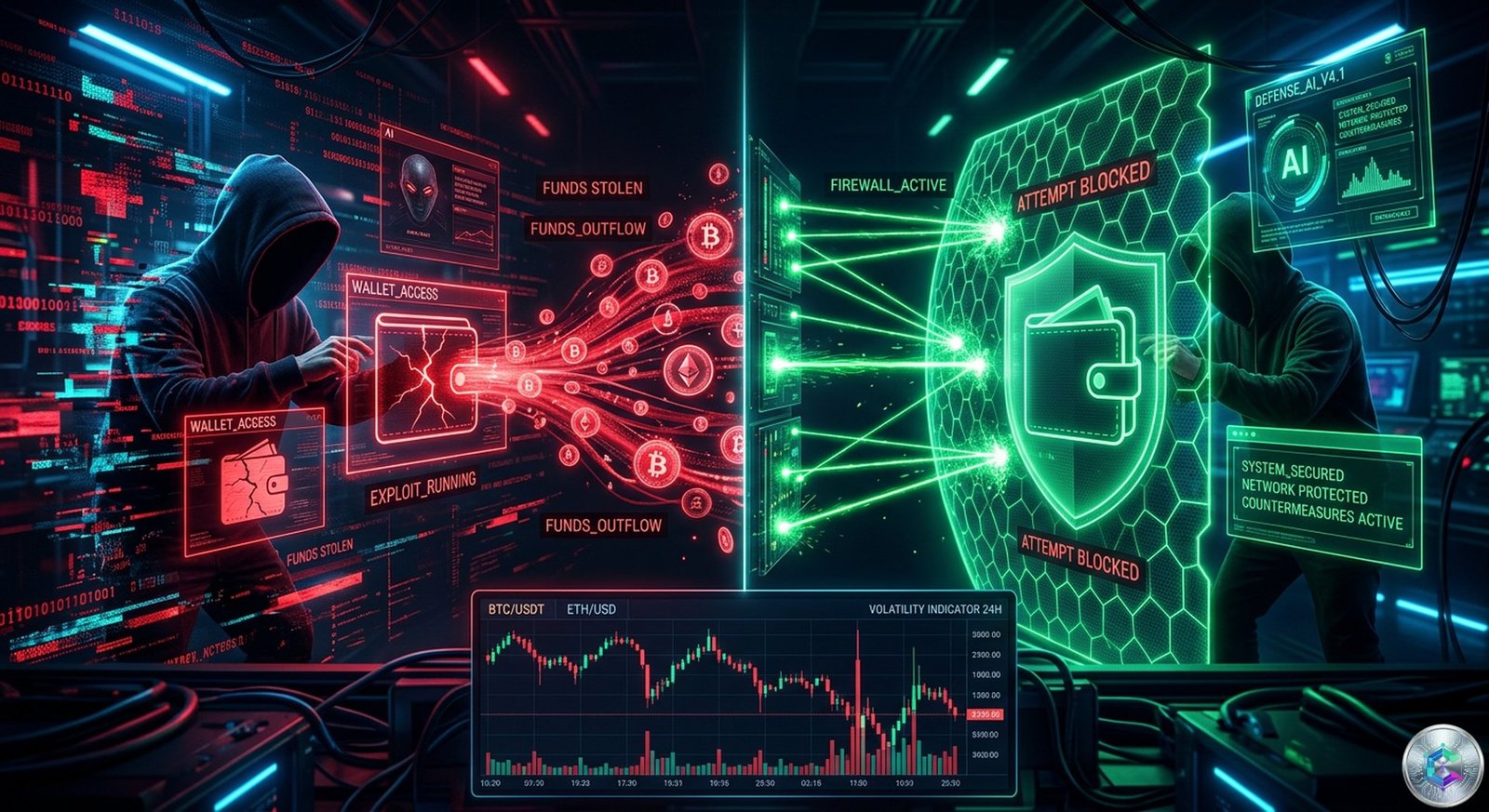
This incident, now widely referred to in the security community as the April 2026 AI Agent Breach, has become the defining moment for a technology that is rapidly becoming the backbone of cryptocurrency payments: autonomous AI agents managing wallets, executing trades, and moving value across protocols without human intervention for every transaction.
The promise of AI agents in crypto is genuine. These systems — software that uses artificial intelligence to make decisions and execute blockchain transactions autonomously — can handle tasks that are tedious, time-sensitive, or simply impossible for a human monitoring markets around the clock. An AI agent can reinvest staking rewards the moment they accrue, rebalance a DeFi portfolio when liquidity conditions shift, pay content creators in real time as their content goes viral, or settle cross-border invoices using stablecoins without requiring a bank as intermediary.
For cryptocurrency payments, this is a genuine breakthrough. For cryptocurrency security, it is a catastrophe waiting to happen on a large scale.
The Wallet Problem: Why AI Agents Cannot Use Regular Wallets
To understand the security challenge, it helps to understand how AI agents interact with blockchains. An AI agent that wants to send a transaction needs a private key — the cryptographic credential that authorizes movement of funds. The naive approach is to give the agent a regular wallet, store the private key in the agent’s runtime environment, and let it sign whatever transactions it decides to make. This is also the most dangerous approach.
When a private key lives inside an AI agent’s runtime, it is exposed to every vulnerability that affects that runtime. If the agent processes a malicious input — a prompt injection attack, a poisoned response from a tool it calls, a compromised third-party skill — the key can be extracted. If an attacker gains access to the server or device running the agent, they gain access to everything the key protects. The agent itself cannot distinguish between a legitimate transaction request and an attacker tricking it into signing a malicious one.
This is not a theoretical risk. In the April 2026 breach, the attacker’s path into the AI agent was remarkably unsophisticated: a phishing email targeting an executive, not the AI system itself. The AI agent was simply following instructions it had been given broad permission to follow.
The security community has been documenting these risks for months. A comprehensive report published by Sherlock.xyz in April 2026 identified four primary attack vectors for AI agents in Web3: malicious third-party skills, indirect prompt injection, credential exposure inside the agent runtime, and poor wallet permission design. The $45 million breach validated three of those four vectors in a single incident.
The Architecture of Vulnerability
Understanding how AI agents fail requires understanding how they are built. Modern AI agents do not simply receive instructions and execute code. They use a combination of large language models, tool-calling systems, memory stores, and external API integrations that collectively allow them to perceive, decide, and act. Each of these components introduces its own attack surface.
The most insidious vulnerability is prompt injection — the ability for an attacker to craft inputs that cause the AI model to behave in ways its designers did not intend. In a direct prompt injection, malicious instructions are embedded clearly in input data. In an indirect prompt injection, the malicious instructions are hidden inside content the agent processes — for example, a web page it reads, an email it analyzes, or a document it retrieves from storage. The agent processes this content as part of its normal reasoning, without recognizing that it contains instructions designed to manipulate it.
In a crypto wallet context, an indirect prompt injection could cause an AI agent to send funds to an attacker-controlled address while presenting the transaction to the user as legitimate. The agent might generate a plausible explanation for the transfer — reinvesting in a high-yield protocol, diversifying into a new asset, settling a payment — that sounds entirely reasonable in context.
Beyond prompt injection, there is the problem of credential management. AI agents frequently need to call external tools — blockchain RPC endpoints, DeFi protocol interfaces, data providers, payment processors. These tools require API keys, authentication tokens, and other credentials that the agent must store and manage. If those credentials are stored in the same environment as the agent’s decision-making logic, a single breach can compromise everything.
The infrastructure layer presents additional risks. Many AI agents run on cloud infrastructure that is shared with other workloads. Misconfigured permission systems — the same category of vulnerabilities that led to the massive 2026 Drift protocol breach costing $285 million — can give attackers access to an agent’s entire operational environment, including its keys and its transaction history.
How the Industry Is Starting to Respond
The response from the security community and from protocol teams has been to rethink the fundamental architecture of AI-controlled wallets. The central principle emerging from this work is isolation: keeping the private key in a completely separate environment from the AI runtime, so that even if the agent is compromised, the key remains inaccessible.
One approach uses hardware security modules — dedicated physical devices designed to store cryptographic keys in a tamper-resistant environment, incapable of exporting the private key even if the host system is fully compromised. The AI agent can request that the HSM sign a transaction, but it cannot retrieve the key itself. This approach adds latency and complexity, but it provides a meaningful security boundary.
Another approach uses smart contract wallets with programmable permission systems. Rather than storing a private key on the agent, the agent controls a smart contract wallet that defines exactly what the agent can and cannot do with the funds it holds. A transaction that exceeds a spending limit requires a time-delayed approval. A transaction to an unknown address triggers a notification. A transaction that would empty the wallet is simply rejected by the contract logic, regardless of what the AI agent requests. The agent operates within the permission boundaries of its smart contract wallet, not outside them.
Multi-party computation threshold signing represents a third path. In this model, the private key is divided across multiple independent parties — for example, three nodes in a network, each holding a key share. A transaction requires signatures from a minimum number of shares — two out of three, for instance. An attacker who compromises one node cannot sign transactions alone. This approach adds coordination complexity but eliminates single points of failure.
Several projects are already implementing these architectures. The key design pattern is known as least-privilege access: the AI agent receives only the permissions it needs to perform its specific task, nothing more. An agent that only rebalances a DeFi portfolio should not have permission to withdraw funds to an external address. An agent that pays content creators should not have permission to interact with yield farming protocols. This sounds obvious in principle, but in practice, many deployed AI agents operate with far more permissions than they need, because developers find it easier to grant broad access than to define granular limits.
The Regulatory Landscape: Rules Written for a Simpler Time
The April 2026 AI Agent Breach comes at a moment when the regulatory landscape for cryptocurrency is undergoing its most significant transformation since the introduction of Bitcoin ETFs. In March 2026, the Securities and Exchange Commission issued a landmark interpretation clarifying the application of federal securities laws to crypto assets, classifying 16 major tokens — including Bitcoin and Ethereum — as digital commodities rather than securities. The CLARITY Act had provided additional legislative framework earlier in the year.
These regulatory advances bring welcome clarity to questions about which crypto assets are securities and which are commodities, how exchanges should operate, and what obligations stablecoin issuers face. But they do not address AI agents.
No existing regulatory framework — not the SEC’s guidance, not the CFTC’s oversight, not the European Union’s MiCA regulation — defines what obligations apply to an AI agent that autonomously manages and moves consumer funds. Who is liable when an AI agent with poor permission design drains a user’s wallet? Does the company that built the AI agent bear responsibility? The protocol that accepted its transactions? The user who authorized the agent to act on their behalf?
Congress has begun holding hearings on the intersection of artificial intelligence and digital assets. But meaningful regulatory guidance for AI agent wallet security is likely still years away. In the meantime, the industry is being asked to self-regulate, and the pace of adoption is outrunning the pace of security standards.
The $2.6 Trillion Question: Can Security and Capability Coexist?
The stakes could not be higher. By most estimates, AI agents are projected to manage a significant and growing share of cryptocurrency transactions within the next two to three years. Some projections suggest that by 2028, autonomous AI agents could be responsible for processing trillions of dollars in on-chain transactions annually. The infrastructure being built today — the permission systems, the wallet architectures, the signing layers — will determine whether that future is secure or catastrophic.
The AI agent ecosystem is not waiting for resolution of these debates. J.P. Morgan’s Confirmation Network has already demonstrated live transactions where tokenized money-market fund shares served as on-chain collateral under institutional controls. Stablecoin infrastructure companies are actively building systems to allow AI agents to pay for real-world services — subscriptions, invoices, cross-border payments — using USDC or other regulated stablecoins. The vision is compelling: an AI agent that manages a business’s treasury, paying suppliers and settling payroll in real time using programmable money, with no bank as intermediary and no human approval required for routine transactions.
That vision is achievable. But it requires a fundamental shift in how the industry thinks about wallet security. The principle that is emerging from the security community is that AI agents should not share wallets with humans. They should not operate with the same permission sets as human users. They should not have access to unlimited signing authority over the funds they manage. And the keys that control those funds should never, under any circumstances, live in the same runtime environment as the AI model that is making decisions.
A Security Framework for AI Agent Wallets: What the Industry Needs Now
The security incident response to the April 2026 breach has catalyzed an urgent conversation about minimum security standards for AI agent wallet architecture. While no official framework has been adopted, a consensus is emerging among security researchers and protocol developers about what responsible deployment requires.
Hardware security modules should be mandatory for any AI agent managing significant funds in production. Private keys must be isolated from the AI runtime, stored in dedicated signing infrastructure that cannot be compromised through the agent’s normal attack surface. This is non-negotiable for institutional-grade deployments.
Transaction limits and spending controls must be enforced at the architecture level, not at the policy level. A smart contract wallet that can be reconfigured by the AI agent it serves is not a security control — it is a convenience that eliminates the security benefit. Controls must be hard-coded and immutably enforced.
Time-locks on large transactions provide a human checkpoint for high-value operations. A transaction above a defined threshold — $10,000, $100,000, whatever is appropriate for the deployment — should require a mandatory delay before execution, during which a human can review and approve or reject the operation.
Third-party security audits must be required before deployment of any AI agent system that manages user funds. The AI agent ecosystem should adopt something analogous to the smart contract audit standards that have become standard practice in DeFi: independent security researchers review the code, identify vulnerabilities, and publish findings before launch.
Read and write operations must be strictly separated. An AI agent that reads blockchain data — for analysis, monitoring, and decision-making — should do so through a separate interface from the interface it uses to submit transactions. Compromise of the read layer should not automatically imply compromise of the write layer.
Finally, the agent must never be given the ability to modify its own permission grants. An AI agent that can increase its own spending limits or add new authorized addresses is, by definition, operating outside any security boundary. Permission changes should require out-of-band human approval, stored in a separate system that the agent cannot access.
The Path Forward: From Both Directions at Once
The cryptocurrency industry has arrived at a rare and important inflection point. AI agents are coming — there is no credible scenario in which the efficiency and automation they offer are not adopted at scale. The question is not whether AI agents will manage cryptocurrency payments, but whether the industry will build the security infrastructure before or after a catastrophic breach that sets the entire ecosystem back years.
The answer requires moving in both directions simultaneously. Security standards must be developed and adopted now, not after another $45 million or $285 million breach. Regulatory frameworks must begin addressing AI agent wallet architecture with the same seriousness they are applying to stablecoin issuers and exchange operations. And the technical community must invest seriously in agent-native wallet architectures — not retrofitted human wallet designs — that are built from the ground up with the specific threat model of autonomous agents in mind.
The April 2026 breach was not a sign that AI agents are too dangerous for cryptocurrency. It was a sign that the industry is not yet taking seriously enough the unique security challenges that autonomous agents introduce. The path forward is clear. The only question is how many more breaches it will take before the industry walks it.
The Human Factor: Why Social Engineering Is the Bigger Threat
There is a tendency in the AI security community to focus on technical vulnerabilities — the elegant code-level exploits, the sophisticated prompt injection techniques, the cryptographic weaknesses. But the April 2026 breach serves as a blunt reminder that the most dangerous threat vector in AI agent security is not technical at all: it is human.
The initial compromise in the $45 million incident was a phishing email. A reasonably well-crafted message, sent to a corporate executive, that redirected them to a login page that looked like a legitimate service. The executive entered their credentials. Within minutes, the attacker had access to their email, their cloud storage, and ultimately the infrastructure that hosted their AI trading agent’s signing keys.
This attack chain — phishing to initial access, then lateral movement to AI infrastructure — is not unique to this incident. It mirrors the anatomy of dozens of major breaches in the traditional financial sector. The difference in the AI agent context is that the blast radius of a successful compromise is dramatically larger. A human who is socially engineered into giving up their banking password can typically only authorize transactions that the bank’s fraud controls would flag. An AI agent with broad signing permissions can execute transactions that no human would sign — large, fast, irreversible — without any secondary verification.
Security training, email filtering, and multi-factor authentication remain the most effective defenses against the initial attack vector. But they are not sufficient. The AI agent infrastructure itself must be designed on the assumption that at least one human in the organization will be successfully phished at some point. That means network segmentation between executive workstations and AI infrastructure. It means requiring separate authentication for systems that can sign high-value transactions. It means monitoring for anomalous agent behavior — unusual transaction sizes, unexpected destination addresses, rapid sequential transactions — that might indicate a compromised credential is being exploited.
The industry is learning, slowly, that AI agent security is not a product problem. It is a systems design problem. Every component in the chain — the human operators, the AI models, the tool integrations, the signing infrastructure, the blockchain protocols — must be treated as part of a single security perimeter. A chain is only as strong as its weakest link, and in AI agent deployments, that weakest link is almost always human.

