

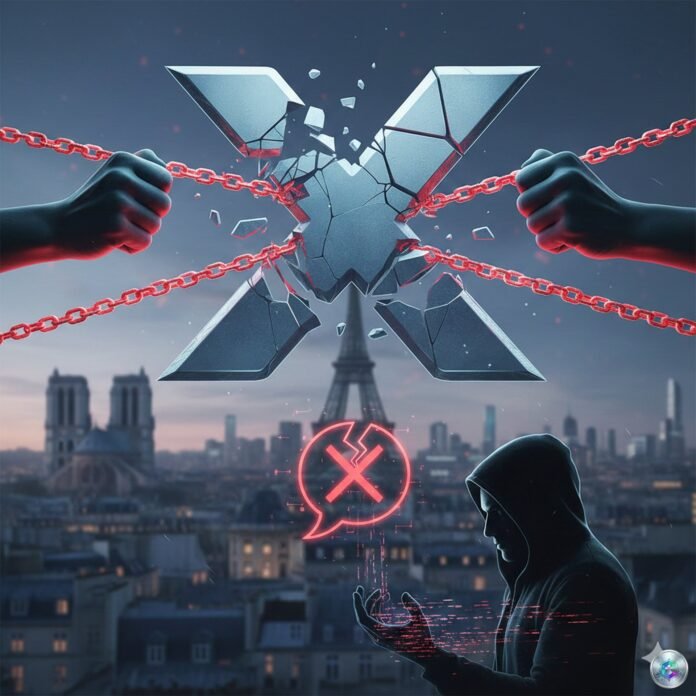
On February 3, 2026, a pivotal moment unfolded in the relationship between tech giants and French authorities. The Paris Public Prosecutor’s office conducted a major search of X’s Paris headquarters (formerly Twitter), owned by Elon Musk, as part of a cybercrime investigation. An operation that reignites the tension between digital freedom of expression and platform accountability.
A Large-Scale Raid on X’s Headquarters
Led by the Paris Public Prosecutor’s cybercrime unit, with support from the National Cyber Unit of the Gendarmerie (CyberGEND) and Europol, this raid was conducted as part of an investigation opened in January 2025. The operation aims to investigate several alleged offenses:
- Complicity in the possession and distribution of child sexual abuse material (CSAM)
- Attacks on personal representation (non-consensual sexual deepfakes)
- Denial of crimes against humanity (Holocaust denial)
- Fraudulent data extraction by organized groups
- Administration of an illegal online platform
The investigation has also expanded to the activities of Grok, the artificial intelligence developed by xAI. The platform has been accused of generating millions of non-consensual sexualized images, particularly of women and children, and publishing Holocaust denial content.
Elon Musk and Linda Yaccarino Summoned for April 2026
In a significant development, the Paris Public Prosecutor has summoned Elon Musk and Linda Yaccarino, former head of X, for questioning on April 20, 2026. These hearings will allow them to present their position on the facts and any compliance measures they are considering. X employees have also been summoned to be heard as witnesses.
Laure Beccuau, Paris Prosecutor, clarified that the investigation is based on a « constructive approach » aimed at ensuring X’s compliance with French law rather than simply imposing sanctions.
Paris Prosecutor Officially Leaves X
In a symbolically powerful decision, the Paris Public Prosecutor announced its permanent departure from X. The institution invited its followers to find it on LinkedIn and Instagram instead. A decision that remains exceptional in France within political and institutional circles, even though a few personalities such as Roland Lescure, Minister of the Economy, had already migrated to Bluesky in January 2025.
Pavel Durov Accuses France of « Persecution »
The reaction was swift. Pavel Durov, founder of Telegram, strongly criticized France on X, stating: « French police are currently raiding X’s offices in Paris. France is the only country in the world to criminally prosecute all social networks that offer a certain degree of freedom to users (Telegram, X, TikTok…). Make no mistake: this is not a free country. »
This statement comes as Durov himself faces legal proceedings in France following his arrest on August 24, 2024, at Le Bourget airport. He has been charged with twelve counts, including complicity in the distribution of child sexual abuse material and drug trafficking via Telegram. His trial is not expected to reach court for at least a year.
France Strengthens Its Digital Regulation Arsenal
While Durov’s criticism may be somewhat exaggerated, it is based on tangible reality: France has significantly strengthened its digital platform regulation measures.
The SREN Law (May 2024)
On May 21, 2024, France enacted the law « aimed at securing and regulating the digital space » (SREN), introducing unprecedented measures to restore trust in the digital sphere. This law created new offenses and aggravated existing penalties when infractions are committed via social networks, including a supplementary penalty of « social network ban. »
Banning Social Networks for Under-15s
On January 26, 2026, the National Assembly adopted by a vote of 130 to 21 a bill aimed at banning social network access to minors under 15 years old. Platforms will have to implement age verification mechanisms, under penalty of sanctions reaching up to 4% of worldwide revenue.
Investigation Against TikTok
France also opened a criminal investigation against TikTok in November 2025 for allegedly promoting content that encourages suicide. This investigation followed complaints from French families and conclusions from a parliamentary inquiry commission.
The European Context: The Digital Services Act
Beyond the national framework, digital platforms face strengthened European regulation through the Digital Services Act (DSA), which entered into force in August 2023. This regulation requires large platforms to remove all illegal content and detail their moderation practices.
On December 5, 2025, the European Commission fined X €120 million for DSA violations, marking the first fine issued under this regulation. The violations cited included the misleading distribution of the blue verification badge, a non-functional ad registry hiding sponsor identities, and refusal to grant researchers effective data access.
Is France Unique in Its Approach?
While Durov’s assertion deserves to be nuanced, France does indeed stand out for the speed and scope of its actions. Many countries have launched investigations against major platforms (United States, United Kingdom, Australia, EU), but France is unique in its determination to hold platform executives personally accountable.
A transparency report revealed that France holds the unfortunate record for removals of violent and hateful content among the 27 EU countries, with 16,288 removals between August and October 2023 — more than double Germany’s figure. Yet X employs only 52 moderators in France for nearly 11 million users.
Fundamental Issues: Freedom of Expression vs Platform Responsibility
This case illustrates the growing tension between tech giants and European regulators. Advocates for regulation argue that platforms must be held accountable for illegal content they host, particularly regarding child protection and combating terrorism.
Conversely, libertarian advocates, including Durov and Musk, believe that platforms should not be responsible for their users’ actions and that excessive moderation constitutes a form of censorship.
Telegram, under Durov’s leadership, cooperates only marginally with judicial requests and account closure demands, allowing numerous criminal groups to thrive on the platform.
Outlook: A Turning Point in Digital Regulation
With the forthcoming April 2026 hearings of Elon Musk and Linda Yaccarino, this legal battle could mark a turning point in social media regulation. The Paris prosecutor emphasized that its approach remains « constructive, » aiming to evolve potentially harmful models rather than simply collecting fines.
X now has 60 days to propose solutions to the shortcomings identified by the European Commission regarding DSA compliance. This case raises crucial questions about the future of decentralization, online freedom of expression, and the role of states in digital regulation. France’s position, though controversial, could set a precedent and influence other jurisdictions in their approach to platform regulation.

