

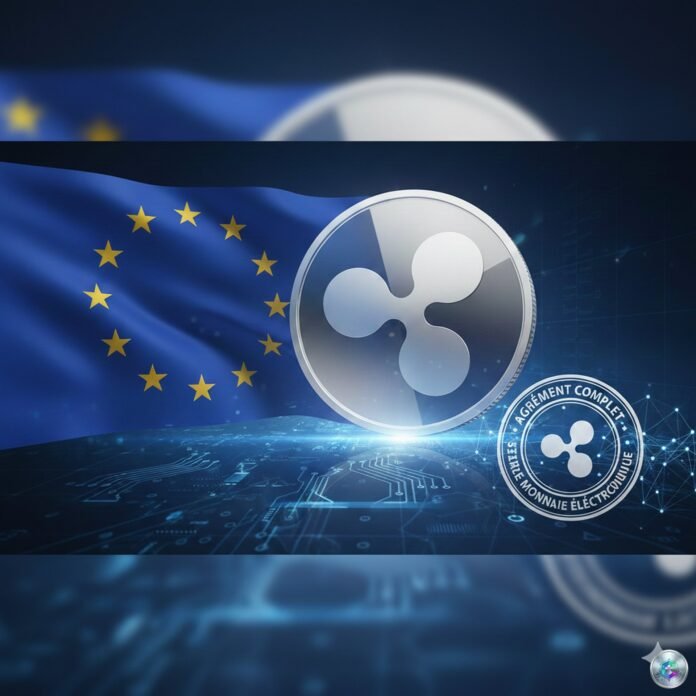

February 2, 2026, marks a turning point for Ripple in its European expansion strategy. The California-based company has officially obtained the full Electronic Money Institution (EMI) authorization from the Commission de Surveillance du Secteur Financier (CSSF) in Luxembourg, transforming access to payment services across all 27 EU member states through the regulatory « passporting » mechanism.
A regulatory passport for all of Europe
This Luxembourg EMI license grants Ripple what the industry calls a « regulatory passport »: a single authorization allowing it to operate in 30 countries across the European Economic Area (27 EU member states, plus Iceland, Norway, and Liechtenstein) without needing to obtain individual approvals in each jurisdiction.
Concretely, this license allows Ripple to:
- Issue electronic money and manage client funds in a regulated manner across Europe
- Provide cross-border payment services using stablecoins (RLUSD) and digital assets (XRP)
- Operate under the harmonized MiCA framework, offering legal certainty to financial institutions
- Deploy Ripple Payments across Europe for instant international transfers
A methodical regulatory strategy bearing fruit
This complete EMI license is not a stroke of luck but the result of a carefully orchestrated strategy. As early as July 2025, Ripple laid the groundwork by establishing its subsidiary Ripple Payments Europe SA in Luxembourg, anticipating the implementation of the European MiCA regulation (Markets in Crypto-Assets). This proactive approach contrasts sharply with competitors like Tether, which still lacks MiCA approval and faces massive withdrawals from European platforms.
Cassie Craddock, Ripple’s Managing Director for the UK and Europe, confirmed that all conditions set by the CSSF had been met: « We have satisfied the conditions established by the CSSF, which allowed Ripple to obtain its full EMI license for the EU – a transformative step that enables us to expand our mission of providing robust and compliant blockchain infrastructure to clients across the EU ».
Why Luxembourg as the European anchor point?
The choice of the Grand Duchy is no coincidence. Luxembourg has established itself as Europe’s leading fintech hub, already hosting major players like Bitstamp and attracting MiCA-compliant stablecoin issuers. Its geographic proximity to Europe’s main financial centers, stable legal framework, and the CSSF’s « progressive and sophisticated » supervisory approach weighed heavily in this decision.
Monica Long, President of Ripple, emphasized that « the EU was among the first major jurisdictions to introduce comprehensive digital asset regulation, providing the certainty financial institutions need to move blockchain from pilots to commercial scale ». This European regulatory clarity contrasts with the uncertainty that long prevailed in the United States, where Ripple fought the SEC for five years.
A regulatory arsenal of 75 worldwide licenses
The Luxembourg license adds to an impressive portfolio of over 75 regulatory approvals that Ripple now holds worldwide. This legal shield includes:
- An EMI license in the UK and crypto asset registration with the Financial Conduct Authority (FCA), approved on January 9, 2026
- Money transmission licenses in 43 US states and territories
- Authorizations in Singapore, Dubai, the Cayman Islands, and several other strategic jurisdictions
- Provisional approval from the US Office of the Comptroller of the Currency (OCC)
This methodical accumulation of regulatory permits positions Ripple as one of the most regulated crypto companies in the world, a status that becomes a key competitive advantage as banks and payment providers avoid working with unauthorized entities.
MiCA: the new European standard Ripple anticipated
MiCA, fully applicable since December 30, 2024, establishes the world’s most comprehensive regulatory framework for digital assets. It imposes strict requirements on governance, minimum capital, client fund protection, and transparency for all Crypto-Asset Service Providers (CASPs) operating in the EU.
Companies obtaining a license in one member state can « passport » their services across the bloc, eliminating the regulatory fragmentation of the pre-MiCA era. In the first quarter of 2026, 68 new crypto licenses were granted across Europe under the MiCA regime, testifying to intensified regulatory activity.
Ripple is also pursuing a full CASP (Crypto-Asset Service Provider) license to further expand its regulated services in the EU. This dual approach – EMI for payments and electronic money, CASP for crypto asset services – ensures comprehensive regulatory coverage.
Ripple Payments Europe: end-to-end infrastructure
With this license, Ripple can now deploy at scale Ripple Payments, its cross-border payment platform that manages value flow end-to-end for institutional clients. Unlike traditional systems like SWIFT that require pre-funded accounts (nostro/vostro) and take 1-3 business days to settle transactions, Ripple Payments uses blockchain technology for real-time settlement, 24/7.
The platform has already processed over 95 billion dollars in cumulative volume and covers over 90% of daily global foreign exchange markets. It integrates several key features:
- Collection: accept payments in stablecoins and fiat currency globally, with instant conversion
- Custody: provision virtual accounts and wallets for clients, holding fiat or crypto
- Exchange: convert between fiat and digital assets 24/7, accessing deep liquidity
- Payment: send global payments in minutes, executing real-time disbursements in the recipient’s preferred currency
XRP and RLUSD: technological pillars of expansion
At the heart of Ripple’s infrastructure lie two complementary digital assets: XRP, the native token of the XRP Ledger used as a bridge asset for instant liquidity, and RLUSD, the dollar-backed stablecoin launched in December 2024.
Ripple’s On-Demand Liquidity (ODL) system uses XRP as a bridge currency to facilitate instant cross-border transfers without requiring pre-funded accounts. The process is remarkably fast:
- The sender’s currency (e.g., EUR) is instantly converted to XRP
- XRP is transmitted on the XRP Ledger in 3-10 seconds
- XRP is immediately converted back to the recipient’s local currency
- Funds are delivered to the beneficiary
This approach eliminates up to 80% of costs compared to traditional SWIFT and liberates enormous amounts of capital immobilized in nostro/vostro accounts. Major institutions like Santander, SBI Remit, and Tranglo already use Ripple ODL for international transfers.
Launched in December 2024 and approved by the New York Department of Financial Services, Ripple USD (RLUSD) has crossed the billion-dollar market cap threshold in less than a year. Fully backed by US dollar deposits, US Treasury bills, and cash equivalents, RLUSD benefits from monthly attestations by independent audit firms.
Ripple is actively exploring ways to offer RLUSD in Europe under MiCA, positioning the stablecoin as a compliant alternative to players like Tether, whose USDT is progressively withdrawn from European platforms for non-compliance.
First European banking partnerships
In December 2025, before even obtaining the final Luxembourg license, Ripple took a symbolic step by partnering with AMINA Bank, a crypto bank regulated by Switzerland’s FINMA. AMINA became the first European bank to deploy the complete Ripple Payments solution, enabling its clients to execute near-instant cross-border transfers using RLUSD and other stablecoins.
Myles Harrison, Head of Product at AMINA, explained: « Native Web3 enterprises often encounter friction with traditional banking systems. With Ripple’s support, we can now significantly expand our capabilities, reducing cross-border frictions and helping our crypto-native clients maintain their competitive edge ».
Integration into European banking infrastructure via TAS Network
Beyond bilateral partnerships, Ripple integrates directly into regulated European banking infrastructure through the TAS Network Gateway. This connection allows European financial institutions to access blockchain settlement without rebuilding their existing systems.
Each transaction processed via TAS strengthens Ripple’s role in the European financial « plumbing », anchoring the company as essential infrastructure rather than just a service provider.
Competitive advantages against Circle and Tether
Ripple’s regulatory lead in Europe becomes a competitive moat difficult to bridge. Ripple holds a unique position by combining:
- Complete payment infrastructure: not just a stablecoin issuer, but an end-to-end platform
- Dual technological approach: stablecoin (RLUSD) + on-demand liquidity (XRP/ODL)
- Exhaustive regulatory coverage: EMI + CASP in progress + 75 worldwide licenses
- Established banking partnerships: direct integration into European banking rails
- Institutional experience: decades of working with traditional banks
XRP price impact: measured reaction but strengthened fundamentals
The announcement of preliminary approval in January triggered a near 4% rise in XRP’s price. However, obtaining the full license in February had a more modest price impact, suggesting that traders prioritize long-term fundamentals over short-term speculation.
Forecasts remain optimistic: Standard Chartered estimates XRP could reach 8 dollars in 2026 and 12.50 dollars by 2028, though Ripple’s CEO refuses to comment on these projections due to obvious conflicts of interest.
Brad Garlinghouse at Davos 2026: traditional finance and crypto convergence
At the World Economic Forum in Davos in January 2026, Brad Garlinghouse, Ripple’s CEO, delivered a landmark speech on the convergence between traditional finance and digital assets. He predicted that crypto markets will reach new all-time highs in 2026, emphasizing that Wall Street’s interest represents « a massive sea change » not yet fully reflected in current valuations.
Garlinghouse praised the GENIUS Act and expressed optimism about the proposed Clarity Act, a regulatory framework for cryptocurrencies. His presence at Davos testified to the institutional legitimacy Ripple has acquired after years of legal battles. The company is no longer perceived as a « crypto rebel » but as an architect of financial infrastructure.
From crypto to global financial infrastructure
With its European EMI license, 75 worldwide authorizations, and 95 billion dollars in processed volume, Ripple is undergoing a profound transformation: from a cryptocurrency company to essential financial infrastructure.
Monica Long sums up this vision: « We’re doing more than just moving money. We’re managing value flow end-to-end to unlock trillions of dormant capital and move legacy finance into a digital future ».
European expansion is just beginning. With the finalized EMI license, Ripple can now:
- Intensify banking integration across all 27 member states
- Launch RLUSD at scale in Europe, directly competing with USDC
- Extend ODL corridors with new instant payment routes
- Serve as a regulatory bridge for hesitant institutions
The July 1, 2026, deadline for the end of MiCA’s transition period will further strengthen Ripple’s advantage, with many non-compliant competitors having to cease operations or rush for last-minute authorizations.
Conclusion: a regulatory shield that changes the game
Obtaining the full EMI approval in Luxembourg represents far more than an administrative victory for Ripple. It’s the institutional validation of a decade of hard work building compliant, scalable payment infrastructure integrated with traditional financial systems.
With its « European passport », Ripple now possesses a competitive advantage difficult to overcome: the ability to operate legally across all of Europe, with approval from the world’s strictest regulators.
For European financial institutions seeking to modernize their cross-border payment systems, Ripple now offers a turnkey regulated solution, eliminating the compliance risk that previously held them back. For XRP and RLUSD, this European expansion opens access to 450 million consumers and trillions of euros in potential payment flows.
As the global crypto industry navigates between innovation and regulation, Ripple demonstrates that success is possible by embracing compliance rather than fighting it. In the post-MiCA environment of 2026, this strategy could well transform Ripple from a crypto company into an indispensable component of global financial infrastructure.

