

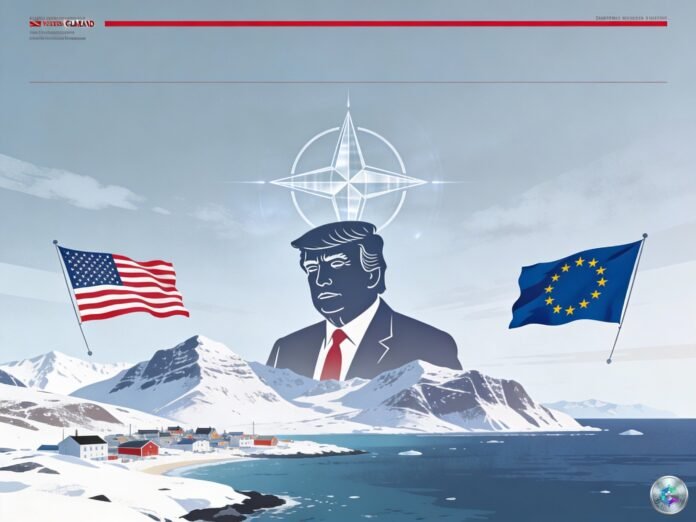
In a spectacular reversal that caught European capitals off guard, Donald Trump announced on Wednesday, January 21, 2026, that he had found « the framework for a future agreement » with NATO regarding Greenland, while suspending the tariff threats that had been looming over eight European countries. This about-face marks a turning point in a diplomatic crisis that threatened transatlantic unity.
An Unexpected Diplomatic Turnaround
After weeks of increasingly aggressive statements about acquiring Greenland, including through military force, Trump radically changed his tone at the World Economic Forum in Davos. Following a meeting with NATO Secretary General Mark Rutte, the US president declared on Truth Social that he had established a framework agreement that would benefit « the United States and all NATO nations. »
This announcement comes with the immediate suspension of the 10% tariffs that were set to hit France, Germany, the United Kingdom, Denmark, Norway, Sweden, the Netherlands, and Finland starting February 1st. These tariffs were even supposed to reach 25% by June 1st if no agreement was reached on the « complete and full sale of Greenland. »
An Agreement with Unclear Contours
Despite Trump’s triumphant announcement claiming the agreement gives the United States « everything we wanted, » concrete details remain surprisingly absent. NATO Secretary General Mark Rutte even specified that the issue of Greenland’s sovereignty was not discussed during his conversation with Trump.
The outlined proposals mainly concern strengthening American military presence in the Arctic and increased cooperation on strategic raw materials. Trump also mentioned the mysterious « Golden Dome » project, an antimissile defense system that would involve European allies in mining and Arctic security matters.
Denmark’s Red Line Remains Uncrossable
Copenhagen has unequivocally reaffirmed that sovereignty over Greenland is « not negotiable » and that the island « is not for sale. » However, the Danish government remains open to discussions on Arctic security, particularly in response to the increased presence of Russia and China in the region.
Danish Foreign Minister Lars Lokke Rasmussen described as « positive » the fact that Trump is renouncing the use of force, while emphasizing that American ambition for the territory « remains intact. »
A Wary Europe Despite the Calm
In European capitals, this sudden reversal raises as many questions as it provides relief. The European Union was preparing to organize an emergency summit in Brussels to coordinate countermeasures, ranging from retaliatory tariffs to freezing certain commercial files.
According to Camille Grand, former NATO Deputy Secretary General and researcher at the European Council on Foreign Relations, « Trump clearly yielded to the awakening of Europeans » who « did not back down in the face of threats. » However, he warns that « distrust has set in » and that « no one in Europe believes this administration will return to NATO as we knew it. »
Markets Welcome the De-escalation
The reaction from financial markets was immediate and positive. The announcement of the suspension of tariffs triggered a rise in major stock indices, reflecting investor relief at the apparent easing of transatlantic trade tensions.
A Test for the Transatlantic Relationship
This Greenland crisis reveals the newfound fragility of the transatlantic relationship. The brutal alternation between military escalation, tariff blackmail, and sudden appeasement demonstrates an unpredictability that profoundly destabilizes European allies.
For the EU, the challenge now goes beyond managing a one-off crisis. It’s about building a long-term strategy facing an essential but volatile ally, by strengthening European strategic autonomy, including in the Arctic.
The next European summit could thus focus less on responding to Trump’s latest announcement than on preparing for the « next shocks, » whether they concern Greenland, NATO, or global trade. The question remains whether this framework agreement will mark a real turning point or simply a tactical pause in American ambitions for the Arctic territory.

