

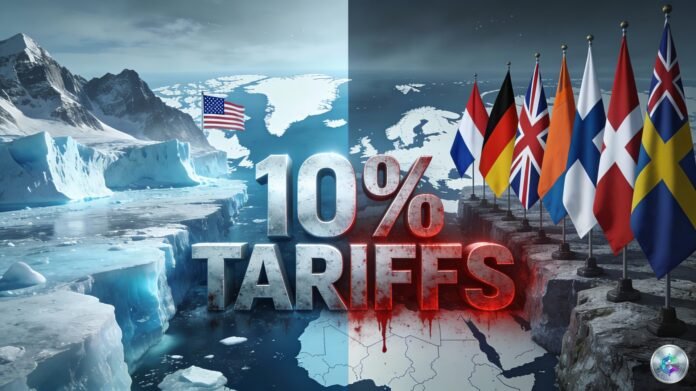
In an unprecedented escalation, US President Donald Trump announced on Saturday, January 17, 2026, the imposition of 10% tariffs on eight European countries, including France, threatening to increase these taxes to 25% if no agreement is reached regarding « the complete and total acquisition of Greenland ». This commercial offensive against NATO allies marks a historic turning point in transatlantic relations.
An Unprecedented Trade Threat Against NATO Allies
In a series of messages published on his Truth Social network, Donald Trump declared that Denmark, Norway, Sweden, France, Germany, the United Kingdom, the Netherlands, and Finland will face a 10% surcharge on all goods sent to the United States starting February 1, 2026. This tax will increase to 25% on June 1 and will remain in effect « until an agreement is reached for the complete and full sale of Greenland ».
Trump justifies these measures by claiming that these countries are « playing a very dangerous game » by having sent military personnel to Greenland in recent days. This announcement comes less than 48 hours after the launch of the European military mission « Arctic Endurance » in Greenland, organized at Denmark’s request.
Greenland: A Major Strategic and Economic Stake
Greenland occupies a crucial geostrategic position between North America, Europe, and the Arctic. This 2.2 million square kilometer island houses the Pituffik Space Base (formerly Thule), installed by the United States since 1951 within the NATO framework. This base hosts a NORAD and US Space Force early warning radar, a key element of the American anti-missile detection system.
Greenland’s subsoil contains immense mineral resources that are fueling international rivalry. According to the Geological Survey of Denmark and Greenland (GEUS), the island possesses 36.1 million tons of rare earths, metals essential for cutting-edge technologies. Exploitable reserves are estimated at 1.5 million tons, making Greenland the world’s eighth-largest rare earth reserve. The island also contains 6 million tons of graphite, 235,000 tons of lithium, and hydrocarbon resources estimated at 28.43 billion barrels of oil equivalent.
Europe Responds with Firmness
Faced with this escalation, European leaders quickly displayed their unity. French President Emmanuel Macron responded firmly: « No intimidation or threat can influence us. » He specified that he would request « the activation of the anti-coercion instrument » of the EU if Trump’s threats materialize.
The European Union has warned against « a dangerous spiral ». Ursula von der Leyen, President of the European Commission, and Antonio Costa, President of the European Council, issued a joint statement: « Tariffs would compromise transatlantic relations and represent a risk of a dangerous downward spiral. »
The Anti-Coercion Instrument: The EU’s « Commercial Bazooka »
The Anti-Coercion Instrument (ACI), adopted in November 2023, is a regulation designed to protect the EU against economic coercion by third countries. This tool, never used before, allows the Union to adopt targeted countermeasures: tariffs, trade restrictions, freezing access to European public markets, or blocking investments.
The strategic advantage of this instrument lies in its decision-making process: it only requires a qualified majority of member states, thus eliminating veto power. An emergency meeting of European Union ambassadors was held on Sunday, January 18 in Brussels to coordinate the European response.
Economic Impact on France
The new 10% tariffs, which would be added to the 15% already in effect since the July 2025 agreement, would bring the total rate to 25% for most French products exported to the United States.
In 2024, France exported 48.6 billion euros worth of goods to the United States. The most affected sectors would be aeronautics (9.1 billion euros), beverages (4.1 billion euros, mainly cognacs, wines and champagnes), pharmaceutical products (3.8 billion euros), as well as perfumes, cosmetics and luxury goods.
According to the French Treasury Department, the impact on French GDP is estimated at -0.1% in 2025 and -0.4% in 2026, while Germany would suffer a loss of -0.8% in 2026.
A Greenlandic Population Massively Opposed
On January 17, several thousand demonstrators gathered in Nuuk, Greenland’s capital, as well as in Copenhagen, to denounce Donald Trump’s territorial ambitions. In Copenhagen, organizers counted 15,000 participants.
Greenlandic Prime Minister Jens-Frederik Nielsen led the procession in Nuuk, chanting with the crowd: « Greenland is not for sale. » According to a poll conducted in January 2025, 85% of Greenlanders oppose attachment to the United States, while only 6% are in favor.
An Existential Crisis for NATO
Danish Prime Minister Mette Frederiksen warned that a US attack on Greenland « would mean the end of NATO ». Denmark and Greenland are NATO members, which raises the question of applying Article 5 of the Atlantic Alliance treaty – the principle of collective defense stating that an attack on one member is considered an attack on all.
This unprecedented crisis illustrates a profound reshaping of transatlantic relations. The use of coercive economic measures against NATO member countries to obtain territorial concessions represents a radical break with post-war diplomatic norms. The coming weeks will be decisive in determining whether Trump will actually carry out his threats on February 1, and whether the European Union will be able to maintain its unity in the face of this unprecedented American pressure.

