

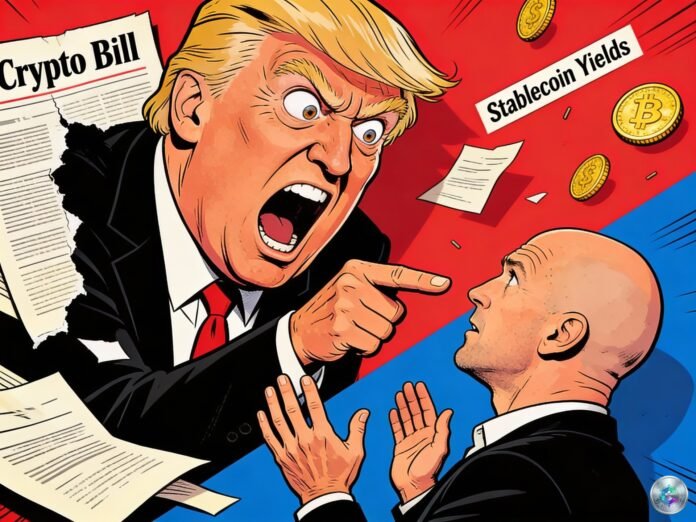
The American crypto sector is experiencing an unprecedented political crisis that could jeopardize the first major federal legislation on digital assets. At the heart of this storm: a direct confrontation between Coinbase, the exchange giant, and the Trump administration, with billions of dollars at stake.
The CLARITY Act: A Historic Bill at a Standstill
The Digital Asset Market Clarity Act of 2025, commonly known as the CLARITY Act, represented until now the most concrete hope for the American crypto industry to finally obtain a clear regulatory framework. After months of meticulous bipartisan negotiations, this ambitious text aimed to definitively clarify the respective powers of the SEC and CFTC in regulating digital assets.
The Senate Banking Committee was scheduled to review the bill on January 15, 2026. But everything changed last Wednesday when Coinbase announced its withdrawal of support, causing the immediate cancellation of the markup session and triggering a major political crisis that now paralyzes the entire legislative process.
Coinbase’s Grievances: Why the Giant Says « No »
Brian Armstrong, Coinbase CEO, justified this radical decision by identifying several critical problems in the current text that would directly threaten the platform’s activities and revenues:
- De facto ban on tokenized stocks that would compromise the planned launch of Coinbase Tokenize
- Excessive DeFi restrictions granting the government unlimited access to users’ financial records
- Erosion of CFTC authority in favor of an SEC historically hostile to crypto innovation
- Elimination of stablecoin rewards, allowing traditional banks to eliminate emerging competition
The $1.3 Billion Issue: The Battle Over Stablecoins
The heart of the conflict lies in a colossal financial stake: revenues generated by stablecoin rewards. Coinbase generated $1.3 billion in USDC-related revenue in 2025, primarily through its rewards program offering up to 3.5% annual yield to holders.
These substantial revenues come from interest generated by the dollar reserves backing Circle’s stablecoin, shared with platform users. An economic model that traditional banks consider an existential threat.
The White House Counteroffensive
According to sources close to the administration cited by journalist Eleanor Terrett, the White House is seriously considering completely withdrawing its support for the CLARITY Act if Coinbase does not return to the negotiating table with an acceptable position on stablecoin yields.
The Trump administration views Coinbase’s move as a unilateral « rug pull » made without notice or prior communication, betraying not only the White House but the entire American crypto ecosystem. A presidential advisor unambiguously reminded that the CLARITY Act is President Trump’s initiative, not Brian Armstrong’s.
This spectacular reversal sharply contrasts with the optimistic statements of David Sacks, the White House crypto advisor, who claimed in December that adoption of this historic legislation was « closer than ever. »
The Banking Lobby in Ambush
Behind this crisis looms the powerful American Bankers Association (ABA), which is waging a relentless war against crypto rewards programs. Banks, particularly small community institutions, are warning of a catastrophic scenario: a « deposit flight » that could reach $6.6 trillion if customers massively favor crypto yields over traditional savings accounts.
Brian Moynihan, CEO of Bank of America, issued a resounding warning this week: up to $6 trillion in deposits could migrate to stablecoins if rewards remain authorized.
The GENIUS Act, adopted in July 2025, already prohibits stablecoin issuers from directly offering interest. However, it allows third-party platforms like Coinbase to distribute rewards. Banks are now demanding a much broader restriction, limiting these rewards to regulated financial institutions with an OCC banking license.
A Divided Industry
Unlike Coinbase, other major players maintain their support for the bill. Ripple and its CEO Brad Garlinghouse called the CLARITY Act a « giant step toward workable frameworks for crypto. » Consensys, however, joined Coinbase, arguing that the text needed substantial improvements to preserve American competitiveness.
Senator Cynthia Lummis (R-WY), one of the bill’s main architects, declared herself « deeply disappointed » by Coinbase’s withdrawal. Her scathing reaction illustrates growing exasperation: « this proves that crypto operators are not ready for the regulatory clarity they’ve been demanding for years. »
Outlook: Is Compromise Still Possible?
Tim Scott, chairman of the Senate Banking Committee, maintains an optimistic stance, assuring that « everyone remains at the table, working in good faith » to achieve clear rules that protect consumers while strengthening national security.
However, analyst Jaret Seiberg of TD Cowen expresses serious doubts about the possibility of improving the text to satisfy Coinbase while preserving the bipartisan support essential to avoid a paralyzing filibuster.
Time is dangerously short: a possible federal government shutdown could occur at the end of January, and the 2026 midterm elections risk significantly weakening Republicans’ ability to pass this crucial legislation.
Billions at Stake
For investors and the entire ecosystem, the stakes go far beyond the Coinbase case. If the exchange loses this regulatory showdown, it could see nearly $1 billion in recurring annual revenue disappear. But if the White House actually abandons the CLARITY Act, the entire American crypto industry could remain paralyzed by regulatory uncertainty for additional years.
This crisis reveals deep tensions between financial innovation and the traditional banking system, between decentralization and regulation, between entrepreneurial ambitions and political imperatives. The outcome of this conflict will lastingly shape the future of digital finance in the United States and, by extension, worldwide.

