

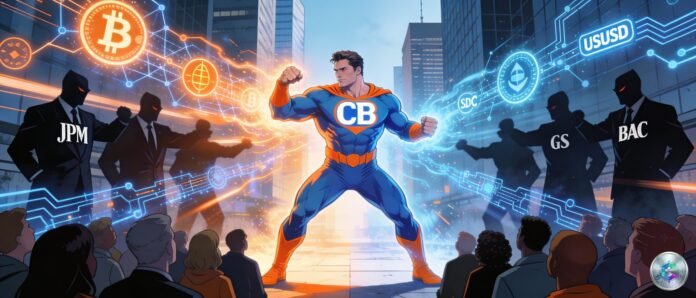
Coinbase CEO Brian Armstrong has withdrawn his support for the U.S. CLARITY Act bill, denouncing traditional banks’ attempts to use regulation to stifle stablecoin competition. This confrontation illustrates an unprecedented lobbying war between the banking sector and the crypto industry, with stakes running into trillions of dollars.
A Stunning Withdrawal That Paralyzes Congress
On January 14, 2026, Brian Armstrong caused a political earthquake by announcing that Coinbase, the largest U.S. crypto exchange, could no longer support the Senate version of the CLARITY Act (Digital Asset Market Clarity Act). This decision, announced less than 24 hours before the Senate Banking Committee’s scheduled vote, forced lawmakers to postpone the session, leaving one of the sector’s most anticipated legislations in limbo.
« There are too many problems, » Armstrong stated in a release posted on X. « We’d rather have no bill than a bad bill. » This radical position from a company that has invested more than $50 million in pro-crypto political action committees underscores the severity of the concerns raised.
Senator Tim Scott, chairman of the Banking Committee, confirmed the postponement, indicating that all parties remained « at the table » to negotiate in good faith. The Senate Agriculture Committee, which oversees the Commodity Futures Trading Commission (CFTC), also pushed back its own vote until late January.
The Central Accusation: Regulatory Capture by Banks
At the heart of the controversy lies a direct and incendiary accusation. During an interview with CNBC from Capitol Hill, Armstrong didn’t mince words: « The fundamental principle is that banks shouldn’t be allowed to eliminate their competition at the expense of American consumers. »
Armstrong explicitly accuses the banking sector of practicing « regulatory capture » – a process by which an established industry uses its political influence to shape regulations that eliminate emerging competition rather than compete on a level playing field. « It seems deeply unfair to me that an industry [banks] can step in and get regulatory capture to ban their competition, » he told Fox Business.
The Battlefield: Stablecoin Rewards
This accusation doesn’t come from nowhere. It’s part of a fierce lobbying battle that has been opposing banking giants to crypto companies for months, with stablecoin « rewards » paid to holders as the main stake.
Stablecoins, these cryptocurrencies pegged to the U.S. dollar like Circle’s USDC, have become a major financial product. Coinbase currently offers up to 3.85% annual yield to users who simply hold USDC on its platform. By comparison, the average interest rate on U.S. bank savings accounts is around 0.14% according to Armstrong, more than 27 times less.
This differential is not trivial. It represents an existential threat to the traditional banking model. U.S. banks currently hold $19.7 trillion in deposits and make $13.2 trillion in loans. Every dollar that migrates to stablecoins is a dollar that no longer finances the mortgages, agricultural loans, or small business loans that form the core of the banking system.
Coinbase’s Economic Weapon
The numbers speak for themselves: Coinbase held $9 billion in USDC on its platform in the third quarter of 2025, a 90% increase from the previous year, largely thanks to its rewards program. Stablecoin-related revenues generated $355 million for Coinbase in the same quarter.
Banking Response: An Unprecedented Coalition
Facing this threat, the banking sector has deployed heavy artillery. An unprecedented coalition of eight national trade associations – including the American Bankers Association (ABA), America’s Credit Unions, and the Independent Community Bankers of America (ICBA) – published a joint letter to the Senate in January 2026.
Even more impressive: 3,200 individual bankers signed a petition urging Congress to close what they call the stablecoin rewards « loophole. » Their argument is compelling: « Every deposit represents a home loan, a small business loan, or an agricultural loan. Simply put, policies that undermine bank and credit union deposits destroy local lending. »
The banking sector brandishes a U.S. Treasury Department estimate that up to $6.6 trillion in deposits could be « at risk » of migrating to stablecoins if they can offer returns. Susan Sullivan, senior vice president of ICBA, summarizes: « Bankers fear that an interest-bearing stablecoin could disintermediate deposits and erode their balance sheets. »
The Controversial Text: Four Breaking Points
The Senate Banking Committee’s bill, unveiled on January 13, 2026, contains several provisions that Coinbase deems « catastrophic. » Armstrong identified four major problems in the 278-page document:
1. Ban on Stablecoin Rewards
The text would explicitly prohibit « digital asset service providers » from paying « any form of interest or yield (whether in cash, tokens or other consideration) solely in connection with holding a payment stablecoin. »
However, in a compromise proposed by Democratic Senator Angela Alsobrooks, the bill would allow « activity-based » rewards, including for liquidity provision, protocol participation, transactions, or even joining a loyalty program. The problem? This wording is so broad that it could potentially encompass almost all existing activities – or so restrictive that it would completely eliminate current programs, depending on regulatory interpretation.
2. De Facto Ban on Tokenized Stocks
The bill would include restrictions that would make trading traditional stocks on blockchain « almost impossible. » This provision directly targets tokenization efforts of traditional financial assets, an area in which companies like Coinbase have heavily invested.
3. DeFi Restrictions and Financial Surveillance
The text would expand the application of the Bank Secrecy Act to decentralized finance (DeFi) protocols, granting the government « unlimited access to financial records » and eliminating the right to financial privacy, according to Armstrong. This provision was described by Alex Thorn, head of research at Galaxy, as « the most significant expansion of government financial surveillance powers since the Patriot Act of 2001. »
4. Erosion of CFTC Authority in Favor of SEC
Armstrong denounces a weakening of the CFTC’s role, which would become « subordinate to the SEC. » The crypto industry generally prefers CFTC supervision, perceived as more innovation-friendly, to that of the SEC, which has pursued aggressive enforcement actions under Gary Gensler’s leadership.
Hidden Stakes: The Circle-Coinbase Agreement
To understand why Armstrong is reacting so vigorously, one must examine the underlying economic structure linking Coinbase to Circle’s USDC stablecoin. An examination of documents filed by Circle for its IPO reveals an extraordinarily lucrative financial arrangement for Coinbase.
According to this agreement, Coinbase receives:
- 100% of interest revenues generated by USDC held on its platform
- 50% of interest revenues generated by all USDC held outside Circle and Coinbase platforms (on other exchanges, in DeFi protocols, etc.)
The result is stunning: in 2024, Circle paid $907.9 million to Coinbase in « distribution fees, » representing more than 56% of Circle’s total revenue – even though Coinbase holds only about 22% of circulating USDC. This structure creates a powerful economic incentive for Coinbase to maximize USDC holdings on its platform, hence the 3.85% rewards program.
This is precisely the « loophole » that banks now want to close via the CLARITY Act. If this closure succeeds, Coinbase could lose nearly a billion dollars in annual revenue – or at least see this economic model seriously compromised.
A Divided Industry
Coinbase’s opposition to the bill is not universally shared in the crypto industry, creating unusual cracks among major players.
Brad Garlinghouse, CEO of Ripple – who himself invested nearly $50 million in crypto political lobbying – called the CLARITY Act « a massive step forward for providing viable frameworks for crypto while continuing to protect consumers. » « I’m surprised at how vehemently they [Coinbase] came out saying ‘we can’t support this,' » he said.
Miles Jennings, policy lead for Andreessen Horowitz’s (a16z) crypto division, was even more direct: « It’s not perfect. But the legislation gives builders the power to create an open and decentralized future… Nothing like that exists today and we need to seize this opportunity. Freedoms are not easily won, but they are easily lost. »
The Lobbying Machine in Action
This legislative confrontation is also a story of unprecedented money and political influence. The crypto industry collectively spent approximately $119 million in political contributions for the 2024 electoral cycle, making it the largest corporate contributor of the year – representing 48% of all corporate donations.
Coinbase alone contributed more than $50 million, primarily channeled to Fairshake PAC, a bipartisan super PAC dedicated to supporting pro-crypto candidates. CEO Brian Armstrong also personally donated $1 million.
This strategy proved remarkably effective: of 42 primary races financially supported by crypto PACs, industry-backed candidates won 36 victories.
White House Role: David Sacks Steps In
The Donald Trump White House is playing an active role in this matter through David Sacks, appointed « Crypto and AI Czar » in December 2024.
After the vote postponement, Sacks tweeted: « The passage of market structure legislation remains closer than ever. Now is the time to establish the rules of the road and secure the future of this industry. » He urges the industry to « resolve remaining differences. »
This White House involvement underscores the strategic importance the Trump administration places on establishing the U.S. as the « global crypto capital, » a central campaign promise.
Conclusion: A Turning Point for the Future of Finance
The confrontation between Brian Armstrong and the traditional banking sector transcends a simple dispute over interest rates. It raises fundamental questions about the future of the financial system:
- Who should control digital monetary infrastructure – traditional banks or crypto-native tech companies?
- How to balance innovation and financial stability in a world where capital can move instantly on a global scale?
- Can the fractional reserve banking model coexist with fully-backed stablecoins without losing its ability to create credit?
As Armstrong stated: « We will continue to advocate for the rights of our customers and the 52 million Americans who engage with crypto daily. » For their part, banks claim to defend financial stability and community lending that « fuels the American economy. »
In the coming weeks, Congressional negotiations will determine whether this coexistence will occur in a spirit of fair competition or if, as Armstrong fears, regulatory capture will allow established players to stifle emerging innovation. The outcome of this debate will shape not only the U.S. crypto industry but the entire global financial ecosystem for decades to come.

