

January 11, 2026, will be etched in stablecoin history. Tether, the issuer of the world’s leading stablecoin, executed one of the largest fund freeze operations ever conducted, immobilizing $182 million USDT across five wallets on the Tron blockchain. This major action, orchestrated in coordination with US authorities, reignites the debate on cryptocurrency centralization and questions the delicate balance between decentralized innovation and regulatory compliance.
An Unprecedented Freeze Operation
Blockchain data doesn’t lie: this coordinated intervention represents the second-largest freeze ever executed by Tether, just behind the $228 million USDT blocked in August 2025. Five distinct addresses on the Tron network were simultaneously targeted, each holding between $12 and $50 million USDT. The frozen tokens remain visible on the blockchain but are now completely unusable – impossible to transfer, exchange, or redeem.
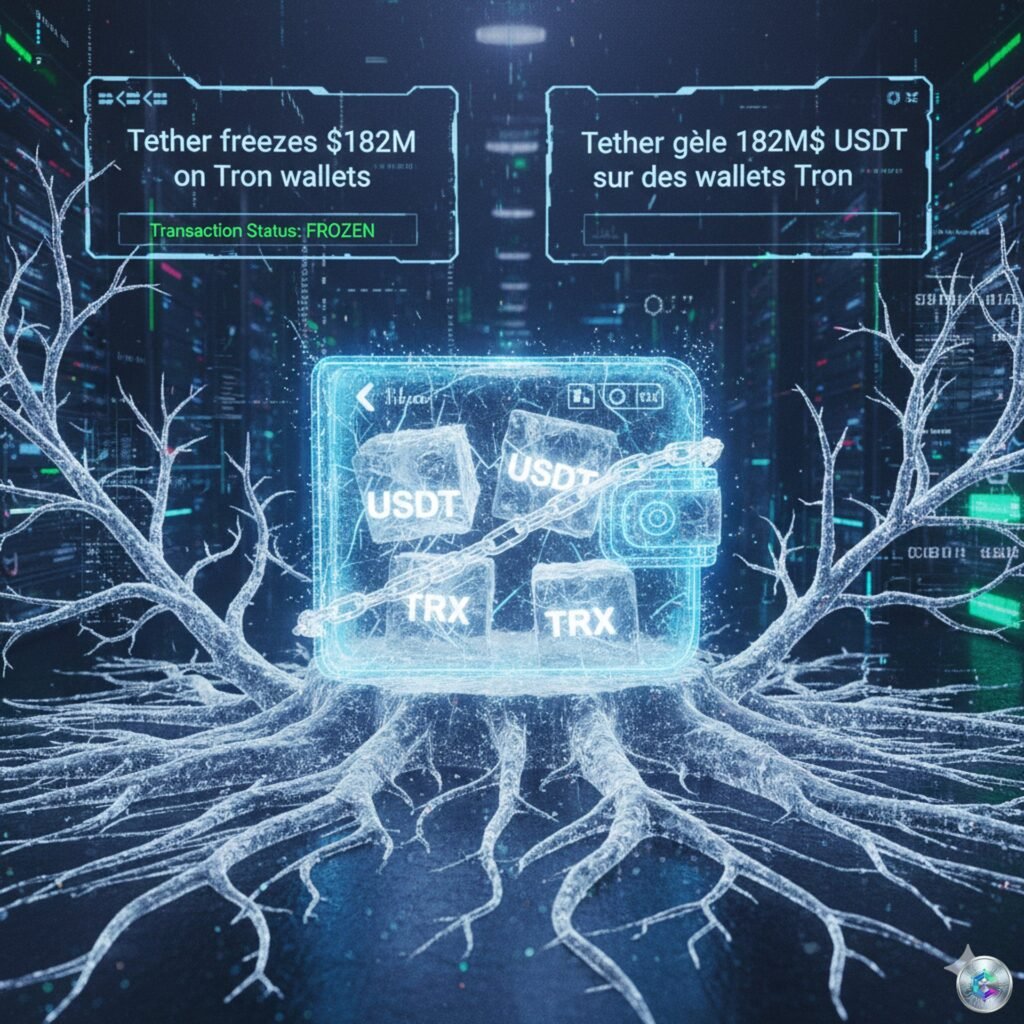
This action doesn’t result from isolated incidents but from a strategic decision coordinated with US authorities. The affected wallets, identified by Whale Alert, illustrate the technical power Tether possesses to intervene directly on the blockchain.
Voluntary Freeze Policy: A Controversial Compliance Tool
Officially launched in December 2023, Tether’s wallet freeze policy aims to ensure compliance with the requirements of the US Treasury’s Office of Foreign Assets Control (OFAC). This proactive approach allows the issuer to instantly block addresses associated with sanctioned entities or those suspected of illicit activities.
The numbers speak for themselves: since 2023, Tether has collaborated with over 310 government agencies across 62 countries, including the FBI and the United States Secret Service. Between 2023 and 2025, the company froze approximately $3.3 billion in assets and added 7,268 addresses to its blacklist. An unprecedented mobilization that positions Tether as a key player in the fight against financial crime in the crypto ecosystem.
Centralization vs Decentralization: The Stablecoin Paradox
Unlike native cryptocurrencies like Bitcoin, USDT is issued in a centralized manner. Tether retains the administrative keys to smart contracts, allowing it to intervene directly on the blockchain to block specific addresses. This technical capability, integrated into the TRC-20 standard, makes stablecoins financial instruments subject to rules and discretionary decisions.
The paradox is striking: this centralization ensures legitimacy in the eyes of institutions and regulated platforms but constitutes a fundamental risk to the principles of decentralization and censorship resistance. With over $187 billion in circulation, representing 64% of the global stablecoin market, each Tether freeze decision has major systemic implications.
Tron: A Prime Target
The choice of the Tron network is not random. The blockchain concentrates a significant portion of USDT volumes, particularly for trading, cross-border payments, and as a substitute monetary infrastructure in certain geographical areas. This concentration makes Tron a prime target for compliance actions but also an indicator of potentially suspicious financial flows.
Chainalysis data reveals that stablecoins will represent 84% of all illicit transaction volumes by the end of 2025. Faced with this reality, issuers like Tether position themselves as financial security actors, working closely with law enforcement. However, this involvement raises questions about the balance between user protection and preservation of financial freedom.
A Strong Signal to Market Players
The January 11 operation sends a clear message: stablecoins are not neutral and autonomous assets. Their integration into the global financial infrastructure requires acceptance of regulatory constraints. For institutional users, this control capacity is perceived as a security guarantee. For decentralization advocates, it represents a betrayal of crypto’s fundamental values.
Despite this massive freeze, USDT maintained its dollar peg, reflecting investor confidence in Tether’s stability measures. This resilience demonstrates that the market has integrated the regulatory dimension as a structural element of the stablecoin ecosystem.
Towards Increased Regulation
Tether’s action occurs in a context of global regulatory tightening. In Dubai, the Financial Services Authority banned privacy coins and tightened rules on stablecoins from January 12, 2026, recognizing only tokens backed by fiat currencies. This trend reflects regulators’ growing willingness to impose strict frameworks on digital assets.
With stablecoins rising as critical infrastructure for crypto markets and international payments, freeze-type interventions could multiply. The boundary between decentralized finance and regulated finance is becoming increasingly blurred, forcing users to navigate between the advantages of crypto innovation and compliance requirements.
Conclusion: A New Era for Stablecoins
The freeze of $182 million USDT on Tron is not a simple technical incident but a symptom of the crypto ecosystem’s maturation. Tether positions its stablecoins as regulated finance instruments capable of meeting authorities’ requirements while maintaining their utility. This evolution, necessary to ensure institutional adoption, questions the ideological foundations of absolute decentralization.
The challenge now consists of finding a balance between compliance and innovation, between security and financial freedom. The crypto industry is entering a maturity phase where players must navigate between the founding principles of decentralization and the pragmatic realities of an increasingly regulated global financial system. The coming months will be decisive in defining the future of stablecoins and their role in the digital economy.

