


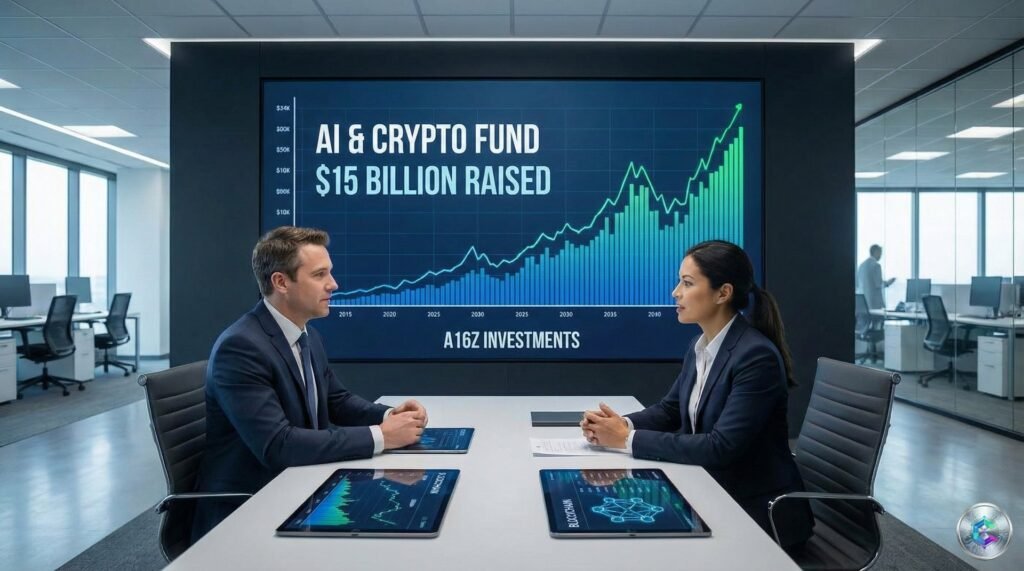
Andreessen Horowitz, the California-based venture capital giant better known as a16z, has just announced its largest fundraising in history with over $15 billion distributed across multiple investment funds. This monumental raise alone represents more than 18% of all venture capital allocated in the United States in 2025 and brings the firm’s assets under management to over $90 billion, placing it on par with Sequoia Capital among the world’s largest venture capital firms.
A Strategic Fund Distribution
The structure of this fundraise reveals a16z’s investment priorities for the coming years. The Growth Fund captures the lion’s share with $6.75 billion, aimed at mature-stage startups. The Applications and Infrastructure funds each receive $1.7 billion, demonstrating the importance placed on fundamental technological development.
But it’s the « American Dynamism » fund that particularly draws attention. With $1.176 billion, this fund has nearly doubled in size and invests in sectors considered critical to American national interest: aerospace, defense, public safety, education, housing, and supply chains. The Biotech and Health fund completes the picture with $700 million, while an additional $3 billion is allocated to other venture capital strategies.
An Assertive Geopolitical Turn
This fundraise comes in a paradoxical context. While the American venture capital market is going through its most difficult period since 2017, with only $66.1 billion raised in 2025 compared to $223 billion at the 2022 peak, a16z has pulled off a spectacular coup.
Ben Horowitz, co-founder of a16z, doesn’t hesitate to adopt a decidedly nationalistic tone: « Our mission is to ensure America wins the next 100 years of technology. It starts with winning the key architectures of the future – AI and crypto. » He goes even further by warning: « If America fails to win technologically, it will lose economically, militarily, geopolitically and culturally. »
This rhetoric clearly positions technological venture capital as a national security issue in the face of international competition, particularly with China. The American Dynamism portfolio aligns remarkably well with Department of Defense priorities, including investments in Anduril (autonomous defense systems), Shield AI (military drones), Saronic Technologies (autonomous ships), and Castelion (hypersonic missiles).
Crypto Remains a Strategic Priority
Although a16z’s crypto fund raises its own capital separately, the firm maintains a dominant presence in the blockchain ecosystem. Its journey in crypto illustrates a spectacular rise: from $300 million in 2018 to $4.5 billion in 2022.
A16z’s crypto portfolio includes some of the industry’s most iconic names: Coinbase (invested as early as 2013), Uniswap, OpenSea, Dapper Labs, Solana, Avalanche, Phantom, and more recently Kalshi and EigenLayer. Just this week, a16z invested $15 million in Babylon Labs’ staking protocol, demonstrating sustained crypto investment activity.
For the crypto industry, a16z’s message is clear: digital assets remain a key technology for America’s future. Priority investment areas include stablecoin and payment infrastructure, asset tokenization, institutional integration, and the convergence of crypto and AI.
A Controversial Political Shift
The political trajectory of a16z’s founders is one of the most discussed aspects of this fundraise. Marc Andreessen and Ben Horowitz, long-time Democratic donors, have become close allies of Donald Trump.
Andreessen cites three main reasons for this change: Biden’s tax proposal on unrealized capital gains which he considers threatening to venture capital, AI regulation that would stifle innovation against China, and the attack on the crypto industry with « unprecedented » regulatory crackdown led by Biden’s SEC.
Andreessen donated over $5 million to groups supporting Trump during the 2024 presidential election and even volunteered to help Elon Musk’s « Department of Government Efficiency. » According to Bloomberg, this proximity to the Trump administration has already borne fruit, with Andreessen allies now integrated throughout the administration.
A Bet on Capital Concentration
This mega-raise is part of a broader trend of venture capital concentration. Mega-raises over $100 million represented nearly 60% of venture capital funding in 2025 globally and 70% in the United States. Five AI companies alone (OpenAI, Scale AI, Anthropic, Project Prometheus, and xAI) raised $84 billion, or 20% of all venture capital in 2025.
A16z participated in at least 165 post-seed funding deals in 2025, positioning itself as the second most active venture capital investor in the world after Y Combinator.
However, this positioning is not unanimous. A16z’s nationalist discourse has caused a stir among rival firms. Critics also point to contradictions between the pro-American rhetoric and the fact that a16z accepts capital from foreign sovereign wealth funds, notably Sanabil Investments, the venture capital arm of the Saudi public investment fund.
Conclusion: A Long-Term Bet on Techno-Hegemony
A16z’s $15 billion raise represents much more than a simple financial operation. It’s a strategic bet on American techno-hegemony, built around AI, crypto, defense, and critical infrastructure.
In a context where venture capital fundraising is going through its worst period in years, this monumental raise sends a powerful signal: some investors think in decades, not months. By explicitly linking crypto to national security and geopolitical competition, a16z is transforming the industry narrative, moving from an experimental sector to a strategic tool for global technological dominance.
Whether this vision materializes will largely depend on the evolution of regulatory policies under Trump, a16z’s ability to effectively deploy these massive capitals, and the resilience of its investment theses in the face of the unpredictable cycles of technological innovation.

