

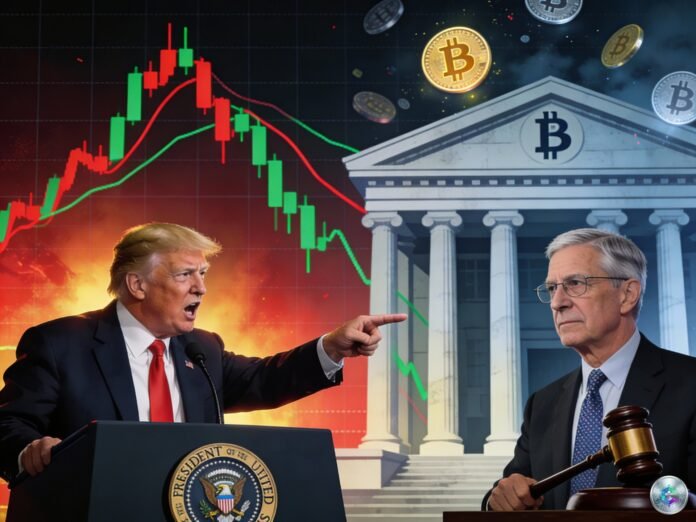
In an unprecedented development shaking global financial markets, Jerome Powell, Chairman of the Federal Reserve, revealed on January 11, 2026, that the central bank had received a subpoena from the Department of Justice. This explosive announcement comes amid extreme tensions between the world’s most powerful monetary institution and the Trump administration.
An Unprecedented Legal Subpoena Rocks Washington
Powell minced no words: this legal threat has « nothing to do with his testimony » but constitutes « a pretext » to bend the Fed to political will. According to the central bank chairman, the real reason for this legal pressure lies in the Fed’s determination to set interest rates « in the best interest of the public rather than to respond to the president’s preferences. »
The Department of Justice investigation officially focuses on Powell’s statements regarding the Fed headquarters renovation project in Washington. Trump has accused the central bank of massive cost overruns, citing a cost of $3.1 billion against an initial $2.7 billion budget. Powell denied these figures, but the Trump administration maintains the pressure.
A Fundamental Issue: Central Bank Independence
« The real question is whether the Fed will be able to continue setting its rates based on economic conditions or whether monetary policy should be directed by political pressure and intimidation, » Powell declared. This statement summarizes the crucial issue of this crisis that extends far beyond American borders.
Relations between Trump and Powell have been strained for years. Already during his first term, Trump called Powell « Too Late » for his monetary decisions deemed too slow. Since his return to the White House, the American president hasn’t hesitated to call the Fed chairman a « bonehead » and has sought to fire him.
Immediate Repercussions on Crypto Markets
The announcement of the legal subpoena triggered significant reactions in cryptocurrency markets. Bitcoin posted a 1.7% gain, reaching $92,000, while Ethereum advanced 2.3% and Solana climbed nearly 5% over 24 hours.
Liquidations were massive: $21.25 million in BTC, ETH, and SOL were liquidated in just one hour on Sunday, January 11. These movements reflect a capital migration toward assets perceived as safe havens amid institutional uncertainty.
Bitcoin: A Hedge Against Political Interference?
Analysts emphasize that this crisis reinforces Bitcoin’s narrative as a neutral and decentralized asset. Tim Sun, senior researcher at HashKey Group, warns that a conviction of Powell would create a « dangerous precedent » where « the president could use executive power and the judicial system to penalize a central bank chairman who doesn’t follow his desired monetary policy. »
This situation calls into question the credibility of the dollar and the American Treasury system, inherently favoring non-sovereign decentralized assets. If the Fed became « subservient to the president, » Bitcoin could experience « a historic moment, » although for now it remains correlated with the dollar.
Outlook and Systemic Risks
Powell’s term expires in May 2026, and Trump has already indicated he will judge his successor on their willingness to quickly lower rates. The five names on the president’s shortlist are all pro-Bitcoin, but also more inclined to follow his directives.
Economists warn of a « self-fulfilling prophecy » of higher inflation if the executive manages to appropriate the Fed. Deutsche Bank had warned that firing Powell could trigger « a severe market disruption. »
Volatility should increase in the short term, « destabilizing rate expectations, distorting the yield curve, and initially increasing volatility across all risk assets, including Bitcoin. » However, in the long term, Bitcoin could become a recognized institutional hedge against political interference.
The Trump Paradox: Attacking the Fed, Promoting Crypto
Paradoxically, the Trump administration has adopted a favorable position toward cryptocurrencies, particularly dollar-backed stablecoins. Powell himself acknowledged « a very significant change in tone » from banks toward digital assets, noting that stablecoins are becoming « a more important part of the traditional financial landscape. »
This duality – attacking Fed independence while promoting cryptocurrencies – creates a complex environment where investors must navigate between opportunities and systemic risks.
Conclusion: A Defining Moment
The Trump-Powell duel represents far more than a simple personal conflict. It’s a fundamental battle for the independence of the world’s most powerful central bank, with direct implications for the crypto ecosystem.
For Bitcoin and cryptocurrency investors, this crisis offers both opportunities and warnings. The weakening credibility of traditional institutions strengthens the appeal of decentralized assets, but political uncertainty and increased volatility can contaminate the crypto ecosystem in the short term.
The next quarter will be crucial, with Trump’s decision regarding Powell’s successor. Cryptocurrencies, far from being marginal players, find themselves at the heart of this unprecedented geopolitical and monetary transformation.

