


Messaging giant Telegram faces a delicate financial situation with $500 million in bonds held by Russian investors frozen, a direct consequence of Western sanctions. This crisis comes amid explosive revenue growth, IPO ambitions, and legal troubles for founder Pavel Durov.
A freeze rooted in sanctions against the Russian depository
Approximately $500 million in bonds issued by Telegram are currently frozen within the National Settlement Depository (NSD), Russia’s main central securities depository. This situation results from sanctions imposed by the European Union in June 2022, followed by the United States and the United Kingdom in June 2024, which placed the NSD on their sanctions lists after Russia’s invasion of Ukraine.
These frozen bonds originated from issuances made in 2021, when Telegram raised over $2.35 billion in bond markets to finance its expansion. At the time, the Russian sovereign wealth fund RDIF (Russian Direct Investment Fund) had acquired approximately $2 million in bonds on the secondary market, through its partnership with Abu Dhabi’s Mubadala fund, which had invested $75 million in total.
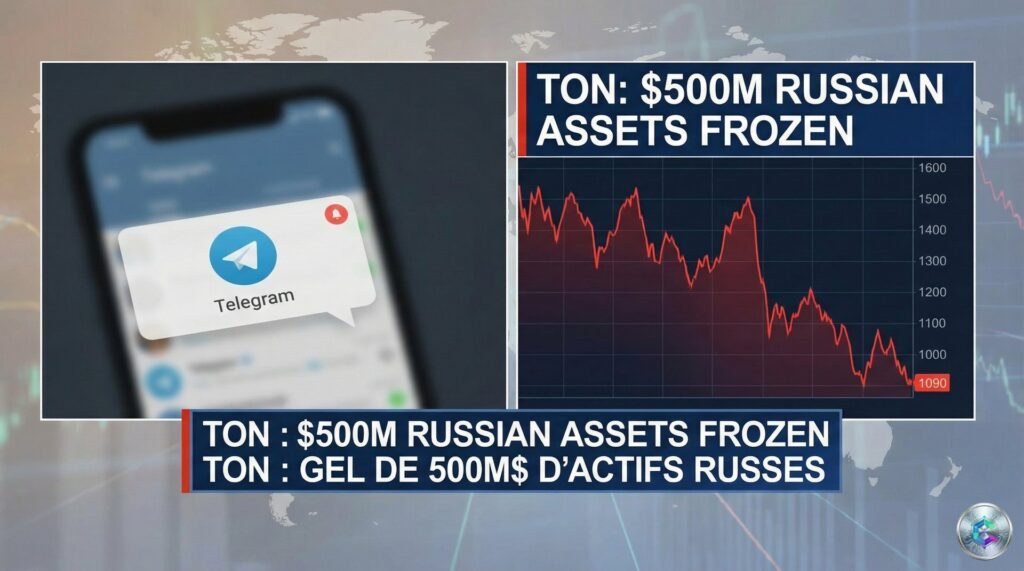
The freezing mechanism results from the blocking of financial infrastructure between Russia and the West. Since March 2022, residents of « unfriendly » countries according to Russia – including the United States and the European Union – have seen their Russian securities registered in special « Type C » custody accounts, effectively frozen due to extensive restrictions applied by Moscow.
A massive bond issuance to refinance debt
Faced with these complications, Telegram undertook a major financial operation in May 2025, raising $1.7 billion through the issuance of convertible bonds maturing in 2030, with a 9% coupon. This operation primarily aimed to refinance $955 million in debt maturing in March 2026, while injecting $745 million in fresh capital to support growth.
The operation generated considerable enthusiasm from top-tier institutional investors, notably BlackRock, Abu Dhabi’s sovereign wealth fund Mubadala, and hedge fund Citadel. Pavel Durov described the investor response as « phenomenal, » noting that demand had far exceeded the initial $1.5 billion offering.
A key element of these bonds’ attractiveness lies in their conversion clause: holders can exchange their securities for Telegram shares at a 20% discount if the company proceeds with an IPO before maturity.
Spectacular growth tarnished by crypto losses
Despite these financial complications, Telegram displays remarkable commercial performance. In the first half of 2025, revenues surged 65% year-over-year to reach $870 million. This growth is fueled by revenue diversification: premium subscriptions, advertising, and especially the TON (The Open Network) ecosystem, which generated approximately $300 million through « exclusive agreements » related to Toncoin.
The company crossed the one billion monthly active users threshold, including 12 to 15 million premium subscribers. Advertising revenues exploded, rising from $100 million in 2023 to $245 million in 2024, with projections of $350 million for 2025.
Paradoxically, this spectacular revenue growth is accompanied by a net loss of $222 million in the first half of 2025, in stark contrast to a profit of $334 million in the same period of 2024. This deterioration is mainly explained by the depreciation of the company’s Toncoin holdings, following the token’s 69% price collapse during 2025.
IPO postponed amid legal obstacles
Telegram’s IPO ambitions face several major obstacles, primarily Pavel Durov’s legal troubles in France. The Franco-Russian founder was arrested in Paris in August 2024 and is subject to a formal investigation for failure to moderate organized crime, child sexual exploitation, drug trafficking, and fraud on his platform.
Under judicial supervision, Durov had to post bail of 5 million euros, report to authorities twice weekly, and cannot leave France without authorization. Telegram informed its bondholders that a resolution of the French case would be necessary before proceeding with a public listing.
Valuation estimates vary considerably depending on scenarios. Conservative analyses place Telegram’s market capitalization between $12 and $14 billion in a conservative scenario, potentially between $18 and $20 billion in a base case, and up to $40 billion in an optimistic scenario.
A precarious balance between technological ambitions and geopolitical realities
The frozen bonds affair reveals Telegram’s difficulty in positioning itself as a global and neutral platform while managing the legacy of its Russian origins. Although Pavel Durov left Russia in 2014 after refusing to share VKontakte user data with Russian security services, the company remains exposed to the financial consequences of geopolitical fragmentation.
The freeze of $500 million, even if it represents only a fraction of the total refinanced debt, symbolizes this tension. On one hand, Telegram demonstrates its ability to attract top-tier Western capital – BlackRock, Mubadala, Citadel – without Russian participation. On the other, it cannot escape assets historically held by Russian investors, now trapped in a financial system disconnected by sanctions.
Telegram’s deep integration with the TON ecosystem adds an additional layer of complexity. Toncoin has become the exclusive non-fiat payment method for Telegram services and the exclusive blockchain for Mini Apps. This strategy offers substantial revenue opportunities but also exposes the company to extreme crypto market volatility.
Outlook: Between opportunities and structural challenges
Telegram stands at a strategic crossroads. The company has demonstrated its ability to generate rapid revenue growth, achieve operational profitability, and attract top-tier institutional investors. The user base of over one billion people constitutes a considerable asset, still largely under-monetized with only 1.3% premium subscribers.
The target of $2 billion in revenue and $720 million in profits for 2025 appears ambitious but achievable. Success will depend on Telegram’s ability to increase conversion rates to premium subscriptions, develop advertising revenues, and effectively monetize the TON ecosystem without suffering the backlash of crypto volatility.
Ultimately, the freeze of $500 million in Russian bonds represents less an immediate financial risk than a symbol of the geopolitical tensions facing global technology platforms. For Telegram, the road to an IPO remains fraught with legal, regulatory, and operational obstacles, even as commercial fundamentals continue to improve.

