


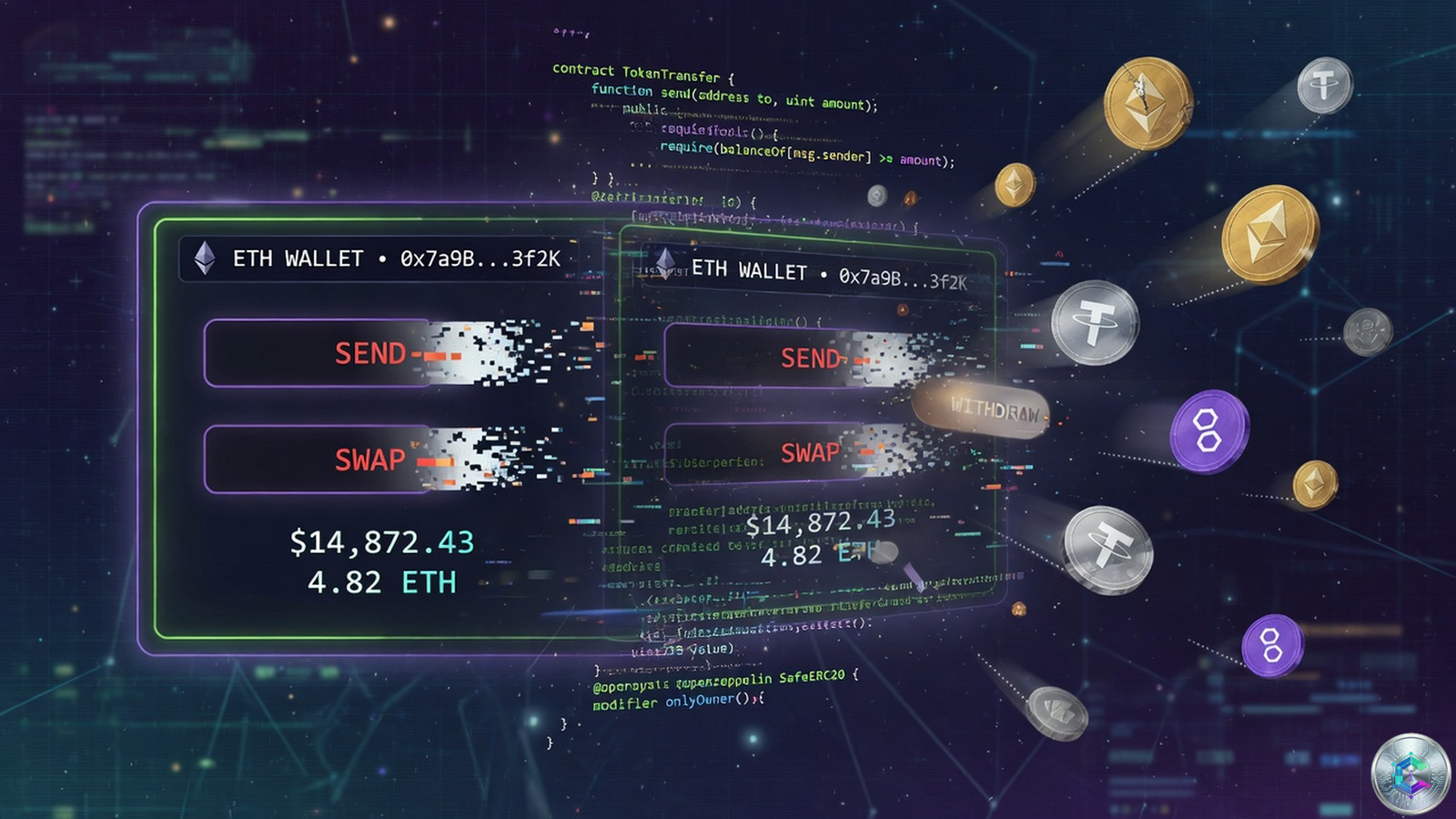
Cyber has set August 15, 2026 as the shutdown date for its CyberWallet and Cyber Passkey Wallet interfaces. Beyond that deadline, users will need to interact directly with the underlying smart contracts to recover their assets, with no company support available.
🔑 Key Takeaways
- Cyber will disable CyberWallet and Passkey Wallet interfaces on August 15, 2026, with no specific time or timezone disclosed.
- Tokens remain on-chain, but the assisted path to access and transfer them disappears with the app.
- Two distinct withdrawal flows: CyberWallet transfers to the signatory wallet; Passkey Wallet requires draining all assets to an external wallet and confirming a zero balance.
- CyberWallet SmartGas deposits are not withdrawable through the normal flow and will be converted to Surf coupons.
- Late users will need to call the contract themselves: address, release function, gas payment, and signing outside the app.
A deadline with no precise hour
Cyber posted a shutdown warning on the homepage of its products on August 14, flagging the imminent closure of both interfaces. The company did not publish a specific cutoff time or timezone, meaning users cannot assume that the apps will remain available until 11:59 p.m. on August 15. Any last-minute strategy therefore carries the risk of an early disconnection, and time zones can compound the uncertainty for international users.
Cyber’s official notice states that tokens will remain on the blockchain after shutdown, but that the assisted path to access and transfer them will be removed. Funds are not lost in a custodial sense, but the convenience layer disappears. For holders who do not act in time, the scenario shifts from a simple in-app action to an unassisted technical process, with no reachable support team.
On August 14, both public URLs were still responding: CyberWallet led to its asset route while the Passkey Wallet address returned an empty application shell. This HTTP-level accessibility did not guarantee that authenticated login, balance loading, or transfer functions were operational for every user, an important caveat to keep in mind before waiting until the last minute.
Two distinct withdrawal paths, easy to confuse
Cyber’s notice clearly separates procedures by product, and confusing the two flows would be a costly mistake. Each wallet follows its own exit mechanics, with its own exceptions, and no automatic bridge is provided between the two.
| Product | Withdrawal procedure | Notable exception |
|---|---|---|
| CyberWallet | Transfer supported standard tokens to the signatory wallet linked to the account | SmartGas deposits converted to Surf coupons, not withdrawable |
| Cyber Passkey Wallet | Transfer all assets to an external wallet, then confirm a zero balance in Passkey | No SmartGas functionality; no partial withdrawal tolerated |
Passkey Wallet users must therefore fully drain their balance, not just primary tokens, or risk leaving residual assets stranded behind a disabled interface. On the CyberWallet side, SmartGas is a special case: these deposits cannot be withdrawn through the standard flow, and Cyber offers Surf coupons to eligible users as compensation.
The gap between custody and accessibility
This shutdown highlights a specific gray zone for smart contract and account-abstraction wallets. According to Spendnode’s analysis, these wallets are non-custodial in the sense that the company does not hold funds in a corporate account the way a centralized exchange would, but access still depends on software the company designs, hosts, and maintains. When that software is abandoned, the ownership claim survives, but the convenience layer vanishes.
“Self-custody removes the counterparty risk of a provider freezing or losing your balance, the failure mode that burned FTX and Wirecard users. It does not remove tooling dependency. A wallet interface is still an interface, and interfaces get abandoned.”
Spendnode, CyberWallet case analysis
For a blockchain developer, interacting directly with a smart contract is a minor inconvenience: retrieve the address, build the call, pay gas, sign. For a retail user who signed up through a polished mobile app, that same process becomes an operational wall. The safest way to read any smart contract or account-abstraction wallet is that its balance is only as accessible as the holder’s willingness to interact directly with the contract if the application disappears.
“The people most likely to have parked funds in a consumer wallet and forgotten about them are exactly the people least equipped to perform a manual recovery.”
Spendnode, at-risk profile
Practical steps before the deadline
For holders with meaningful balances, three actions are recommended without delay. First, initiate a full transfer now to a wallet under durable control, ideally a hardware wallet or a recognized open-source software wallet. Second, confirm each transaction is recorded on-chain by checking a block explorer before treating the operation as complete. Third, prioritize which assets to withdraw: on-chain moves cost gas, and for low-value tokens, recovery fees may exceed the recoverable value.
- Transfer to a wallet under durable control (hardware wallet or reputable open-source software).
- Verify each transaction on a block explorer before considering the withdrawal final.
- Prioritize assets with sufficient value to amortize gas fees; abandon unprofitable dust.
- Note the contract addresses and wallet address now, while the application still displays them.
For those who still expect to miss the deadline or who hold dormant balances, a minimal precaution is to note the token contract addresses and the wallet address while the application still displays them. Reconstructing this information after the interface is disabled will prove significantly harder than copying it today, especially when on-chain flows involve proxies, recovery modules, or abstract-account contracts.
Conclusion: an access event, not a loss event
The converging view from available sources is unambiguous: this shutdown is not a loss event but an access event. Funds remain on-chain and remain the legal and technical property of their holders, but the shift from a simple in-app action to an unassisted technical process upends the situation for unprepared users. The reasonable scenario for anyone still holding a balance is to withdraw immediately via the correct route, signatory wallet for CyberWallet and external wallet for Passkey, and to surrender SmartGas deposits in exchange for the planned Surf coupons.
For users who still miss the deadline, the recovery path exists but remains narrow. It requires knowing the contract address, identifying the function that releases the funds, having a wallet capable of signing custom calls, and accepting to pay gas directly. The more familiar the interface, the more improbable this scenario seems, until the day it becomes the only option.
Sources
- CryptoSlate — CyberWallet users have until Aug. 15 before crypto withdrawals become a smart contract recovery job
- Spendnode — CyberWallet shutdown August 15 withdrawal deadline 2026
This article is published for informational and educational purposes only. It does not constitute investment advice. Do your own research (DYOR) before making any decision.

