


Russia’s central bank enacted federal law 282-FZ on August 4, 2026, creating a new retail crypto framework that takes effect September 1. The text caps annual purchases at 300,000 rubles per platform and restricts eligible assets to Bitcoin, Ethereum and USDT. It reflects Moscow’s strategy: use crypto for foreign trade while sealing household savings from digital asset outflows.
🔑 Key takeaways
- Federal law 282-FZ adopted on August 4, 2026, effective September 1, 2026
- Annual cap of 300,000 rubles (≈$3,600) per platform for retail investors
- Mandatory aptitude test before any crypto investment for non-qualified investors
- Asset whitelist limited to Bitcoin, Ethereum and USDT for non-qualified buyers
- Crypto payments banned for individuals but authorized for businesses in cross-border trade
A strict regulatory framework for retail investors
Federal law 282-FZ, published on August 4, 2026 and applicable from September 1, introduces an unprecedented regime for Russian retail crypto investors. Any individual wishing to acquire digital assets will now have to pass an aptitude test administered under the authority of the Bank of Russia, an approach already used for derivatives and unlisted securities. The exam is designed to filter out the least experienced profiles before any exposure to crypto markets.
If they pass, purchases will remain capped at 300,000 rubles per calendar year per platform, roughly $3,600 at current exchange rates. Because the limit applies separately to each supervised broker or exchange, investors can in practice multiply the ceiling across multiple registered venues. Qualified investors remain exempt from the cap for now, but they too will need regulator approval before transacting.
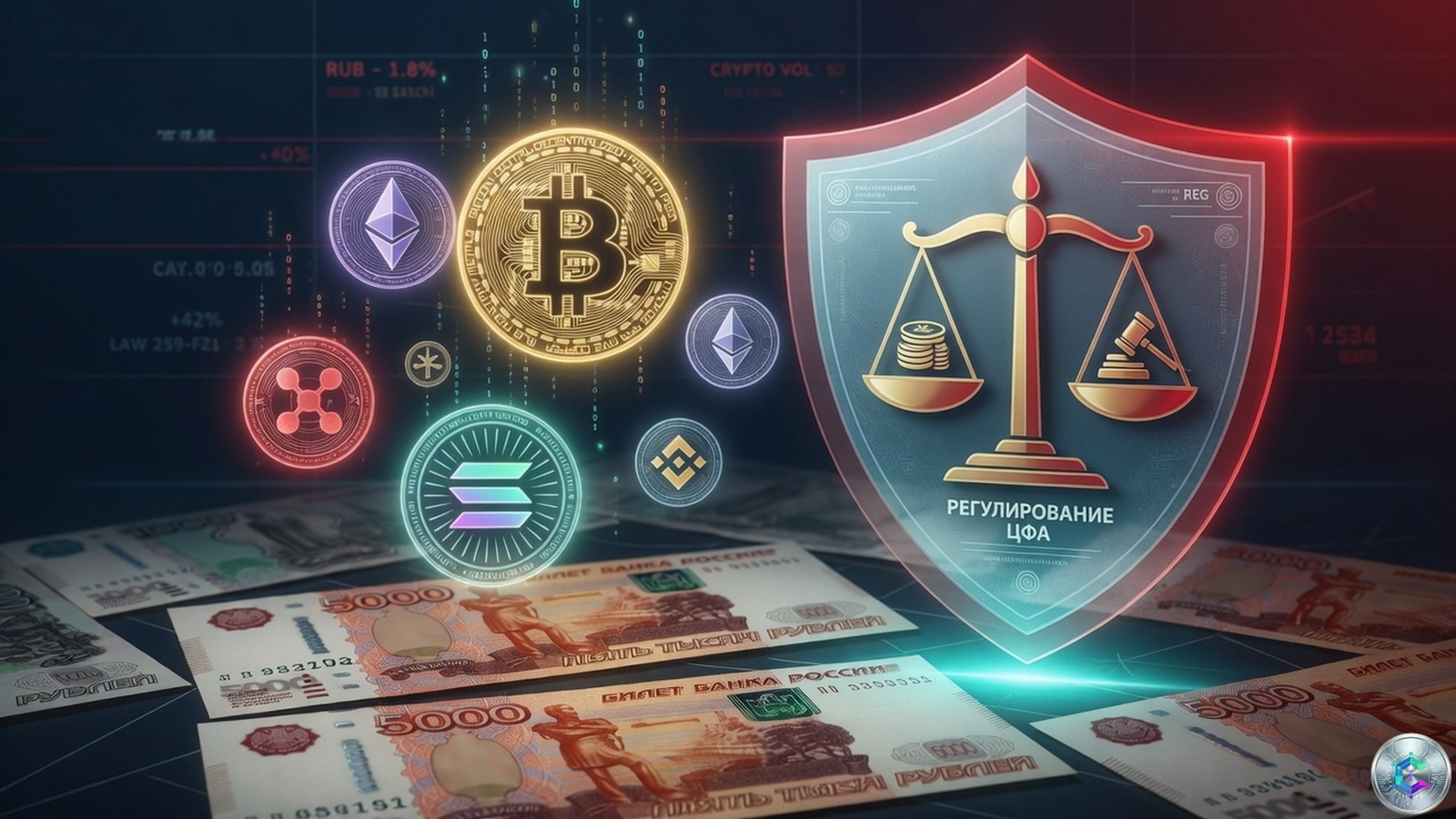
The law does not lift the general ban on crypto payments for Russian residents, which stays absolute. It does, however, explicitly authorize companies to settle cross-border commercial transactions in digital assets with no ceiling or restriction. The opening is aimed at letting Russian multinationals trade with foreign partners while bypassing Western sanctions and the freeze on traditional payment rails such as SWIFT or dollar correspondent banking.
“Just like dollarization, cryptoization limits the sovereignty of monetary policy, which could force banks to permanently maintain a higher key rate to contain inflation.”
Bank of Russia, report dated February 21, 2026
BTC, ETH and USDT: a narrow but strategic whitelist
The draft instruction submitted by the central bank for public consultation until August 24 limits non-qualified investors to three assets only: Bitcoin (BTC), Ethereum (ETH) and USDT. The list, still subject to change before final publication, may look restrictive when thousands of tokens trade globally, but it reflects an explicit risk-and-liquidity logic set by the regulator.
The inclusion of USDT, a stablecoin issued by Tether and subject to US regulation, may come as a surprise. Theoretically freezable at the click of an American button, it has nonetheless been a historical pillar of the Russian market: residents traded roughly $51 billion in crypto in 2023, mostly BTC and ETH, but also an estimated $20 billion in USDT, some of which was used to finance the invasion of Ukraine according to several Western investigations. Despite the censorship risk, the stablecoin’s unmatched liquidity and central role in cross-border transfers convinced Moscow to keep it on the list.
| Indicator | 2023-2026 value |
|---|---|
| Russian crypto trading volume (2023) | ~$51 billion |
| Including USDT (cumulative estimate) | ~$20 billion |
| Annual retail cap | 300,000 ₽ (≈$3,600) |
| Eligible assets (non-qualified) | BTC, ETH, USDT |
A Russian economy under severe pressure
The new rules come against a particularly strained macroeconomic backdrop. The Bank of Russia raised its key rate to 8% in August 2026, up from 7.5% since April, and has signalled it is ready to go further if inflationary risks persist. The decision aims to curb capital outflows ahead of possible new Western sanctions in a country where outflows already reached $75 billion in the first half of 2026.
The International Monetary Fund (IMF) cut its growth forecast for Russia to 0.2% in 2026, without factoring in potential additional European sanctions. As IMF chief economist Olivier Blanchard put it, “new sanctions should push Russia’s growth rate even lower.” The Russian economy already contracted by 0.3% in the first quarter of 2026, with negative prints in January and February before a March rebound. Vladimir Putin himself acknowledged the slowdown and called on the government to revive activity.
The federal deficit reached 4.58 trillion rubles in the first quarter of 2026, or 1.9% of GDP according to the Finance Ministry. Regional budgets are also under growing strain: Finance Minister Anton Siluanov warned that their cumulative shortfall could hit 1.9 trillion rubles in 2026, up 27% year on year. War-related and military spending reached roughly 16 trillion rubles in 2025, equal to 7.5% of GDP, absorbing skilled labour through higher wages and mechanically tightening the civilian labour market.
Internal tensions and historical precedents
The new law has not silenced criticism. Pavel Durov, co-founder of Telegram, warned about the consequences of an overly restrictive framework: “The cryptocurrency ban proposed by the Bank of Russia will trigger an exodus of IT specialists from the country and destroy several segments of the high-tech economy.” He argued for progressive regulation to preserve the national blockchain ecosystem.
“Technically, banning cryptocurrency is like banning peer-to-peer transfers. Yes, they can make it very hard to deposit funds on crypto exchanges, which means intermediary services will appear and operate through foreign jurisdictions.”
Leonid Volkov, ally of Alexei Navalny
Leonid Volkov, a close ally of opposition figure Alexei Navalny, offered a more measured view: a full ban is technically impossible and would only divert flows toward foreign jurisdictions while inflating transaction costs. Back in February 2022, the central bank had already floated in a report the idea of an outright ban on crypto investment, payments and mining, citing risks for household savings, monetary sovereignty and the energy footprint of mining. Yet Russia remains the third-largest mining hub worldwide, behind the United States and Kazakhstan. According to anonymous sources cited by Bloomberg, the FSB has pressured the central bank governor to harden the stance, notably over crypto donations to organizations labelled “foreign agents” by the Justice Ministry.
Toward state-controlled cryptoization
The compromise reached by Moscow illustrates a broader trend: states now seeking to channel rather than outlaw crypto flows. Russia accepts digital assets for its external trade while locking household access behind a narrow asset whitelist. A 300,000-ruble cap, however, looks too low to meaningfully divert bank deposits, especially with the ruble under inflationary pressure. If the ruble weakens further or new sanctions accelerate capital flight, the regulator may be forced to raise the ceiling or widen the eligible-asset list. Conversely, a further crackdown, including a de facto ban, remains plausible if FSB pressure prevails. The live test starts on September 1.
Sources
This article is for informational and educational purposes only. It does not constitute investment advice. Do your own research (DYOR) before making any decision.

