


The Bank of Korea will launch phase 2 of its CBDC program in September, integrating nine major banks including KB Kookmin, Shinhan and Hana. Building on the Hangang pilot with 100,000 participants, this step lays the operational groundwork for a potential digital won.
🔑 Key takeaways
- Phase 2 launches in September with nine major Korean banks (KB, Shinhan, Hana, Woori, Gyeongnam, iM…)
- Hangang pilot (April–June 2025) reached 100,000 users with a KRW 1M cap (≈$689)
- Stack runs on Naver Cloud with blockchain integration and real-time merchant settlement
- Hana Bank is building infrastructure for a future won-pegged stablecoin
- BoK rejected bitcoin inclusion in its foreign reserves on March 16
Hangang pilot: 100,000 users under strict caps
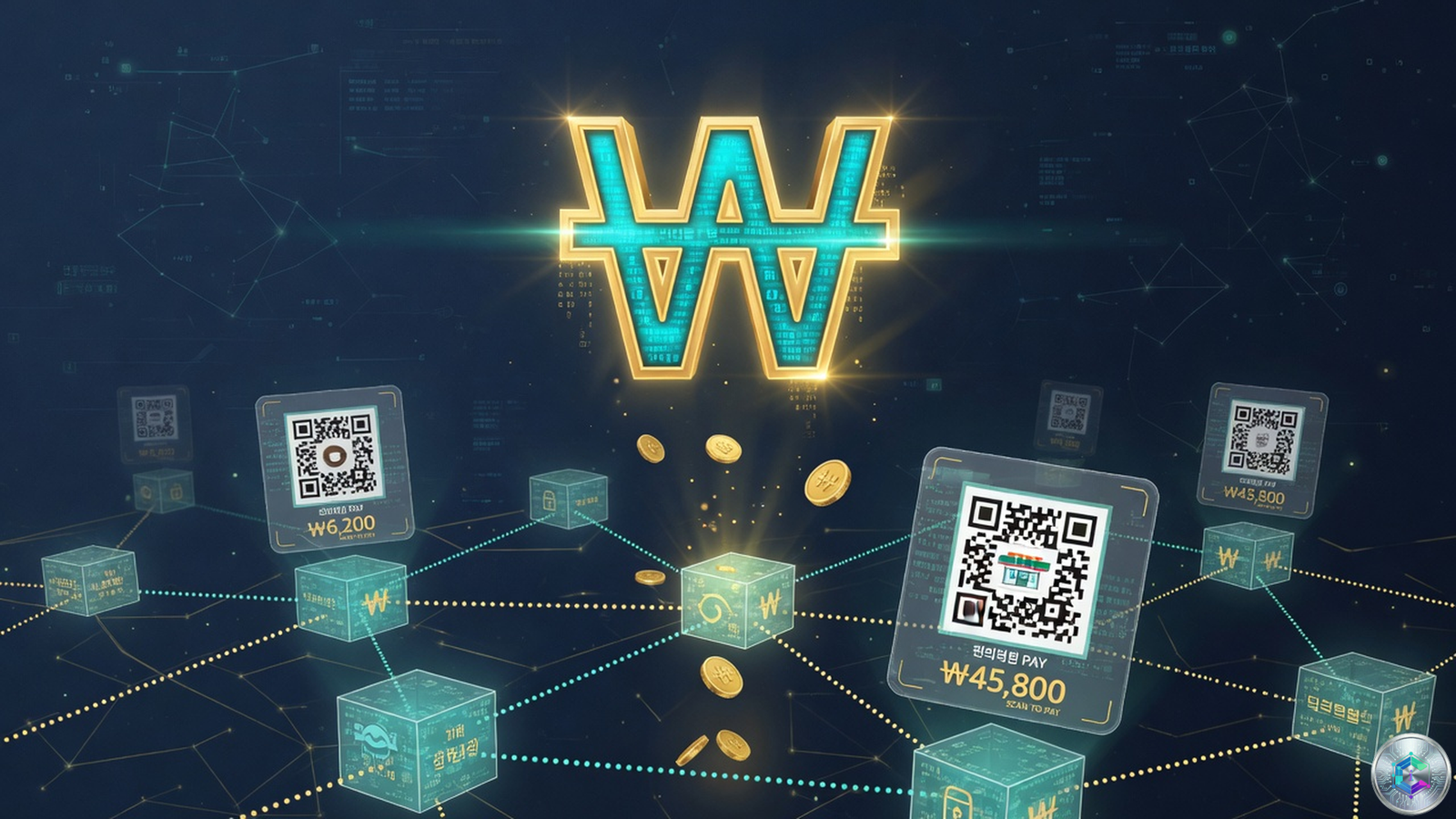
The Hangang project, deployed from April to June 2025, forms the technical and operational foundation of this scaling-up. Some 100,000 participants converted their bank deposits into deposit tokens, which they then used to make payments at affiliated merchants via QR codes inside banking apps.
The caps applied during this initial phase limited deposit-token holdings to KRW 1 million (≈$689) per person, with a cumulative transaction ceiling of KRW 5 million across the entire test window. Employees of participating banks validated the system internally before the broader rollout.
Partner merchants spanned consumer-facing brands — Hyundai Home Shopping, Ddangyo, Modhaus, 7-Eleven, Hanaro Mart, Kyobo Bookstore and Ediya Coffee — as well as Silla University. This diversity of use cases was designed to stress-test the system across e-commerce, food service, retail and education scenarios.
Phase 2: nine banks on a centralized architecture
Phase 2 marks a step-change in scale. The Bank of Korea still supplies the core infrastructure, but each participating bank will run its own commercial operations on top of its deposit tokens. Nine banks are taking part, including the country’s three largest financial groups — KB Kookmin, Shinhan and Hana — alongside Woori Financial Group. Gyeongnam Bank and iM Bank round out the panel.
The technical architecture rests on several building blocks:
- Electronic wallets for both customers and merchants
- A voucher system for Treasury disbursements
- Digital currency management tools
- A blockchain integration layer
The stack runs on Naver Cloud, signalling a commitment to domestic technological sovereignty and tighter control over sensitive financial data. As a BoK official put it:
« We will lay the groundwork for commercialization from this second phase. »
Bank of Korea official, quoted by Yonhap
| Period | Phase | Participants | Merchants / Banks |
|---|---|---|---|
| April–June 2025 | Hangang pilot (phase 1) | 100,000 | 7-Eleven, Ediya, Hanaro Mart, Silla Univ. |
| September 2025 | Phase 2 — commercial CBDC | 9 banks | KB, Shinhan, Hana, Woori, iM, Gyeongnam… |
| Oct–Dec 2025 | Phase 3 (planned) | TBD | TBD |
Real-time settlement and lower fees
Integration with commercial banking systems is the operational core of phase 2. As a BoK official explained, deposit-token payments allow merchants to receive settlement funds in real time, while cutting transaction fees by reducing the number of intermediaries along the payment chain.
That economic argument is central: a well-architected CBDC could compress payment operating costs — a major competitiveness issue for the South Korean financial system. Governor Shin Hyun-son, appointed in April, made the CBDC and deposit tokens his top priority in his first official speech.
According to the government cited by Yonhap, the stated goal is to « create an environment where the won can be exchanged freely, regardless of time or place » — a formulation that points to an ambition of financial inclusion and modernized retail payments.
Stablecoins, bitcoin and the regulatory framework
The CBDC program sits inside a fast-moving regulatory environment. The Ministry of Economy and Finance is preparing to modernize the seven-decade-old national asset law so that cryptocurrencies are classified as national assets — a meaningful legal pivot.
In parallel, Hana Bank has started designing the infrastructure needed to support a future won-pegged stablecoin — covering issuance, redemption, settlement, digital wallets and anti-money-laundering (AML) controls. Without a firm commitment to issue, the bank is positioning its systems ahead of a clearer legislative framework.
On March 16, the Bank of Korea formally rejected the idea of including bitcoin in its foreign exchange reserves, which stand at roughly $415 billion (9th largest globally). The central bank cited extreme volatility and the BTC’s failure to meet IMF criteria:
« We believe a cautious approach is needed regarding the inclusion of bitcoin in foreign exchange reserves. »
Bank of Korea, written response, March 16
The decision follows directly on US President Donald Trump’s executive order of March 6, aimed at establishing a US BTC reserve. The ECB, under Christine Lagarde, has similarly rejected the idea, arguing that reserves « must be liquid, secure and safe ».
Global context: 41 countries now testing a CBDC
Globally, CBDC projects are accelerating. According to the Atlantic Council tracker, 41 countries are currently testing a CBDC, 33 more are developing one, 15 have gone inactive and nine have cancelled their projects. The Bahamas launched theirs in October 2020, Nigeria in 2021 and Jamaica in 2022.
South Korea officially launched its CBDC pilot in April 2020. Phase 1 wrapped up successfully in December 2021, phase 2 in June 2022. In April 2024, the BoK joined Project Agorá, run by the Bank for International Settlements (BIS) with six other central banks, aimed at tokenizing cross-border payments.
In parallel, LINE Plus — a subsidiary of LINE Corporation, jointly owned with SoftBank — has launched a blockchain-based CBDC solution, customizable to each central bank’s specific needs. The solution embeds the KYC (Know Your Customer) and AML features essential to government authorities.
Conclusion: three scenarios for 2026–2027
Phase 2 of South Korea’s CBDC program sends a clear signal: Seoul is targeting operational rollout in the medium term, without rushing. The priority set by Governor Shin Hyun-son, combined with ongoing legislative modernization and banks’ stablecoin preparations, sketches a framework in which a digital won could coexist with private assets pegged to fiat currency.
Three scenarios are taking shape. Optimistic: successful commercial deployment, significant merchant adoption, cross-border integration via Project Agorá. Median: phase 3 extended, deployment limited to specific use cases. Cautious: commercial launch delayed by technical or political friction. For crypto players, the main stake remains the coexistence between a state-issued CBDC, bank-issued stablecoins and the open cryptocurrency market — arbitrated by the clarity of the upcoming regulatory framework.
Sources
- CoinDesk — Bank of Korea prepares for live CBDC transactions with nine banks in September
- CoinGeek — Bank of Korea rejects BTC reserve, announces CBDC tests
- Crypto.news — South Korea LINE blockchain CBDC solution
- The Block — Bank of Korea announces plan to test wholesale CBDC
- CryptoRank — Bank of Korea CBDC commercial bank integration
- Chosun — Bank of Korea rejects bitcoin reserves (March 2025)
This article is published for informational and educational purposes only. It does not constitute investment advice. Do your own research (DYOR) before making any decision.

