


BNB Chain is preparing a Layer 1 dedicated to AI agent trading, targeting 100,000 TPS and a mainnet launch in early 2027. The ecosystem is betting on a deep architectural overhaul — mempool eliminated, sub-second finality, on-chain governance — to serve an economy where primary users are no longer human but autonomous algorithms.
🔑 Key Takeaways
- New Layer 1 targeting 100,000 TPS, sub-50ms preconfirmation, sub-1s finality
- TxStream architecture: public mempool eliminated to remove sandwich attacks
- PriorityLane mechanism: reserved bandwidth for oracles, liquidations, and bridges
- Testnet expected end of 2026, mainnet early 2027
- BNB Chain processed $2 trillion in DEX volume in 2025
Why a Fourth Chain?
BNB Chain already operates three distinct blockchains: BNB Smart Chain (BSC), opBNB (a rollup built on the OP Stack), and Greenfield (decentralized storage). The announcement of a fourth network raises legitimate questions about liquidity fragmentation and ecosystem complexity.
The CTO, known as David Z, has clarified the rationale: the new Layer 1 is not designed to cannibalize BSC’s existing DeFi ecosystem. It targets a fundamentally different use case category, for which BSC was never architected. BSC will continue serving as the settlement hub, connected to the new network via a native official bridge using BNB as the unified asset across all chains.
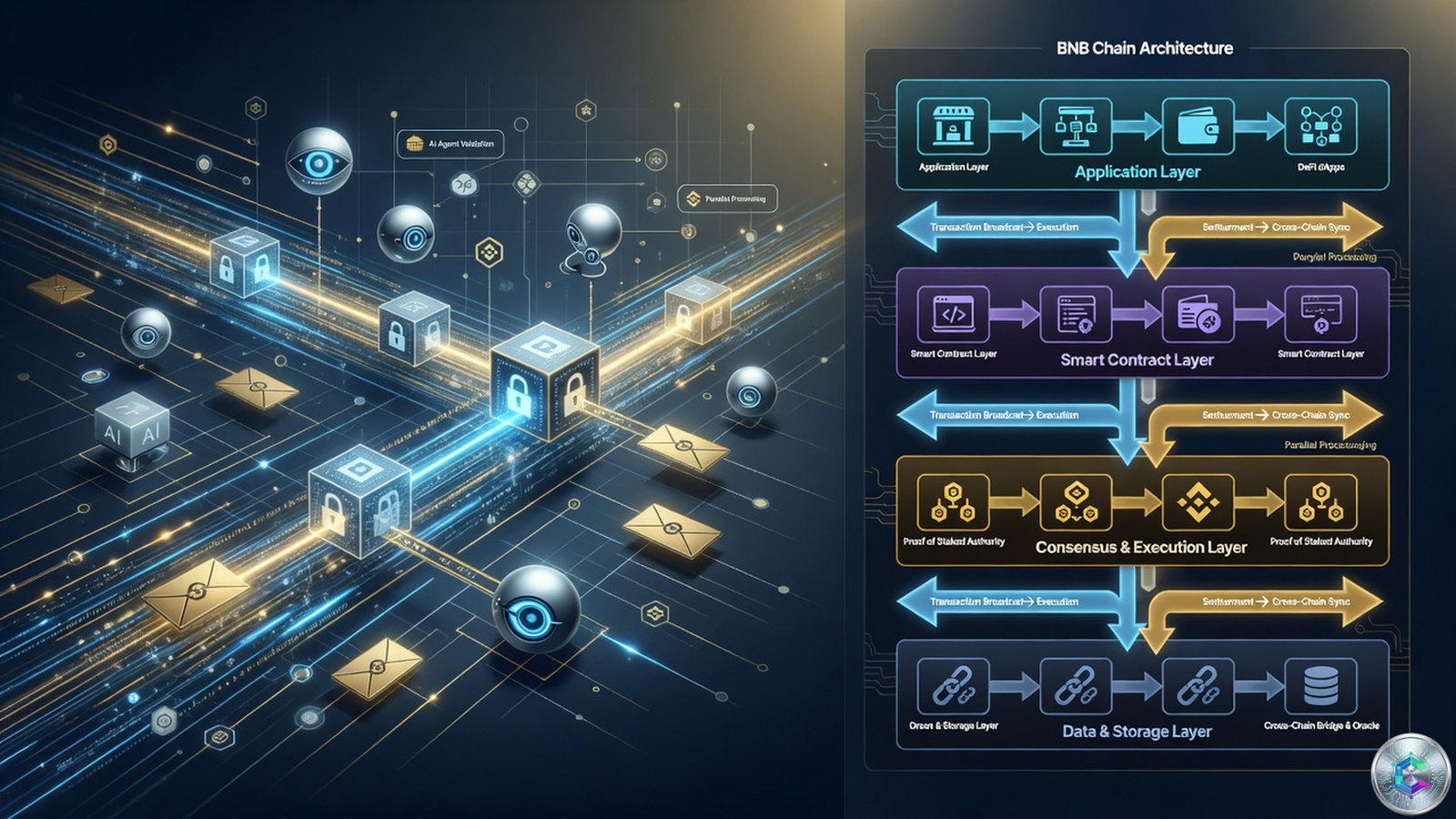
The philosophy, according to the team, is to grow the overall BNB cake rather than redistribute it. The new chain is explicitly built for high-frequency trading scenarios, enterprise-grade AI applications, and institutional-grade financial infrastructure that require performance characteristics incompatible with a general-purpose EVM chain.
TxStream: Eliminating the Mempool to Stop Front-Running
The most technically ambitious component of the new architecture is TxStream. In existing blockchain networks, transactions submitted by users enter a public mempool: a shared waiting room where all pending transactions are visible. This transparency is a gift to MEV (Maximal Extractable Value) bots, which can inspect pending transactions, identify profitable opportunities, and insert their own orders ahead of them in line.
Sandwich attacks are among the most common forms of this extraction. A bot detects a large pending swap on a DEX, front-runs it by buying the same asset at a lower price, then back-runs the victim’s trade by selling at the higher price the victim’s order creates. The victim pays more for their tokens; the bot profits from the spread. On high-volume DeFi chains like BSC, this behavior is systematic and well-documented.
TxStream eliminates this attack vector by removing the public mempool entirely. Transactions are routed directly to the block leader, bypassing the shared waiting room altogether. Since no external party can observe a transaction until after it has been included in a block, the window for front-running closes by design. The ordering of transactions is sealed before anyone outside the direct sender-receiver path knows the transactions exist.
To prevent the block leader itself from becoming a new extraction point, leadership rotates every 200 milliseconds. This is too short a window for any leader to systematically build a business around position advantage. The ordering behavior of leaders remains publicly auditable, preserving the accountability that makes the blockchain trustworthy in the first place.
This approach puts BNB Chain in direct competition with other high-performance chains that have tackled MEV through different mechanisms. Solana has explored encrypted transaction streams, while other chains have experimented with encrypted mempool designs. BNB Chain’s bet on direct-to-leader routing with rapid leader rotation is architecturally distinct and represents a specific engineering judgment about the tradeoff between decentralization and execution speed.
PriorityLane: Reserved Bandwidth for Critical Infrastructure
The second major architectural feature is PriorityLane, a block space reservation mechanism for critical infrastructure components including oracle feeds, liquidation engines, and cross-chain bridges. In a general-purpose blockchain, all transactions compete for the same limited block space. During periods of high network activity, oracle updates can be delayed, liquidations can fail to execute in time, and bridge transactions can be stuck for minutes. For a human trader, a few extra seconds of delay is inconvenient. For an autonomous agent managing a leveraged position, the same delay can mean the difference between a successful liquidation capture and a cascade of forced liquidations that destabilize the entire protocol. PriorityLane addresses this by allocating a dedicated slice of block capacity under on-chain governance control, preventing the feature from becoming locked into a specific set of protocols and allowing organic growth of the infrastructure ecosystem.
Performance Targets: 100K TPS and Sub-50ms Preconfirmation
The headline numbers for the new chain are striking in their ambition. Processing more than 100,000 transactions per second would place this network well ahead of current benchmark performances across the industry. Solana, widely considered one of the highest-performance Layer 1s, processes in the range of several thousand to tens of thousands of transactions per second under real-world conditions. Ethereum processes somewhere between 15 and 30 transactions per second on its mainnet, with Layer 2s handling the bulk of execution.
| Network | Throughput (TPS) | Finality |
|---|---|---|
| Ethereum mainnet | 15-30 | ~12s |
| BSC (2025) | ~5,200 | 0.75-3s |
| Solana | Several thousand to tens of thousands | ~2.5s |
| BNB Chain new L1 (target) | 100,000+ | sub-1s |
Achieving 100,000 TPS requires advances across multiple system layers simultaneously. On the execution side, the team is employing parallel execution, where independent transactions are processed simultaneously rather than sequentially, along with JIT compilation optimizations and what the CTO describes as compiler engineering without flashiness: incremental improvements to how smart contracts are compiled and executed that compound into meaningful throughput gains. On the consensus side, the team describes a co-optimized consensus mechanism that reduces the overhead of the agreement process between validators. Block finality in under one second requires that the agreement protocol converge almost immediately after a block is produced, rather than requiring multiple confirmation rounds. Storage is handled through LtHash, a hash function based on Euclidean networks that provides state integrity guarantees resistant to quantum computing attacks.
The Context: BNB Chain’s Strong 2025 Foundation
The timing of this announcement is significant. 2025 was a breakout year for BNB Chain across almost every metric. The network processed $2 trillion in DEX volume over the course of the year. Total Value Locked in DeFi protocols grew from $5.3 billion in Q1 to $7.8 billion by Q3, a 47% increase. Daily transactions surged from 4.9 million at the start of the year to 13.3 million by Q3, with peaks touching 14.2 million in mid-December. Daily active addresses expanded from 1.2 million to 2.3 million, with a single-day peak of 5 million users.
| Metric | Q1 2025 | Q3 2025 | Change |
|---|---|---|---|
| DeFi TVL | $5.3B | $7.8B | +47% |
| Daily transactions | 4.9M | 13.3M | +171% |
| Daily active addresses | 1.2M | 2.3M | +92% |
| Stablecoin market cap | ~$7B | $13.9B | ~+99% |
BNB Chain briefly became the number one Layer 1 by DEX volume, surpassing both Ethereum and Solana during the October peak, driven largely by the four.meme launchpad which accounted for approximately 21.8% of the ecosystem’s year-to-date app revenue. On the infrastructure side, the Lorentz and Maxwell hard forks reduced block times from 3 seconds to as low as 0.75 seconds. Network bandwidth scaled beyond 133 million gas per second. The BSC reth client and incremental snapshot upgrades reduced node overhead. The Goodwill Alliance initiative helped reduce sandwich attacks on the network by 95%. BSC’s current benchmark throughput stands at approximately 5,200 transactions per second, nearly double what it was at the start of 2025. The stablecoin market cap on BNB Chain doubled in 2025, reaching $13.9 billion by Q3, establishing the network as the third-largest chain by stablecoin market capitalization. More than 138 million stablecoin transfers occur on BNB Chain each month on an adjusted basis. The 0 Fee Carnival initiative, which enabled gasless transfers for leading stablecoins, and the BNB Chain-centric launch of World Liberty Financial’s USD1 were particularly important catalysts.
The AI Agent Economy and Why It Changes Everything
The new Layer 1 is being built specifically for what BNB Chain calls the agent economy, and the project’s conviction here is backed by concrete infrastructure already deployed. BNB Agent Studio, launched in partnership with the AWS Generative AI Innovation Center, allows developers to build and deploy autonomous AI agents using a text prompt. The platform handles infrastructure configuration, identity management, crypto payments, hosting, and AI services automatically. According to the project, an agent can be deployed in roughly 15 minutes from a text description of its intended function. The ecosystem has already grown to approximately 150,000 deployed agents, a number that suggests the demand for agent-friendly infrastructure already exists.
These agents are not merely automated trading bots. Using ERC-8004 digital identities secured by users’ private keys, agents can earn income, pay for their own operations, maintain persistent identities across sessions, and interact autonomously with DeFi protocols, oracle systems, and other agents. A human trader processing information on the order of seconds or minutes is simply irrelevant at machine timescale. What matters is machine-to-machine latency: how quickly a transaction submitted by one agent is confirmed and visible to the next agent in a trading strategy. The 200-millisecond leader rotation, the sub-50-millisecond preconfirmation, and the elimination of the mempool are all engineered specifically for this machine-native use case.
« Our goal is to grow the overall BNB cake rather than redistribute it between existing chains. The new Layer 1 addresses a use case profile that BSC was never designed for. »
David Z, CTO of BNB Chain
Networks built primarily for human users tend to optimize for user experience, gas cost efficiency, and accessibility. Networks built for AI agents optimize for raw throughput, deterministic latency, and freedom from extraction. These are different design goals that lead to different architectural choices, and the new BNB Chain Layer 1 is making a clear bet on the latter.
The Quantum Security Question
The technical roadmap also addresses the long-term threat posed by quantum computing to existing blockchain cryptographic foundations. Most blockchains today rely on elliptic curve cryptography, particularly the secp256k1 curve, for transaction authentication. A sufficiently powerful quantum computer could, in theory, derive private keys from public keys, fundamentally breaking the security assumptions that protect user funds.
BNB Chain’s approach to this threat is a hybrid one. Rather than waiting for a complete quantum-resistant solution to be standardized and deployed, the project is layering quantum-resistant protections on top of existing cryptography. The state commitment scheme based on LtHash already provides post-quantum integrity for the chain’s state, meaning that even if an attacker with a quantum computer could forge new signatures, they could not produce a valid alternate history of the chain. The harder problem is account migration: the issue is not just protecting new transactions from quantum attack but migrating existing accounts, whose public keys are already exposed on the blockchain, to quantum-resistant key schemes. The challenge is that a user’s address must remain stable even as their authentication scheme changes. BNB Chain’s account abstraction design is intended to handle this transition by linking addresses to authentication policies rather than to specific keys. However, the CTO acknowledges that no project in the industry, BNB Chain included, currently has a complete and production-ready scheme for quantum migration. This is a genuine open problem for the entire blockchain industry.
The Competitive Landscape
BNB Chain is not alone in targeting the high-performance blockchain market. The 2026 Layer 1 outlook published by The Block noted that the base layer is fragmenting across specialized chains optimized for specific use cases, with privacy, performance, and app-chain coordination each attracting distinct projects. Solana continues to dominate the retail trading and memecoin narrative, processing tens of thousands of transactions per second with its proof-of-history consensus. The Firedancer validator client from Jump Crypto promises to unlock additional performance headroom on the Solana network, potentially pushing its effective throughput significantly higher.
Monad, which launched its mainnet in 2025, positioned itself as an Ethereum-compatible chain with Solana-like performance, targeting developers who want EVM familiarity without the throughput limitations of Ethereum mainnet. Its HyperBFT consensus and parallel execution architecture are explicitly aimed at the same performance envelope BNB Chain is targeting. Hyperliquid has emerged as the dominant venue for onchain perpetual futures trading, processing tens of billions of dollars in monthly volume and developing its own EVM-compatible sidechain called HyperEVM. Its market share in derivatives has made it a natural destination for algorithmic trading strategies. MegaETH, another performance-focused Layer 1, is pursuing extreme throughput through real-time block production and data availability optimizations. Each of these projects is making different architectural tradeoffs, and the market has not yet determined which approach will prevail.
Institutional Ambitions: Privacy, RWA, and Enterprise
The roadmap makes clear that institutional adoption is a primary target for the new chain. BNB Chain says it will continue expanding infrastructure for institutional users through privacy frameworks, stablecoin support, AI security tools, and middleware for real-world asset and DeFi projects. The privacy component is particularly important for institutions that want to execute large orders onchain without telegraphing their positions. In the current blockchain landscape, every transaction is public. A large institutional order submitted to a DEX will move the market before it is fully executed, a phenomenon known as information leakage. Protocol-level privacy, as promised in the new chain’s specification, would allow institutions to execute at size while maintaining confidentiality, potentially making onchain execution viable for order sizes that are currently impractical.
Real-world assets represent another institutional use case that BNB Chain has been cultivating aggressively. RWA value on BNB Chain surpassed $1.8 billion in 2025, with integrations from USYC and participation from institutional names including BlackRock, Franklin Templeton, and VanEck. The stablecoin economy doubling in size and the network’s growing role as the primary rail for World Liberty Financial’s USD1 stablecoin suggest that BNB Chain is positioning itself as the settlement layer for a broader institutional onchain finance ecosystem.
A Word of Caution: Targets vs. Reality
It is worth emphasizing that all performance numbers cited for the new Layer 1 are targets at this stage. The chain has not reached testnet, and the jump from current BSC performance of approximately 5,200 TPS to a claimed 100,000 TPS is an order of magnitude improvement that will require successful execution across execution engines, consensus protocols, networking layers, and storage systems simultaneously. The history of the blockchain industry is littered with announced performance targets that were later revised downward or delayed indefinitely. Solana’s early roadmaps promised 700,000 TPS. Various projects have announced sub-second finality that proved difficult to achieve in production.
That said, BNB Chain enters this race with advantages many competitors lack. It operates one of the world’s largest crypto exchanges, giving it direct access to institutional clients, liquidity providers, and a steady stream of real transaction demand. Its ecosystem already processes $2 trillion in annual DEX volume, providing genuine stress-testing conditions. And its developer ecosystem, powered by programs like BNB Hack (which attracted over 300 teams in a single cohort), has demonstrated the ability to build production applications at scale.
What to Watch: The Testnet Milestone
The most important near-term milestone is the testnet launch expected at the end of 2026. This will be the first real validation of whether the architectural claims hold under realistic network conditions. Independent validators, MEV researchers, and trading firms will be watching closely to measure actual throughput, preconfirmation latency, and whether the TxStream mempool elimination delivers the MEV resistance the team has promised. The full roadmap, published alongside the announcement, will provide additional detail on the timeline and feature completeness expected at each stage.
BNB Smart Chain itself will continue evolving throughout this period. The commitment to double BSC’s throughput again before the new Layer 1 launches means developers do not need to wait for the new chain to access improved performance. The existing BSC roadmap, combined with opBNB’s scaling capabilities, provides a clear upgrade path for applications that need higher throughput today.
Conclusion
BNB Chain’s new Layer 1 for agentic trading represents one of the most clearly articulated bets on AI-native blockchain infrastructure in the industry. The architectural choices are deliberate: no public mempool to eliminate sandwich attacks, reserved lane infrastructure for critical protocols, and performance targets calibrated not to human trading tolerance but to machine-level latency requirements. The project is grounded in real momentum. BNB Chain’s 2025 results, with $2 trillion in DEX volume, 13.3 million daily transactions at peak, 2.3 million daily active addresses, and 150,000 deployed AI agents, demonstrate that the ecosystem has the scale and diversity of use cases to justify a dedicated high-performance infrastructure layer.
The 2027 mainnet target is ambitious and many things could change between now and then. The competitive landscape is crowded with well-funded projects chasing similar goals. Quantum security remains an open industry problem. And the gap between specification and production deployment has historically been larger than teams expect. But the clarity of the use case definition sets this announcement apart. BNB Chain is not building a faster general-purpose chain. It is building infrastructure for a future where the primary users are autonomous agents that execute, settle, and compound value without human intervention.
Sources
- CoinAcademy – BNB Chain builds a new Layer 1 for agentic trading
- Crypto Briefing – BNB Chain to launch layer 1 blockchain for agentic trading by 2027
- BNB Chain Blog – BNB Chain in 2025: Making Scale the Standard
- The Block – 2026 Layer 1 Outlook
- Yahoo Finance – BNB Chain Year in Review
This article is published for informational and educational purposes only. It does not constitute investment advice. Do your own research (DYOR) before making any decisions.

