


Ethereum co-founder Vitalik Buterin has released the « Lean Ethereum » strawmap, a three-to-four-year roadmap that puts quantum resistance, programmable privacy, and a rebuilt base layer at the heart of the protocol by 2029. The scope of the work, comparable to the September 2022 Merge, sketches Ethereum’s third great iteration.
🔑 Key Takeaways
- Five north stars targeted by end-2029: near-instant finality, gigagas L1 (10,000 TPS), teragas data layer, post-quantum cryptography, native privacy.
- Glamsterdam fork slipped from H1 2026 to Q3 2026 — the roadmap’s first critical milestone.
- Four distinct cryptographic vulnerabilities flagged by Buterin: consensus BLS signatures, KZG data availability, ECDSA wallet signatures, application-layer SNARKs.
- Ethereum Foundation cut ~20% of staff (54 people), with annual spending targeted at ~5% of treasury by 2030.
- EthLabs launched June 22 by five former EF researchers to drive adoption and growth.
1. The Quantum Threat Becomes Existential
Buterin’s X post was blunt: quantum safety has « shifted up a LOT in priority. » In March 2026, Google Quantum AI estimated that breaking 256-bit elliptic curve cryptography (ECDSA) — the algorithm protecting Ethereum accounts — could require roughly 1,200 logical qubits. Previous estimates were far higher. Google has set an internal deadline of 2029 to migrate its own systems to post-quantum cryptography. The U.S. NIST anticipates deprecating ECDSA by 2030 and disallowing it entirely by 2035.
The hardware gap remains significant — current machines operate with a few thousand noisy physical qubits — but the trajectory is unsettling. Logical qubits, which correct for errors, require many physical qubits each. The gap is narrowing faster than expected.
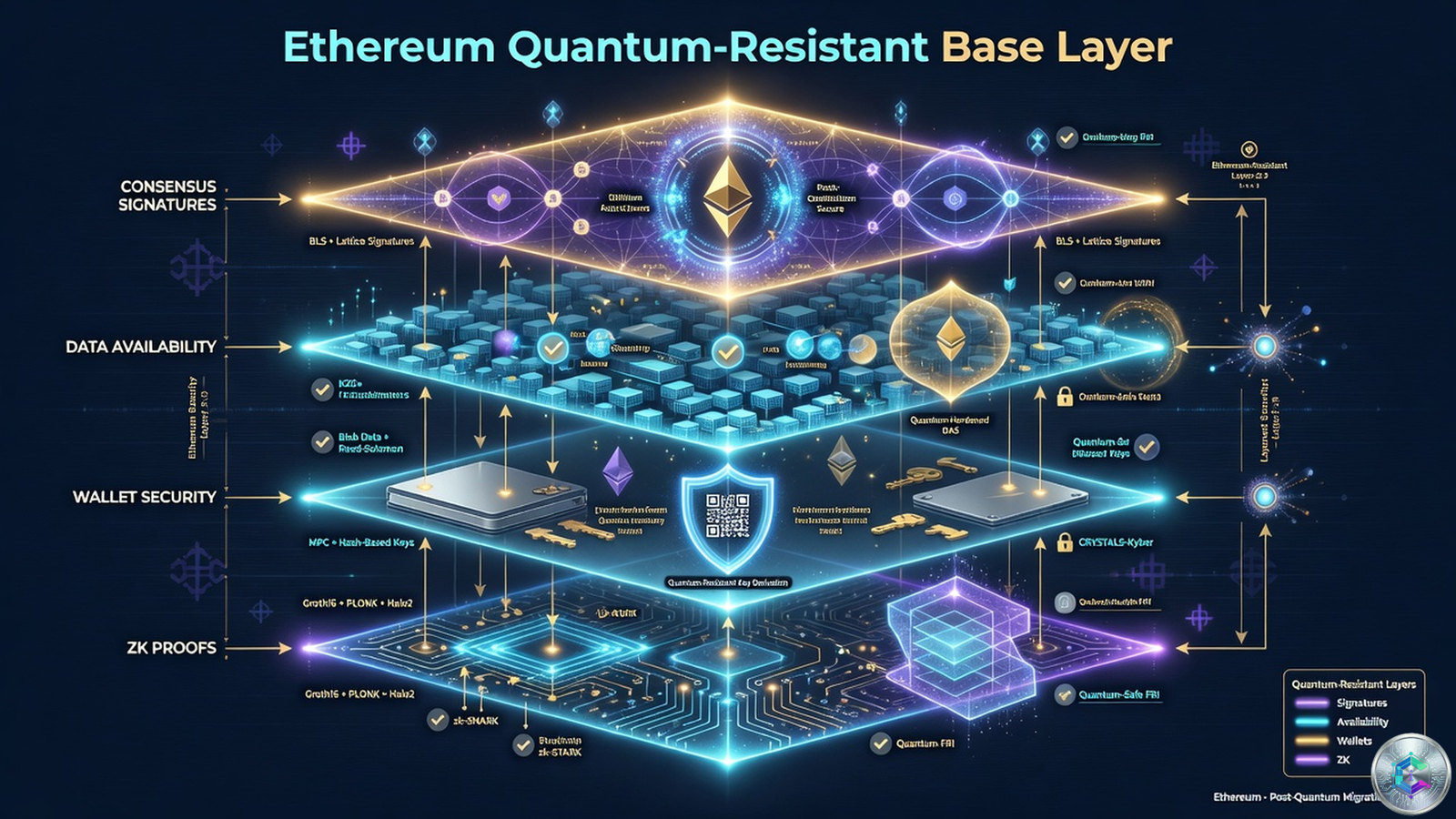
Buterin has identified four distinct cryptographic zones to upgrade, each with its own technical constraints.
Consensus-layer BLS signatures. Ethereum’s proof-of-stake protocol relies on BLS (Boneh-Lynn-Shacham) signatures to aggregate votes from hundreds of thousands of validators. Efficient but vulnerable to Shor’s algorithm because of its reliance on elliptic curve pairings. The planned replacement is leanXMSS, a hash-based signature scheme considered quantum-safe. The trade-off: ~3,000 bytes per signature versus 96 for BLS. The leanVM, a minimal zero-knowledge virtual machine, compresses signature data by a factor of 250x.
Data availability (KZG). Rollups depend on KZG polynomial commitments to prove blob data availability without requiring every node to download everything. KZG uses a trusted setup and the same vulnerable elliptic curve pairings. Candidate replacements: STARK-based commitments (hash-based) or lattice-based schemes.
Wallet signatures (ECDSA secp256k1). Every externally owned account (EOA) signs transactions with ECDSA. Any account that has broadcast a transaction has exposed its public key onchain — and a quantum computer could derive the private key from it. Researchers call this exposure risk « harvest now, decrypt later »: adversaries can already record exposed public keys today and decrypt them once quantum hardware matures. The fix: EIP-8141, which makes wallets « signature agile, » able to adopt quantum-resistant schemes without waiting for full protocol migration.
Application-layer ZK proofs. Many L2 rollups use SNARKs over elliptic curves — quantum-vulnerable. STARKs, based on hash functions, are already quantum-resistant and adopted by several rollups. Ecosystem migration is underway but incomplete.
« Quantum safety has shifted up a LOT in priority. »
Vitalik Buterin, Ethereum co-founder
2. The Five North Stars of the Strawmap
The Strawmap, published at strawmap.org, organizes development around five targets to reach by end-2029.
Near-instant finality. Ethereum’s economic finality, currently around 16 minutes, could shrink progressively: 10 min 40 s with 8-second slots, then 6 min 24 s, 1 min 12 s, 48 s, 16 s, down to 8 seconds. Slot time becomes an adjustable parameter, reduced incrementally as the network gains confidence in safety. A side benefit: slots could become quantum-resistant faster than finality itself, keeping the chain alive even if finality were suddenly disrupted.
Gigagas L1. Target 10,000 transactions per second on the base layer, via higher gas limits and the leanVM for more efficient computation verification.
Teragas data layer. Massively scale blob data capacity on the L1, making rollups cheaper and more scalable.
Privacy by default. Treated as a first-class protocol property, via a new VM specification (leanISA or RISC-V) that natively supports privacy-preserving smart contracts. A direct answer to AI-powered onchain surveillance.
Post-quantum cryptography. Comprehensive replacement of vulnerable primitives underlies the other four goals — a successful quantum attack would compromise every other improvement.
| North star | Quantitative target | Primary mechanism |
|---|---|---|
| Near-instant finality | 16 min → 8 s | 8 s slots, single-epoch finality |
| Gigagas L1 | ~10,000 TPS | Higher gas limits + leanVM |
| Teragas data layer | Massive blob capacity | EIP-4844 + scaling |
| Native privacy | Privacy by default | leanISA / RISC-V + ZK |
| Quantum resistance | 100% PQC primitives | leanXMSS + STARKs + EIP-8141 |
3. Ethereum Foundation Restructures, EthLabs Emerges
In June 2026, the Ethereum Foundation announced it was cutting approximately 20% of its workforce (54 people) and reducing its budget by ~40%. Buterin framed the cuts as a deliberate shift from ~15% to ~5% annual treasury spend by 2030. The 38-page « Mandate » document refocused the Foundation on CROPS principles: censorship resistance, open-source code, privacy, security. The Foundation now positions itself as « one of many nodes, » explicitly refusing to optimize for token price.
The layoffs followed senior departures: Hsiao-Wei Wang (co-executive director, June), Tomasz Stańczak (February), Tim Beiko and Barnabe Monnot (May). In total, nine senior EF employees have left since January 2026.
The vacuum was filled fast. On June 22 — the day before the layoff announcement — five former senior researchers launched EthLabs, an independent non-profit R&D lab. The founding team — Ansgar Dietrichs (executive director), Barnabe Monnot, Caspar Schwarz-Schilling, Josh Rudolf, Julian Ma — had run much of the EF’s protocol economics, scaling, data availability, and finality work. Backers include BitMine and SharpLink (the two largest publicly traded ETH treasury companies), Joe Lubin (Consensys), Anchorage, Octant, and SNZ.
The EF’s dedicated Post-Quantum Security team, formed in January 2026 under Thomas Coratger, runs weekly interoperability tests with more than 10 client teams. It launched a $1 million research prize (Poseidon Prize) and will host the second PQ Research Retreat in Cambridge in October 2026.
4. Timeline Risks and Brutal Competition
The first concrete test is Glamsterdam, which brings a zkEVM to the base layer and unlocks quantum-safe signature schemes. Already slipped from H1 to Q3 2026, another delay would be an alarming signal.
Dankrad Feist, a respected former protocol engineer, calls the timeline too slow: three to four years could shrink to one with AI-assisted development. Analyst Ignas Fiodorovas cites the EF’s track record of missed deadlines. ETH remains under pressure: the ETH/BTC ratio sits ~60% below its Merge level, and ETH trades ~65% below its all-time high.
Competition is brutal. Solana has overtaken Ethereum in DEX volume share, which has dropped from ~68% to ~20%. Solana and Tron now each generate fee revenue comparable to or greater than the Ethereum L1. Ethereum’s remaining moat is real: ~50% of stablecoin supply sits on Ethereum, and its share of tokenized real-world assets remains above 50%. The absolute value of RWAs on Ethereum has grown more than 12x over the past two years.
Conclusion
The Lean Ethereum strawmap is the most ambitious bet in crypto history: simultaneously rebuilding the base layer, privacy, and cryptographic security of a protocol carrying $500+ billion in market capitalization. The bull case: a leaner Foundation combined with a new ecosystem of aligned organizations produces a compound effect that puts ETH back on a growth trajectory. The bear case: dispersed responsibility creates factions with misaligned incentives — CROPS principles versus ETH price appreciation — that fracture the community.
The nearest-term test is Glamsterdam. If it slips again, the restructuring has not solved execution. If it ships cleanly, it will be the first concrete evidence that the Lean Ethereum roadmap is more than a document.
Whether the destination is reached in three years or seven may determine which blockchain settles the global economy.
Sources
- Cointelegraph — Vitalik Buterin shares top priorities for new ‘Lean Ethereum’ strawmap
- CoinDesk — Vitalik Buterin unveils Ethereum roadmap to counter quantum computing threat
- Ethereum.org — Post-quantum cryptography on Ethereum
- Galaxy Research — Ethereum Foundation Cuts 20% of Workforce as Chain Enters ‘Third Iteration’
This article is published for informational and educational purposes only. It does not constitute investment advice. Do your own research (DYOR) before making any decisions.

