

Gold has slipped back below the psychologically critical $4,000 per troy ounce threshold, marking its worst quarterly performance in over a decade. With a new Fed chair, capital rotation towards AI, and China’s retail crackdown, we analyze the forces at play and the outlook for the precious metal.
🔑 Key Takeaways
- Gold dropped nearly 14% in Q2 2026, its worst quarter since 2016.
- The nomination of Kevin Warsh as Fed chair triggered a hawkish repricing of rate expectations.
- Central banks purchased 244 tonnes in Q1, providing a record structural demand floor.
- China is restricting retail precious metals trading, curbing speculative leverage.
- ETF outflows and rotation towards AI and SpaceX weigh on near-term sentiment.
The Kevin Warsh Factor: A Fed Regime Change That Shook Gold
The nomination of Kevin Warsh as the next Federal Reserve chair by President Donald Trump in January 2026 sent shockwaves through markets. At his inaugural Federal Open Market Committee (FOMC) meeting in June, Warsh took a step no Fed chair had in 14 years: he withheld his personal interest rate projection from the quarterly « dot plot. » This single act dismantled the forward guidance framework established by former Chair Ben Bernanke, plunging markets into heightened uncertainty.
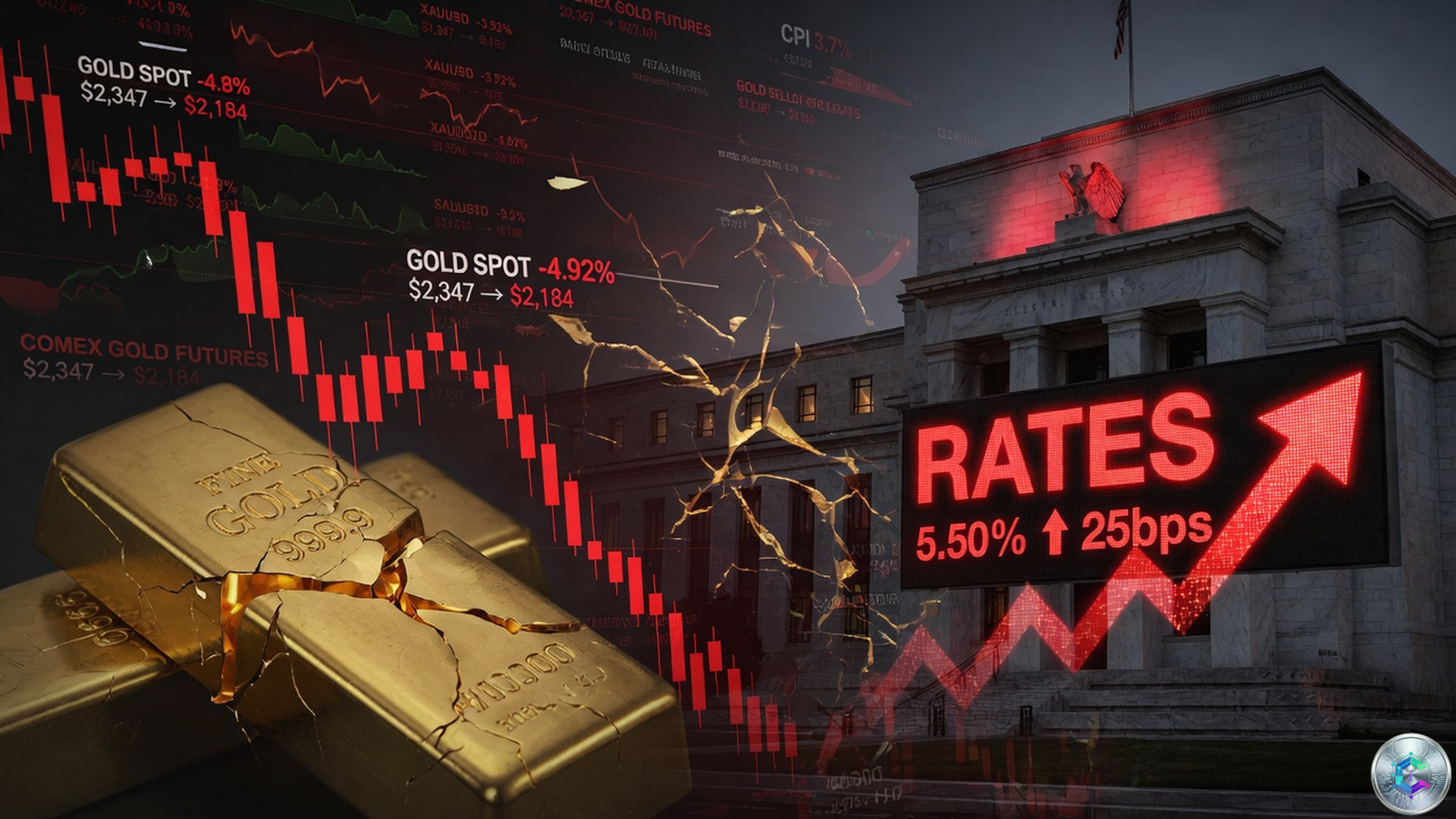
The June dot plot revealed that nine of the eighteen FOMC members projected higher rates by year-end. Core Personal Consumption Expenditures (PCE) inflation was revised up to 3.6%, and the CME Group’s FedWatch tool priced in a 60% probability of rates moving above the current 3.50%-3.75% range by October. Real yields—nominal Treasury yields adjusted for inflation—have climbed sharply, with the 10-year real yield exceeding 2.28%. For gold, which moves inversely to real interest rates, this hawkish repricing is a direct headwind, as it increases the opportunity cost of holding a non-yielding asset.
The Middle East Conundrum: Energy Shocks and Inflation Pipelines
Warsh inherited a divided committee and an economy still grappling with inflation. The most immediate pressure at his first meeting came from the escalating conflict in the Middle East, which pushed oil prices sharply higher. Brent crude rose above $68 per barrel, its highest level in over a year. During his Senate confirmation hearing, Warsh had revealed his preference for analyzing inflation through « trimmed-mean » averages, such as the Cleveland Fed’s 16% Trimmed Mean CPI.
This approach creates an unusual tension. Headline inflation may fall if oil prices pull back, but if underlying trimmed-mean measures remain elevated, Warsh has intellectual cover to maintain a hawkish stance. The transmission channel of energy inflation is lagged: costs for jet fuel, petrochemicals, natural gas, and fertilizers work their way through the economy over quarters. Warsh’s own research suggests higher inflation prints may not have fully arrived, keeping rate hike odds elevated into the fall.
A political dimension complicates the picture. Trump, who has long advocated for lower rates, remained conspicuously quiet after Warsh held rates steady with no hint of a cut. This presidential discretion offers Warsh maximum flexibility but creates maximum uncertainty for markets, especially as economic data softens and the political calendar intensifies.
Capital Rotation: From Gold to AI and SpaceX
Beyond the Fed and geopolitics, the quarter saw a significant rotation of capital away from gold toward what many traders call the « next big narrative. » The artificial intelligence boom—particularly the valuations of companies involved in AI chips, infrastructure, and applications—has absorbed enormous quantities of speculative capital. SpaceX’s record-breaking IPO, reportedly valuing the company at over $800 billion, drew further capital away from traditional haven assets.
« The narrative has moved to AI and SpaceX. »
Nicky Shiels, Analyst at MKS Pamp
A stronger dollar, which accompanied Warsh’s nomination, also weighed on gold, as the metal is priced in dollars and becomes more expensive for international buyers. The dollar index rose 0.2% to 96.44 on the day of the announcement. This rotation is visible in gold ETF behavior: while Asian retail investors continued buying physical bars and coins at record pace, U.S.-based ETF holders recorded net outflows in March 2026—the first since early 2024. According to the World Gold Council, physical bar and coin demand in Asia hit 474 tonnes in Q1, up 42% year-over-year, while Western institutional investors reduced their paper gold exposure.
The Debasement Trade Unwinds
One of the most significant structural forces behind gold’s multi-year bull run had been the « debasement trade »—fleeing paper currencies for hard assets like gold and Bitcoin. This trade flourished under former Fed Chair Jerome Powell, whose near-zero rates and balance sheet expansion eroded confidence in the dollar’s purchasing power. Warsh’s arrival appears to have disrupted this trade significantly. Gold peaked on January 30, 2026—the day Trump announced Warsh’s nomination—at $5,595 per ounce, before falling 23% in five months. The correlation between gold and real interest rates, which broke down during the debasement era, has firmly re-established.
China’s Retail Crackdown: Speculative Valve Closes
Beijing has added another layer of pressure on the gold market from the demand side. In June 2026, two of China’s largest state-owned banks—the Industrial and Commercial Bank of China (ICBC) and China Guangfa Bank—announced restrictions on retail precious metals trading. ICBC will cease providing intermediary services for individual clients to trade on the Shanghai Gold Exchange after July 24, while China Guangfa Bank ordered clients to liquidate positions by June 30.
This is not a new development—Chinese regulators have been tightening retail access to leveraged trading since late 2020—but their timing, coinciding with gold’s sharpest quarterly decline in a decade, has amplified their impact. These restrictions effectively close the speculative valve that allowed millions of Chinese retail investors to take leveraged positions in gold. For Nitesh Shah, head of commodities at WisdomTree, any measure aimed at curbing speculative gold purchases cannot be bullish for prices in the near term.
Central Banks: The Counter-Cyclical Buoy
Against this backdrop of retail outflows and ETF redemptions, the most striking feature of the current gold market is the unwavering appetite of the world’s central banks. In Q1 2026, they purchased a net 244 tonnes of gold—a 3% year-over-year increase and the seventeenth consecutive quarter of net purchases. These institutions were buying at multi-year high prices, through the correction, not around it.
The 2026 Central Bank Gold Reserves Survey by the World Gold Council, conducted with 76 participating institutions, paints a striking picture: a record 45% of central banks plan to increase their gold reserves over the next 12 months, up from 29% two years ago. An extraordinary 89% of respondents expect global central bank gold reserves to increase, while only 1% expect a reduction. An OMFIF survey found that a net 30% of central banks plan to increase gold allocations over one to two years, and 61% expect gold to settle between $5,000 and $6,000 per ounce. The drive to reduce dollar exposure is also notable: 24% of central banks intend to reduce dollar holdings—a record—while the yuan and euro are gaining ground.
« Central banks are buying gold for its performance during crises and its ability to preserve purchasing power over the long term—a diversification that dollar-denominated assets cannot offer. »
World Gold Council, 2026 Survey Report
This behavior is not speculative but strategic. Central banks are not trying to time gold’s price; they are adding to reserves because gold performs a structural role in a diversified balance sheet, a calculation almost entirely insensitive to quarterly price movements.
Conclusion: The Battle Between Private Selling and Official Buying
The gold market in mid-2026 is caught between two powerful and opposing forces. On one side, private investors—particularly in the West—are reducing exposure in response to higher real yields, a stronger dollar, and a less predictable Fed. The speculative positions that pushed gold to $5,595 in January have been largely unwound. On the other side, central banks are buying at a record pace, reinforcing a structural demand floor that private selling alone cannot breach. This divergence—private capitulation against official accumulation—has historically preceded the most significant gold reversals.
The critical variable for the next several months is the path of real interest rates, which depends on inflation data and the Fed’s reaction. If trimmed-mean inflation remains hot, the Fed may be forced to raise rates despite political pressure, keeping real yields elevated and weighing on gold. Conversely, if Middle East tensions de-escalate and oil prices pull back, the energy inflation narrative may prove transitory, giving Warsh room to pause or signal a cut—creating the environment gold bulls have been waiting for. Traders should watch the technical floor at $3,943, ETF outflows, central bank purchasing data from China, Turkey, Poland, and India, and the dollar index. The structural case for gold has not been destroyed by this quarter’s decline—it has been interrupted. The fundamental forces that drove gold to $5,595 in January are still there; the only question is timing.
Sources
- CoinAcademy: Or : pire trimestre en plus de dix ans, sous les 4 000 $
- FXStreet: How Kevin Warsh Upended the Game Plan for Gold
- GoldSilver: The Fed Just Killed Its Rate Roadmap. Here’s What That Means for Gold.
- Yahoo Finance UK: Gold prices fall as Trump announces Kevin Warsh as Fed chair pick
- OMFIF: Central banks are riding the wave of persistent volatility
- World Gold Council: Central Bank Gold Reserves Survey 2026
- World Gold Council: Gold Demand Trends Q1 2026 — Central Banks
- KuCoin / Nai500: End of Retail Bank Gold Leverage in China as ICBC Halts Trading
- CryptoBriefing: Chinese banks shut down retail trading services for precious metals
- GoldSilver: WGC Q1 2026: What Asia Knows That Wall Street Doesn’t
This article is published for informational and educational purposes only. It does not constitute investment advice. Conduct your own research (DYOR) before making any decisions.

