

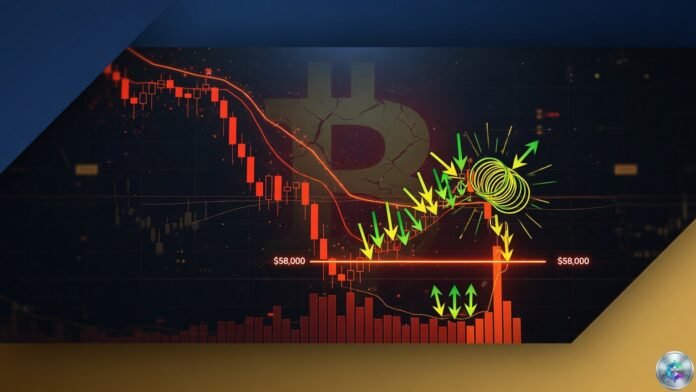
Bitcoin cratered more than 5% on June 25 to hit $58,000 — its lowest level since 2024 — before bouncing to around $59,400. Between crowded short positioning, record ETF outflows and a hawkish Federal Reserve, a textbook short-squeeze setup is emerging beneath the market chaos.
Key Takeaways
- Bitcoin plunged to $58,000, its lowest since 2024, before recovering to $59,400
- Liquidation risk is concentrated above current price — a setup that favors the long side
- Negative funding rates and rising open interest reveal overcrowded bearish positioning
- Fed Chair Kevin Warsh signals at least one rate hike in 2026, killing the rate-cut narrative
- The Fear & Greed Index collapsed to 18, deep in Extreme Fear territory historically linked to market bottoms
A Swift Crash Amid a Perfect Macro Storm
The June 25 session opened with a gut-wrenching 5% nosedive that drove Bitcoin from $61,200 to $58,000 within hours. That floor, which had held since the depths of the 2024 bear market, finally gave way under a toxic combination of forces. The CoinDesk 20 Index retreated an additional 1.8%, while Ether shed roughly 5.5% to settle near $1,550. Most major altcoins posted losses between 3% and 5%.
Throughout May, Bitcoin had traded in a relatively stable range between $68,000 and $75,000. That consolidation zone turned out to be a distribution range rather than a foundation, and the breakdown that followed in June was swift and brutal. Key catalysts included record-breaking ETF outflows, an unexpectedly hawkish Federal Reserve under new Chairman Kevin Warsh, stubbornly elevated inflation driven by Middle East energy shocks, and geopolitical tensions that have pushed crude oil to multi-year highs.

Liquidation Heatmap Favors the Bulls
One of the most compelling observations from the June 25 session comes from derivatives analytics — specifically a liquidation heatmap cited by CoinDesk. The data reveals that the bulk of clustered liquidation risk sits above current prices, not below them. In practical terms, this means that further downside is unlikely to be amplified by a cascade of forced selling from short liquidations. The real danger, according to this analysis, lies in wait for the bears.
When a market drops and short sellers pile in — drawn by what appears to be a clear directional bet — the resulting concentration creates a fragile equilibrium. If prices stabilize or bounce even modestly, shorts are forced to cover to avoid funding fees or liquidation. That covering generates buying pressure, which triggers more covering, which generates more buying. The result is a rapid and often violent reversal that catches the consensus trade entirely wrong-footed.
The past 24 hours of data supports this reading. Open interest in Bitcoin futures rose approximately 0.28% even as price fell by around 3%. This is a counter-intuitive signal: when prices drop and open interest rises, it typically means traders are not closing positions in response to the decline — they are doubling down and opening new shorts, betting that the $58,000 floor will finally crack. This is precisely the kind of overcrowded trade that professional traders and market makers target when seeking weakness to exploit.
Negative funding rates in Bitcoin futures reinforce this interpretation. When funding rates turn negative, the market is collectively paying a premium for downside exposure — short positions are being incentivized relative to longs. This signals crowded bearishness, which is precisely the condition that precedes short squeezes. The combination of rising open interest during a price decline, concentrated short positioning, and negative funding rates is a pattern that has preceded numerous violent reversals in Bitcoin’s history.
The Spot Market Depth Signal
Perhaps the most compelling technical argument for a short squeeze comes from spot market depth analysis using CoinGlass data. There are approximately 6,900 BTC in bid orders between the current price and $50,000, representing roughly $409 million in buy-side liquidity. On the ask side — sell orders between current price and $70,000 — there are only 1,570 BTC, representing approximately $93 million.
The disparity is striking: there is more than four times the sell-side liquidity above the market as buy-side liquidity below it. This creates a bullish skew in supply. When the market attempts to move higher, it faces relatively thin resistance from sell orders. When it attempts to move lower, it runs into a wall of buy orders capable of absorbing selling pressure. It is the opposite of the distribution pattern that characterizes market tops, where large sell walls accumulate above as sophisticated players distribute holdings to late-arriving buyers.
The Fed’s Hawkish Pivot: The Macro Headwind That Changes Everything
To fully grasp the gravity of the current moment, it is necessary to zoom out from the technical picture and examine the macroeconomic context driving crypto lower since early June. The single most important development is the Federal Reserve’s dramatic monetary policy shift under new Chairman Kevin Warsh, who succeeded Jerome Powell in May 2026.
Warsh’s first FOMC meeting on June 17, 2026 maintained the benchmark fed funds rate at 3.50%–3.75% with a unanimous 12-0 vote. But the real story was buried in the updated dot plot — the chart showing where Fed officials expect interest rates to go. In March 2026, policymakers had projected rate cuts through year-end, with the median expectation pointing to 3.4% by December. The June update inverted this picture entirely. Nine of 18 FOMC members now expect at least one rate hike before year-end, with six projecting two. The median projection jumped to 3.8% — a full 40 basis points higher than the March forecast. Forward guidance, a fixture of Fed communications since the pandemic-era rate cuts, was stripped out entirely and replaced with language focused on delivering price stability.
The inflation backdrop makes this pivot understandable, if no less painful. The Consumer Price Index rose 4.2% year-over-year in May 2026 — the largest increase since April 2023 — driven by Middle East energy shocks. The Fed’s preferred PCE inflation gauge is now forecast to reach 3.6% for 2026, sharply higher than the 2.7% March forecast, with core PCE expected at 3.3%. These are figures that give a Fed committed to its 2% inflation target no room to ease, even as the economy shows signs of slowing.
« A hawkish Federal Reserve hurts crypto through three reinforcing channels: higher rates reduce capital flows to speculative assets at the far end of the risk spectrum; a stronger dollar creates headwinds for dollar-priced assets; and rising real yields make it more expensive to hold non-yielding assets. »
Crypto.news, analysis of the Fed’s June 2026 decision
Warsh’s removal of forward guidance injects a new layer of uncertainty into markets that had grown accustomed to relying on the Fed’s quarterly projections for directional cues. Without forward guidance, the market must now price a wider range of outcomes, which typically leads to increased volatility and a higher risk premium being applied to assets like cryptocurrencies. The Fed is no longer telegraphing its moves in advance, and this opacity is particularly challenging for an asset class that has historically shown high correlation with changes in monetary policy expectations.
Record ETF Outflows and the Institutional Exodus
The institutional hemorrhage forms the immediate pillar of June’s correction. According to CoinStats data, Bitcoin spot ETFs recorded their sixth consecutive week of outflows for the week ending June 24, 2026, with total net outflows reaching $5.94 billion. Over the preceding 30 days, cumulative outflows reached $6.23 billion, with 26 out of 30 trading days recording net negative flows.
June 24 alone saw outflows of $81.40 million, following a two-day total of $195.20 million. The largest single-day redemption events have exceeded $1 billion — a level of institutional withdrawal that would have been unthinkable when spot ETFs first launched in early 2024. The breakdown by provider reveals the breadth of the retreat: Grayscale’s GBTC saw redemptions of $54.30 million, while ARK’s ARKB posted outflows of $50.70 million on June 24. These are not trivial figures, but they represent only a fraction of total assets under management across the spot Bitcoin ETF complex, suggesting that selling has been broad-based rather than concentrated.
An additional signal of institutional distress comes from the Coinbase Premium Index, which collapsed to -0.15% in early June. This indicator measures the spread between Bitcoin’s price on U.S. exchanges and offshore venues. A negative premium of this magnitude represents a historic reversal — U.S. institutional buyers are paying less for Bitcoin than their offshore counterparts, or are net sellers relative to the global market. CFTC Commitment of Traders reports confirm the shift: asset managers have significantly reduced leveraged long positions while hedge funds have increased short exposure. The sophisticated money, in other words, is positioned for continued downside.
Strategy’s Historic Bitcoin Sale: Symbolic and Practical Implications
Among the most symbolically significant events of the June 2026 selloff was the disclosure that Strategy — the corporate treasury company formerly known as MicroStrategy — sold approximately 32 BTC from its reserves. The company, which at its peak held over 500,000 BTC valued at more than $20 billion, had previously pledged under Michael Saylor’s leadership to hold its Bitcoin for 100 years. Even a minor sale represents a meaningful departure from that stated philosophy.
Strategy’s shares (ticker MSTR) fell 11% to a 2.5-year low, reinforcing bearish sentiment around corporate Bitcoin exposure and raising questions about potential margin calls on debt instruments used to finance Bitcoin acquisitions. If Bitcoin drops to $50,000, as some technical analysts now project, Strategy could be forced to sell additional holdings to meet obligations, potentially creating cascading selling pressure that further depresses the market.
Despite the broad retreat, select institutional buyers have emerged at lower levels. Strategy purchased 520 BTC for approximately $35 million in one of the lower tranches of its ongoing acquisition program. Strive, another corporate Bitcoin holder, added 759 BTC for roughly $50 million at an average price of $65,850 per coin, according to an SEC Form 8-K filed on June 22. These purchases are relatively small compared to the scale of ETF outflows, but they suggest the long-term store-of-value narrative has not been abandoned — it has merely been temporarily overwhelmed by macro and technical forces.
Fear & Greed at Extreme Readings: Contrarian Signals
The Fear & Greed Index — one of crypto’s most reliable contrarian indicators — fell to 18 on June 24, firmly in Extreme Fear territory with a seven-day average of 19. This is among the lowest readings since the index was introduced, placing the market squarely in the zone that contrarian analysts associate with capitulation phases and potential bottoming signals. The logic is straightforward: when sentiment becomes overwhelmingly negative, most natural sellers have already sold, and remaining holders are the most committed believers in the asset’s long-term thesis.
The total peak-to-trough decline from Bitcoin’s all-time high of $126,000 in May 2025 to the current $58,000 level represents approximately 54%. This is severe but not unprecedented. The 2017–2018 cycle saw drawdowns exceeding 80%, and the 2021–2022 cycle included a 75% decline from $69,000 to approximately $16,500. At the current level, Bitcoin has retraced roughly half its distance from the all-time high to what some analysts consider a plausible bear market floor in the $50,000–$55,000 range.
Ethereum’s Deeper Drawdown and the Altcoin Landscape
While Bitcoin’s decline dominated headlines, Ethereum’s performance during the June 2026 correction has been even more dramatic. ETH traded below $1,600 during the worst of the June 25 selloff — a decline of approximately 65% from its all-time high of roughly $4,950. The breakdown below the $2,000 psychological and technical floor marks a significant deterioration in market structure, with prediction markets pricing a 71% probability of ETH testing $1,500 in coming weeks.
The ETH/BTC ratio has declined to levels not seen since 2022, consistent with historical patterns where Bitcoin outperforms Ethereum during severe bear phases as traders rotate toward simpler, more liquid market structure. Whether this rotation represents tactical repositioning or fundamental reassessment remains an open question.
The one notable exception to altcoin carnage has been Hyperliquid, the decentralized perpetual futures exchange that attracted nearly $150 million in assets since its May 2026 launch, with mostly positive inflow days. The platform has processed approximately $2.99 trillion in perpetual futures volume and $5.5 trillion in open interest over its lifetime, and its fee-based token buyback mechanism — which uses trading fees to repurchase and retire the native HYPE token — has proven attractive to investors seeking infrastructure exposure with tangible product-market fit.
Technical Analysis: Support Levels and the Bear Flag
From a purely technical perspective, June 2026’s breakdown confirmed a bear flag formation that completed on June 24. The downside target, if confirmed, projects to the $54,000–$56,000 range — a meaningful extension of the decline from the $77,623 peak reached on May 25.
Key support levels identified by technical analysts include:
| Level | Significance | Type |
|---|---|---|
| $62,457 | 200-week moving average | Major support |
| $60,000 | Psychological round number | Support |
| $58,000 | Current floor | Immediate support |
| $55,000–$54,000 | Major structural zone | Structural support |
| $50,000 | 50% correction from ATH | Worst-case target |
On the upside, immediate resistance sits at $62,800–$63,100 (24-hour high), with a critical cluster at $65,500–$67,180 corresponding to the underside of the broken May 2026 trading range. Bitcoin is currently trading below all key moving averages — 20-day, 50-day, 100-day, and 200-day — a condition that historically precedes extended bearish phases rather than V-shaped reversals. The daily RSI at 37 is approaching oversold territory but has not yet reached the deeply oversold levels below 30 that historically correspond to short-term bottoms. The weekly RSI at 34 remains below the 41.5 bull/bear threshold, confirming that higher-timeframe momentum remains firmly bearish.
What Comes Next: Positioning vs. Macro
The central tension in Bitcoin markets as of late June 2026 is between a positioning setup increasingly conducive to a short squeeze and a macro environment that remains unambiguously hostile. The Fed’s hawkish turn, elevated inflation, record ETF outflows, and geopolitical uncertainty all argue for continued caution. Yet derivatives data — crowded short positioning, negative funding rates, thin sell-side liquidity above the market, and thick buy-side liquidity below — suggests the path of least resistance may be up rather than down.
Past cycles suggest bear markets do not end with capitulation alone — they require a catalyst. The 2022 bottom was preceded by FTX’s collapse and complete confidence destruction. The 2020 COVID crash bottomed only after the Fed launched unprecedented emergency easing. The current setup may be building toward something similar: a short squeeze triggered by a catalyst yet to emerge — perhaps a dovish inflation print, a de-escalation in the Middle East, or simply the mechanical dynamics of crowded short positioning meeting a quiet weekend with thin liquidity.
Conclusion
The June 2026 correction reveals a fundamental truth about cryptocurrency markets: their technological sophistication does not render them immune to traditional monetary cycles. The rate-cut trade that underpinned much of the bull case has been dismantled by the Fed’s unexpected hawkish pivot. The institutional demand that spot ETFs were supposed to provide has proven cyclical rather than permanent, evaporating quickly when the macro environment deteriorates.
For traders navigating the current environment, the key variable to watch is not Bitcoin’s headline price but the behavior of open interest and funding rates during any attempted bounce. If short sellers begin covering and that covering pushes Bitcoin back above the $62,000–$63,000 resistance zone, the squeeze could extend rapidly toward the $65,500–$67,180 cluster. Conversely, if the bounce fails to attract follow-through buying and open interest rises during recovery, it would suggest new shorts being opened to fade the rally — arguing for lower prices ahead. The lesson is clear: in moments of macro crisis, the most explosive setups emerge at the intersection of crowded positioning and mechanical market dynamics, regardless of which side the consensus is leaning.
Sources
- CoinDesk — Bitcoin price news: BTC hits $58,000 but a short-squeeze could set up for bounce (June 25, 2026)
- CoinStats AI — Bitcoin (BTC) Daily Market Analysis — June 25, 2026
- Intellectia AI — Crypto Market Crash June 2026: Bitcoin’s Worst Week as Institutional Investors Flee
- Crypto.news — Kevin Warsh just killed crypto’s rate-cut trade (June 2026)
- CoinDesk — Federal Reserve holds rates steady in first decision under Chairman Kevin Warsh (June 17, 2026)
This article is published for informational and educational purposes only. It does not constitute investment advice. Do your own research (DYOR) before making any decisions.

