

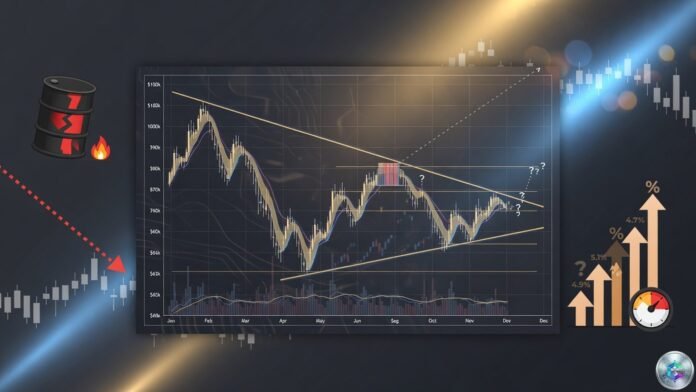
Bitcoin finds itself in a peculiar position as June 2026 unfolds. While the initial shockwaves from the Iran-conflict oil crisis have largely subsided in energy markets, the reverberations continue to echo through Bitcoin’s price action, keeping the digital asset pinned within a frustratingly familiar range. The question on every trader’s mind is simple: when will Bitcoin break free from this gas-price hangover?
Key Takeaways
- Bitcoin trades near $64,000, mid-range within the $57,000 to $77,000 channel defined by the Strait of Hormuz shock.
- U.S. inflation remains elevated with May CPI at 4.2% year-over-year, a three-year high.
- The Fed holds rates between 3.50% and 3.75%, revises inflation forecasts higher, and awaits August data.
- ETF flows show consolidation, with total net assets around $77.58 billion.
- Four scenarios are outlined for coming months, based on inflation data and geopolitical risks.
Bitcoin Stuck Mid-Range as Oil Shock Fades
As of late June 2026, Bitcoin trades near $64,000, sitting roughly in the middle of the $57,000 to $77,000 channel that has defined the market since the Strait of Hormuz shock sent oil prices soaring earlier in the year. The cryptocurrency has failed to mount a decisive breakout in either direction, a consolidation pattern that analysts attribute to lingering uncertainty about the inflation outlook. This range-bound behavior is not without historical precedent; markets often spend extended periods consolidating before a catalyst emerges.
« Absent a decisive catalyst, the path of least resistance is range-trading driven by positioning and flows rather than fresh spot demand, » explained Can-Luca Koymen, Investment Strategist at Sygnum Bank, in a recent client note.
Can-Luca Koymen, Investment Strategist, Sygnum Bank
Structural forces reinforce this range-bound dynamic. BlackRock’s covered-call ETF, ticker BITA, sells call options against its holdings, introducing recurring profit-taking on rallies. Recent ETF outflows reflect profit-taking and macro de-risking rather than structural exits, with total Bitcoin ETF net assets at approximately $77.58 billion, similar to post-Trump election levels in late 2024.
The May CPI Shock: Why It Still Matters
The May Consumer Price Index report delivered a stark reminder that the oil shock was not merely a passing episode. Headline CPI rose 0.5 percent month-over-month and 4.2 percent year-over-year in May—a three-year high that put inflation more than two percentage points above the Federal Reserve’s 2 percent target. Gasoline prices jumped 7.0 percent for the month alone and were up a staggering 40.5 percent year-over-year.
The Federal Reserve responded by holding its federal funds rate target steady in the 3.50 percent to 3.75 percent range at its June meeting, but updated projections caught markets off guard. The 2026 Personal Consumption Expenditures forecast was revised sharply higher to 3.6 percent from 2.7 percent, while the core PCE forecast climbed to 3.3 percent from 2.7 percent. These upward revisions signal that the Fed itself views the inflation shock as more persistent.
The critical data calendar includes: June CPI on July 14, July CPI on August 12, July PCE on August 26, August CPI on September 11, and the OFAC General License X expiration on August 21. Notably, August PCE data arrives on September 30, after the Fed’s September 17 meeting.
Key Inflation Data and Calendar
| Date | Data | Expected Impact |
|---|---|---|
| July 14 | June CPI | Still partially affected by shock |
| August 12 | July CPI | First cleaner read |
| August 26 | July PCE | Additional perspective |
| September 11 | August CPI | Final major read before FOMC |
| August 21 | OFAC License Expiration | Key geopolitical risk node |
« Energy shocks pass through inflation with a lag, so a single softer reading does not undo it. A read that genuinely reflects post-normalization realistically only shows up in the August data, which is the print the FOMC weighs in September, » noted Koymen.
Can-Luca Koymen, Investment Strategist, Sygnum Bank
Structural Forces and Market Dynamics
Beyond immediate inflation and oil dynamics, the oil futures curve suggests markets have priced resolution, with WTI contracts trading below $75 per barrel and the Cboe Oil Volatility Index cooling to pre-war levels. WTI crude has retraced more than 16 percent from crisis peaks to around $87 per barrel.
Bitcoin’s macro sensitivity in 2026 is heightened, with the cryptocurrency integrated into conventional financial markets. Fed rate decisions affect Bitcoin through liquidity and opportunity cost dynamics; rising real yields historically weigh on Bitcoin’s price. The liquidity environment is critical, with correlations to global M2 money supply. The U.S. dollar’s strength remains a persistent headwind when it appreciates, tightening global financial conditions.
The transitory versus persistent inflation debate is crucial. According to MUFG Research, a 0.3 percent month-over-month core inflation reading could prompt an initial rally if seen as transitory. Charles Schwab documents the complex transmission mechanism: a permanent 10 percent increase in oil prices adds roughly 0.4 percentage points to headline CPI over a year, with indirect effects lasting around 20 months. Food inflation, at 2.6 percent annually in February 2026, is particularly sensitive due to fertilizer and natural gas links through the Strait of Hormuz.
Scenarios and Outlook for Summer 2026
Four scenarios are sketched. In the bull case, oil curve eases, July and August CPI/PCE prints show clear relief, OFAC license extends, reviving hopes for a September Fed rate cut and challenging Bitcoin above $77,000. In the base case, oil improves but confirmation comes slowly, ETF accumulation remains muted, Fed holds rates steady, and Bitcoin remains in the $57,000 to $77,000 channel.
In the bear case, gasoline and goods prices prove sticky, August prints run hot, Fed signals more hikes, and Bitcoin breaks below $57,000. In the tail-risk scenario, OFAC license expires without extension, oil spikes again, inflation re-accelerates, and Fed faces pressure to tighten aggressively into slowing growth—a stagflationary trap damaging to Bitcoin’s investment case.
Conclusion
The summer of 2026 appears to be one of guarded patience for Bitcoin. The oil shock is fading in real terms, but its effects on inflation data have not fully washed out. Bitcoin remains tethered to macroeconomic data releases, Fed communications, and the evolving oil price narrative. Whether it breaks out or falls back depends on whether August inflation data confirms the oil shock’s effects are genuinely transitory. Until that confirmation arrives, range trading driven by positioning and flows rather than fresh spot demand is likely to dominate, keeping the gas-price hangover until cleaner inflation data arrives.
Sources
This article is published for informational and educational purposes only. It does not constitute investment advice. Conduct your own research (DYOR) before making any decisions.

