


Charles Schwab, a U.S. brokerage giant, partners with Cboe Global Markets to integrate prediction market-style contracts into its traditional brokerage environment, targeting the S&P 500 with an innovative partial payout structure.
🔑 Key Takeaways
- Schwab and Cboe are launching binary options on the S&P 500 with a « Plus Zone » feature for partial payouts.
- Contracts are traded via existing listed options infrastructure, offering regulatory compliance.
- The partnership directly threatens Polymarket and Kalshi, crypto-native platforms, due to Schwab’s reach (34 million accounts).
- Target market is short-term directional trading, similar to 0DTE options, with average daily volume of 580,000 contracts in 2025.
The Schwab-Cboe Partnership: Mechanics and Regulatory Framework
On June 19, 2026, The Wall Street Journal reported that Charles Schwab, one of the largest brokerage firms in the United States with tens of millions of retail accounts, had partnered with Cboe Global Markets to bring prediction market-style contracts directly into the traditional brokerage environment. This collaboration represents one of the most significant developments in retail financial products in recent memory, with far-reaching implications for both traditional finance and the burgeoning crypto prediction market sector.
The announcement sent ripples across Wall Street and the crypto industry. Schwab, a household name in American retail investing, handles trillions of dollars in client assets and serves millions of Main Street investors who already use its platform to buy stocks, ETFs, and options. The addition of prediction market contracts to that ecosystem means that a simple yes-or-no wager on whether the S&P 500 will close above a certain level could soon be executed from the same screen where a client checks their retirement portfolio. This is a fundamental shift in accessibility, bringing a product category that once required crypto fluency into the familiar territory of a licensed, regulated brokerage account.
At its core, the collaboration centers on binary options tied to the performance of the S&P 500 index. Specifically, the product is based on Cboe’s Mini-SPX binary options infrastructure. These are European-style option contracts that pay out a fixed cash amount if the settlement value of the underlying Mini-Standard & Poor’s 500 Binary Index meets or exceeds the exercise price at expiration, or pay nothing if the condition is not met. The settlement value is calculated as one-tenth of the official closing price of the S&P 500 Index, rounded to the nearest cent.
Unlike traditional prediction market platforms that use tokenized shares and stablecoin collateral, these contracts are structured as listed options. They will be cleared through the Options Clearing Corporation (OCC), the same clearinghouse that processes the vast majority of U.S. listed options trades. This distinction is critical. By wrapping prediction market mechanics inside a traditional options wrapper, Schwab and Cboe sidestep many of the regulatory and operational challenges that have kept crypto prediction markets at arm’s length from mainstream investors.
| Aspect | Schwab-Cboe | Polymarket | Kalshi |
|---|---|---|---|
| Regulation | Listed options, OCC | Legal gray area, non-U.S. | CFTC, DCM |
| Collateral | Brokerage account, cash | Stablecoins (pUSD) | Fiat or crypto |
| Resolution | Official S&P data | Decentralized oracles | Public data |
| Accessibility | 34M Schwab accounts | Crypto wallet required | Separate account |
« Cboe’s planned prediction market contracts help new investors benefit from the market-leading integrity, governance, and reliability of the S&P 500 within a simple and easy-to-access contract structure. »
Cameron Drinkwater, Chief Product Officer at S&P Dow Jones Indices
The Plus Zone Innovation: A New Paradigm for Binary Markets
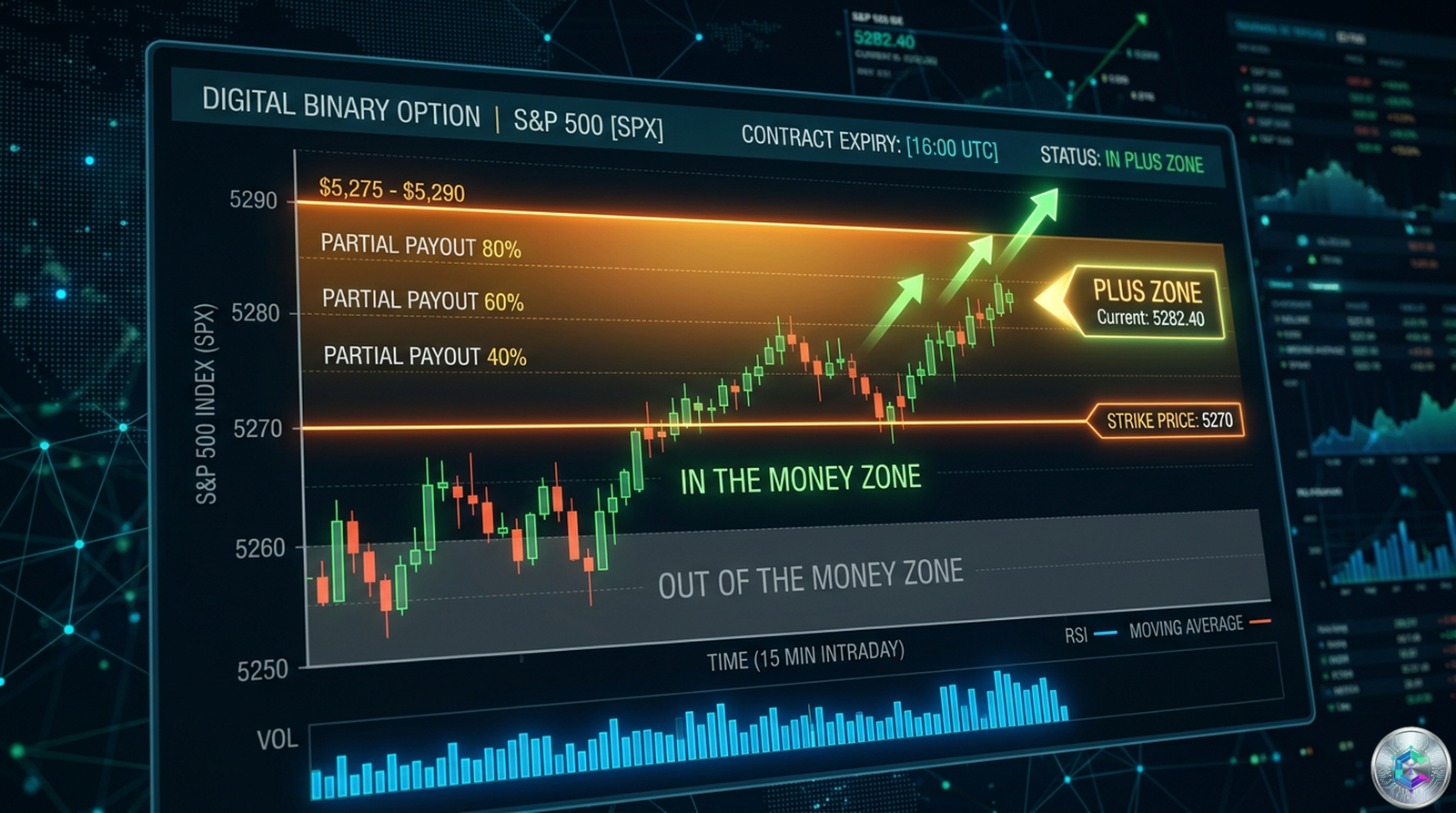
A particularly innovative aspect of the product is the « Plus Zone, » a feature Cboe has been developing as part of its broader prediction markets framework. Announced in March 2026, the Plus Zone introduces a third tier to what would otherwise be a binary outcome. Under this framework, if a trader’s prediction is directionally correct but not precisely on target, they can still receive a partial payout rather than nothing. This addresses one of the key limitations of traditional binary contracts, where being almost right is functionally the same as being completely wrong.
As Cboe explained, the concept borrows from the mechanics of a vertical spread, one of the most popular options strategies among retail traders, but packages it in an intuitive, accessible format. The three-tier payout structure effectively rewards informed perspectives even when the trader does not nail the exact outcome. For a retail investor who has heard of but never used vertical spreads, the Plus Zone offers a way to express a similar view without learning about strike prices, leg pricing, or multi-leg order entry. It is a simplification, but one that retains the economic substance of the strategy.
This design choice also has risk-management implications. Because partial losses are built into the Plus Zone structure, a trader who misses the target by a small margin does not lose their entire position. This reduces the volatility of outcomes and may make the product more psychologically comfortable for risk-averse retail investors. It also aligns the product more closely with the way people actually form opinions about market direction, which are rarely binary.
The numbers behind the opportunity are compelling. Cboe’s March 2026 announcement referenced an extraordinary data point about existing retail appetite for directional, event-based trading: in 2025, average daily volume in zero-days-to-expiration (0DTE) SPX options reached approximately 580,000 contracts per day. These are options that expire at the end of the same trading day on which they are purchased and have become one of the most popular retail trading products in recent years. The 0DTE phenomenon demonstrated that there is enormous retail demand for simple, high-conviction directional bets on the S&P 500, particularly around market open and close. Prediction market contracts are in many ways a natural evolution of that demand, offering a cleaner interface and a more intuitive payout structure than the raw mechanics of 0DTE options.
Implications for Crypto-Native Platforms: Threat or Opportunity?
The obvious question is whether Schwab and Cboe will eat Polymarket and Kalshi’s lunch. The honest answer is: partially, but not entirely. The brokerage-based product is deliberately narrow in scope. It will focus exclusively on financial events, specifically the S&P 500 and potentially other major market indexes. The contracts will be tied to objectively verifiable, easily settled outcomes: did the index close above or below a specified level on a given date? This is the cleanest, most regulator-friendly slice of the prediction market universe, and it is the one most naturally suited to a listed options wrapper.
Crypto-native platforms, by contrast, have built their businesses on breadth. Polymarket’s volume has historically been concentrated around political events, particularly U.S. elections, where the combination of high stakes, cultural relevance, and global participation creates liquidity that no regulated derivatives exchange can match in that category. Sports, entertainment, pop culture, and long-tail events that are difficult or impossible to wrap in a traditional options contract are natural territory for decentralized platforms. The regulatory approval process for launching a new contract type on a regulated exchange is measured in months or years; the speed with which Polymarket can open a market on virtually any resolvable question is measured in hours or days.
There is also a meaningful difference in the trading experience. Crypto prediction markets offer global participation, which drives liquidity and often more accurate forecasting. Polymarket’s markets have developed a reputation for surprisingly accurate predictions across a wide range of topics, partly because of the diverse, global pool of participants. A Schwab customer betting on the S&P 500 through their brokerage account is participating in a more constrained market with a narrower participant base.
« The product makes the clearest retail use case feel safer, cleaner, and closer to the investor’s existing money. »
Industry commentary post-announcement
That said, the Schwab-Cboe product does address some genuine pain points that have limited the adoption of crypto-native prediction markets. Wallet security, stablecoin bridge risk, jurisdiction restrictions, and the occasional controversy around market resolution have all been friction points. By delivering prediction mechanics inside a regulated brokerage environment, Schwab eliminates virtually all of that friction for the subset of customers whose primary interest is financial outcomes.
The Future of Prediction Markets: Scenarios and Outlook
The Schwab-Cboe partnership is expected to reach customer accounts in the coming months, pending final regulatory clearance. The initial product will focus on S&P 500 outcomes, with discussions ongoing to expand to other market indexes and financial benchmarks. The Plus Zone feature may be included from launch or introduced in a subsequent product iteration, depending on regulatory review timelines and product readiness.
Investors and market observers should watch several signals in the coming months. First, confirmation from Schwab about customer availability, product scope, and the mechanics of placing a prediction market trade through its platform. Second, Cboe’s fee filing and liquidity development for the Mini-SPX binary options, including how market-makers engage with the product and what bid-ask spreads look like in practice. Third, regulatory developments: the extension of the review period into July 2026 suggests that regulators are taking the product design seriously and are working through the implications for investor protection and market integrity.
For crypto-native prediction markets, the response strategy is likely to involve leaning harder into the categories where they have structural advantages: political and election markets, sports, cultural events, long-tail topics, and global markets where U.S. brokerage products cannot easily reach participants. The financial-event niche that Schwab and Cboe are targeting is valuable, but it is also finite. Polymarket and Kalshi have already demonstrated that the prediction market category is real and growing; now they need to demonstrate that they can retain their differentiated position even as traditional finance moves into their space.
Conclusion
The Schwab-Cboe partnership is a watershed moment for the prediction market industry. It signals that the category has become large enough, and the retail demand clear enough, that the largest players in traditional finance are willing to invest in bringing it to the mainstream. The product design, which wraps prediction market mechanics in a regulated options wrapper with cash settlement through the OCC, is a clever approach that minimizes regulatory friction while maximizing accessibility for the tens of millions of Schwab customers who already have accounts and options approvals.
Whether this spells doom for crypto-native prediction markets is far from clear. Polymarket and Kalshi have built genuine businesses around real demand, and they have structural advantages in breadth, speed, and global participation that regulated products cannot easily replicate. What is clear is that the prediction market category has crossed a threshold. It is no longer a niche crypto phenomenon or an academic curiosity. It is a product category that Charles Schwab and Cboe believe is worth hundreds of millions of dollars in development and regulatory investment. That validation alone changes the competitive landscape in ways that will play out for years.
Sources
- CryptoSlate: Charles Schwab prediction market partnership with Cboe
- CoinDesk: Schwab to Join Prediction Markets Race with S&P 500 Event-Based Options
- Cboe Global Markets: Cboe Introduces Innovative Prediction Markets Framework
- Seeking Alpha: Charles Schwab with Cboe Venturing into Prediction Markets
- GuruFocus: CBOE Partners with Schwab for Innovative Prediction Market Contracts
- Bitcoin.com: Report: Charles Schwab Targets Kalshi and Polymarket Territory
This article is published for informational and educational purposes only. It does not constitute investment advice. Conduct your own research (DYOR) before making any decisions.

