


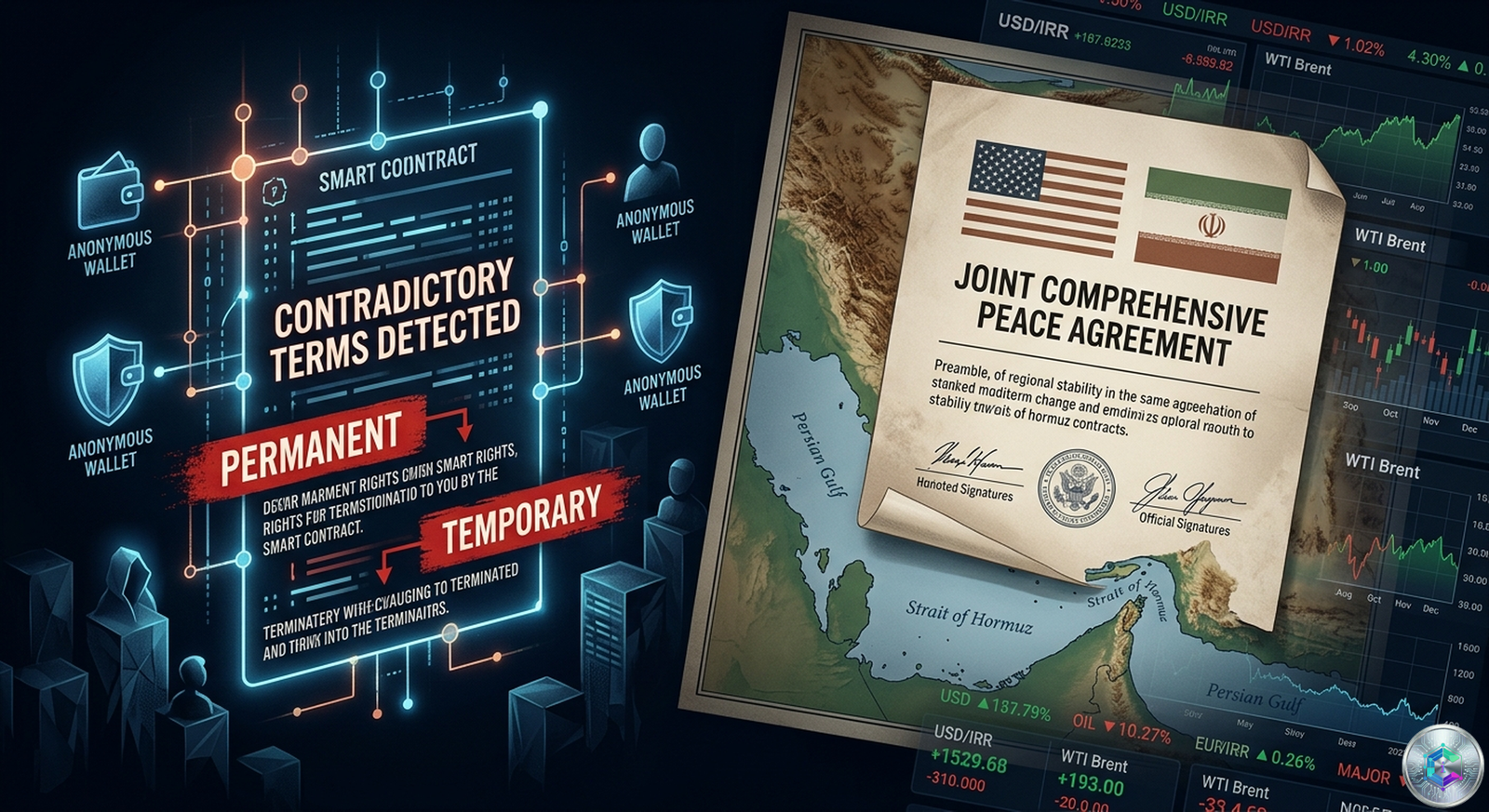
A single word — « permanent » — has paralyzed $345 million in trading on Polymarket, the decentralized prediction market platform, triggering the most consequential governance dispute in the platform’s history. The market asks whether the United States and Iran will sign a permanent peace deal, and the answer should theoretically be obvious: President Trump announced the deal was « complete, » Pakistani officials declared it signed, and financial markets rallied on the news. But the contract’s requirement that hostilities have « permanently ceased » has generated a fierce dispute that Polymarket’s decentralized arbitration system — run by anonymous cryptocurrency token holders voting via a Discord chatroom — is struggling to resolve.
🔑 Key Takeaways
- A $345 million market on Polymarket is stalled due to a dispute over defining « permanent » in a US-Iran peace deal.
- UMA governance, reliant on nine anonymous wallets, is under scrutiny for potential flaws.
- Allegations of insider trading emerge with well-timed bets before key announcements.
- The actual deal is a 60-day memorandum of understanding, not a full peace treaty, fueling the debate.
- Structural lessons for decentralized prediction markets are questioned amid geopolitical stakes.
The Stakes: A Market Larger Than Most Stock Indices
Polymarket has hosted more than $345 million in trading volume on whether and when the US and Iran would sign a peace deal, making this by far the largest market in the platform’s history. To put that figure in perspective, it exceeds the daily trading volume of many mid-cap publicly traded companies. A subset of this market — the contract resolving whether a deal would be signed by a specific Monday deadline — held $66 million in open positions.
When President Trump announced on June 11, 2026 that he had canceled scheduled strikes against Iran and that a peace deal would be announced shortly, the market surged. When Pakistani Prime Minister Shehbaz Sharif announced days later that the US and Iran had reached an agreement for the « immediate and permanent termination of military operations on all fronts, » the price of « Yes » shares climbed toward 90 cents on the dollar — meaning traders were pricing in an overwhelming probability that the contract would resolve positively. Then the dispute began.
The implications extend beyond technicalities. A $345 million trading volume on a geopolitical prediction market is unprecedented for Polymarket, which has grown from a niche political curiosity — best known for its 2024 US presidential election markets — into a financial instrument attracting colossal sums. This market moved global asset prices, with WTI crude oil plunging more than 5% to approximately $80 per barrel, the Nikkei 225 index surpassing 68,000 points, and Bitcoin reclaiming $65,000.
| Indicator | Value |
|---|---|
| Total Trading Volume | $345 million |
| Open Positions (Sub-market) | $66 million |
| Price of « Yes » Shares Post-Announcement | ~90 cents/$ |
| Deal Signing Deadline | June 19, 2026 |
The Contract’s Fatal Ambiguity
The Polymarket contract’s resolution rules state that any qualifying agreement must « explicitly indicate that military hostilities between the United States and Iran have ended or will permanently cease. » Temporary extensions of existing ceasefire agreements explicitly do not qualify. This distinction — between a genuinely new permanent peace agreement and a renewal of a temporary ceasefire — sounds straightforward in theory. In practice, it has proven nearly impossible to apply.
What emerged from the diplomatic negotiations mediated by Pakistan and Qatar was a June 15 memorandum of understanding that halted more than 100 days of conflict, lifted the US naval blockade of the Strait of Hormuz, and extended the ceasefire for 60 days, with a formal signing ceremony scheduled for June 19 in Switzerland. The key issues — including limits on Iran’s uranium enrichment program and verification mechanisms — were deferred to a subsequent 60-day negotiation period. There is no final, binding peace treaty. There is a memorandum of understanding. Whether that constitutes « permanent » cessation of hostilities is precisely what the dispute mechanism is now being asked to answer.
On one side of the dispute are traders who purchased « Yes » shares after Sharif’s announcement, which described the agreement in language that closely tracks the contract’s exact wording. On the other side are traders and UMA token holders who argue that the 60-day framework, the deferred nuclear negotiations, and the absence of a signed document mean the contract’s conditions have not been met. Some argue that an agreement reached under the pressure of imminent US military strikes, with the most contentious issues deliberately left unresolved, cannot reasonably be described as permanent.
The UMA Governance Problem: Nine Anonymous Wallets Decide $345 Million
Polymarket does not resolve disputed markets itself. Instead, it relies on UMA, a decentralized oracle protocol whose token holders vote on contested outcomes. The process works as follows: when a market’s outcome is disputed, anyone can propose a resolution. The proposal enters a two-hour challenge window during which anyone can dispute it. If disputed, the matter escalates to a UMA token holder vote. The token holders debate the topic in an online chatroom — specifically, a UMA Discord server — and then vote on the outcome.
The structural problem with this system has been documented extensively, but never more dramatically than in the current Iran market. Bloomberg analysis found that just nine anonymous wallet addresses control more than half of all UMA tokens used for dispute resolution voting. Those nine wallets — whose owners are unknown, whose potential conflicts of interest are undisclosed, and who face no formal accountability framework — can collectively determine the outcome of markets worth hundreds of millions of dollars.
« It’s highly unlikely that these are good-faith trades; it’s much more likely that these are insiders with access to information ahead of the public. »
Blake Moore, Representative
The incentive structure compounds the problem. When token holders vote to dispute a proposal, they stake a portion of their tokens. If their dispute ultimately prevails, they receive a reward. If it fails, they lose their stake. This creates a financial incentive to align with the expected majority rather than to adjudicate based on the objective facts of the situation. Critics have compared it to a jury that profits from reaching a particular verdict.
The result is a secondary market in which traders do not merely bet on whether the US and Iran will reach a permanent peace agreement — they bet on how the anonymous token holders will vote. The price of « Yes » shares reflects trader sentiment about the governance outcome, not merely the underlying geopolitical reality. As one analyst noted, the market has become a bet on what nine anonymous wallets will decide in a Discord chatroom, rather than a prediction of events in the Middle East.
A trader going by the pseudonym « wan123 » illustrates both the upside and the opacity of these markets. According to reporting by BigGo Finance, this trader accumulated « Yes » shares at an average cost of approximately 16 cents per share as the market was still priced at low probability. When the contract reached 88 cents following the deal announcement, the position was worth approximately $1.25 million — a gain exceeding 460 percent. Whether that trade reflected superior geopolitical analysis or advance knowledge of the announcement cannot be determined from public blockchain data.
The Insider Trading Problem
The Iran peace deal market is not the first time Polymarket has faced allegations of insider trading. In January 2026, a cluster of newly created accounts placed well-timed bets on the US government’s plans to abduct Venezuelan President Nicolas Maduro — bets that proved accurate in a direction that defied the publicly available evidence at the time. Two months later, the US launched an operation that did result in Maduro’s detention. Similarly, several accounts placed large, precise bets on the start of the US-Israel war on Iran before the first strikes occurred.
Reporting by AP News documented a specific example from April 2026: a group of accounts created on the morning of April 7 placed approximately $72,000 in « Yes » bets on a ceasefire at prices around 8.8 cents, earning roughly $200,000 in profits within hours when Trump announced the ceasefire later that evening. One account placed a bet just 12 minutes before Trump’s announcement. An account created the previous day placed an $11,283 bet on a US strike against Iran by March 1, then switched positions to bet on a ceasefire by March 31 and April 15 after the initial strike timeline passed.
« This is why these markets need regulation. We can’t have people trading with inside information and expect other traders are going to be OK being in these markets. »
Todd Phillips, Professor
Bipartisan legislation has been introduced to extend the definition of insider trading to cover prediction markets, and both Polymarket and its competitor Kalshi have publicly supported expanded rules. Representative Moore has also sponsored a bill that would restrict government and military officials from profiting from prediction market positions related to their official responsibilities. The fact that the platform operates across borders and uses pseudonymous blockchain accounts creates enforcement challenges that traditional securities regulation was not designed to address.
What the Deal Actually Contains and Market Reactions
Setting aside the market’s technical resolution, the underlying deal between the US and Iran is itself more limited than the initial announcements suggested. The June 15 memorandum of understanding establishes a 60-day framework in which Iran will clear mines from the Strait of Hormuz — a process expected to take approximately 30 days — and both sides will negotiate the more contentious issues, including Iran’s nuclear program and the status of its regional proxy forces, in Qatar during that period. The formal signing ceremony scheduled for June 19 in Switzerland is expected to produce another memorandum, not a binding peace treaty.
Israeli opposition adds a layer of complexity that the contract’s binary resolution cannot capture. Prime Minister Benjamin Netanyahu stated that Israel is not bound by the Lebanon provisions of any US-Iran agreement. Israeli airstrikes on Hezbollah targets in Beirut occurred during the period when the agreement was being finalized, prompting Trump to describe the timing as « unacceptable » and to accuse Netanyahu of being « very difficult to deal with. » A US official was quoted as saying that Israel was « attempting to sabotage » the agreement. Whether a peace framework that Israel explicitly disavows can constitute « permanent » cessation of hostilities is a question the UMA dispute process may have to answer, even though it is fundamentally a political rather than contractual question.
The announcement of the deal — even in its interim form — produced immediate and dramatic market reactions. WTI crude oil plunged more than 5 percent to approximately $80 per barrel. Brent crude fell below $84 per barrel. The Strait of Hormuz handles roughly a fifth of the world’s oil and liquefied natural gas shipments, and its reopening represents a fundamental shift in the global energy supply picture. The Nikkei 225 surpassed 68,000 points. South Korea’s KOSPI triggered a circuit breaker. Bitcoin reclaimed $65,000, touching $65,881 — a 12-day high.
Bank of America identified the primary beneficiaries of the de-escalation: Bitcoin, gold, and emerging market currencies, particularly the Indian rupee and Indonesian rupiah. These assets had been significantly de-leveraged during the conflict period, and their recovery reflects the expectation that the worst-case scenario — a prolonged closure of the Strait of Hormuz driving energy prices and inflation sharply higher — has been averted.
But a secondary trade has emerged that is more specific and more speculative: traders are positioning for the pace of Iran’s oil export restoration and OPEC+’s response to additional supply. The market has priced in the ceasefire, analysts noted, but not the full restoration of Iranian crude exports. How quickly Iranian oil returns to global markets, and how OPEC+ manages the additional supply, will determine whether the geopolitical risk premium in energy markets is fully unwound.
The Crypto Fear and Greed Index stood at 23 — « Extreme Fear » — even as traditional markets rallied. Traders, it seems, are acutely aware that the rally is built on a foundation of unsigned documents, unresolved nuclear terms, and an agreement that one party to the conflict has publicly stated it does not consider itself bound by.
The Structural Lessons
The Iran peace deal dispute has crystallized several structural tensions that have been building in Polymarket’s ecosystem for years. The platform has grown from a niche political curiosity — best known for its 2024 US presidential election markets — into a financial instrument attracting hundreds of millions of dollars in trading volume on consequential geopolitical events. That growth has outpaced the development of governance mechanisms adequate to the stakes involved.
Traditional financial exchanges like ICE and CME operate under regulatory frameworks that mandate professional committees, conflict-of-interest disclosures, and formal dispute resolution procedures. Polymarket’s dispute resolution depends on anonymous cryptocurrency token holders debating in a Discord server. A $345 million market is being resolved by nine wallet addresses whose owners may hold direct financial stakes in the outcome, who are identified by pseudonymous blockchain addresses rather than legal names, and who profit from reaching certain conclusions.
This is not merely a technical governance problem. It is a question of whether the financial markets that emerged from the 2008 crisis — with their emphasis on transparency, accountability, and systemic risk management — learned the right lessons. Decentralized prediction markets represent the antithesis of that regulatory philosophy. They are explicitly designed to operate without central authority, without disclosure requirements, and without accountability to any formal institution. For small markets on inconsequential questions, that structure may be perfectly adequate. For markets on whether the US and Iran are at war — markets that moved global oil prices and influenced how traders assessed geopolitical risk across asset classes — the governance model looks dangerously underpowered.
The dispute resolution process is also slow. The market will remain open during the UMA deliberation period, allowing traders to place bets on how the governance vote will resolve. This creates a meta-market that is entirely disconnected from the underlying geopolitical question. Whether the UMA token holders vote « Yes » or « No » may depend less on what actually happened in Geneva or Doha and more on which side of the debate attracts more persuasive arguments in a Discord thread, or which outcome would be more favorable to the anonymous wallets holding the largest UMA stakes.
For now, the traders who bet on the Iran peace deal — and the broader market that watched the $345 million market move global asset prices — are waiting for nine anonymous cryptocurrency wallets to cast their votes in a chatroom. The world’s most consequential financial judgment may depend not on diplomats, generals, or regulators, but on whoever controls those wallets.
Conclusion
The dispute on Polymarket over the US-Iran peace deal market exposes critical flaws in decentralized governance when facing high-stakes geopolitical events. Whether the UMA vote goes for « Yes » or « No, » the consequences will be profound: setting a precedent for resolving similar markets, increasing pressure for regulation, and prompting a reevaluation of decentralized prediction platforms’ reliability for global events. Future scenarios include heightened regulatory action from the SEC and CFTC, reforms to UMA governance, and a possible reassessment by traders of these platforms’ trustworthiness. The world now watches, not diplomats, but anonymous wallets, to decide a question that has already moved billions in financial assets.
Sources
- TheBlock
- TheNextWeb
- Yahoo Finance / Bloomberg
- BigGo Finance
- AP News
- Al Jazeera
- Polymarket
- Polymarket Documentation
This article is published for informational and educational purposes. It does not constitute investment advice. Conduct your own research (DYOR) before making any decisions.

