


The third-largest U.S. bank by assets, Citigroup, is making a bold entry into the tokenization of private company shares. In partnership with Switzerland’s SIX Digital Exchange (SDX), the banking giant is launching a platform to tokenize late-stage pre-IPO equities—a development set to reshape access to private markets estimated at $75 billion globally.
🔑 Key Takeaways
- Citigroup and SDX are launching a platform for tokenizing pre-IPO private company shares, with a live date targeted for Q3 2025.
- Citi will act as digital custodian and tokenization agent on SDX’s regulated DLT-based Central Securities Depository.
- The platform initially targets eligible private and institutional investors in Switzerland, Singapore, and broader Asia, currently excluding U.S. investors.
- The tokenized securities market is projected to reach $5.5 trillion by 2030, according to Citi Institute research.
- The initiative is part of Citi’s three-tier tokenization architecture, spanning payments, deposits, and private equity.
Why Tokenization Now?
The private equity market has long been plagued by inefficiencies. Investors navigating late-stage private companies face « a daunting set of PDFs and paper documents, » describes Nisha Surendran, Digital Asset Emerging Solutions Lead at Citi Ventures. Settlement times stretch across five to eight weeks, a process entirely repeated for each exit. Traditional private company shares do not appear in investor wealth statements, remaining trapped in fragmented systems. Companies like SpaceX, Anthropic, and OpenAI, each valued in the hundreds of billions, have remained private far longer than historical norms, intensifying pressure on investors seeking liquidity.
« The most notable characteristic of private markets is that there is no infrastructure, at least nothing scalable, » Surendran noted. The Citi-SDX partnership aims to change that by providing a regulated, scalable digital infrastructure for private share tokenization.
How the Platform Works
The Citi-SDX platform leverages the R3 Corda distributed ledger technology, the same infrastructure SDX has operated since 2021 under a license from Switzerland’s Financial Market Supervisory Authority (FINMA). SDX consists of three entities: SDX Trading AG (the exchange), SIX Digital Exchange AG (Switzerland’s only DLT-based CSD), and SDX Web3 AG (institutional crypto custody and staking).
Citi’s role is multifaceted: digital custodian holding the underlying securities, tokenization agent creating the digital representations on-chain, and issuer agent for tokenized depositary receipts. Clients thus do not buy direct shares as with public stocks; they hold tokenized interests authorized and issued by Citi, providing a regulated wrapper for private-market exposure. The platform enables clients to hold these interests alongside traditional securities in a single account, offering greater transparency compared to special-purpose investment vehicles.
The first live transaction on the platform was completed with digital asset firm Kaleido, demonstrating operational readiness. Distribution partners Sygnum (Europe) and SBI Digital Markets (Asia) will facilitate access for their respective client bases. Standard Chartered also joined SDX as a CSD member in March 2025, reflecting broader industry momentum.
Competitive Landscape and Citi’s Positioning
Citi is not alone in targeting tokenized private markets. Major players like KKR, partnered with Securitize to tokenize a $4 billion health care fund with a $100,000 minimum, and Hamilton Lane, offering three tokenized feeder funds covering private equity, private credit, and secondaries, are also positioning themselves.
What distinguishes Citi’s approach is its infrastructure-layer positioning—acting as custodian and tokenization agent for individual private company shares rather than launching a proprietary fund vehicle. This allows the bank to serve as neutral infrastructure for the broader market.
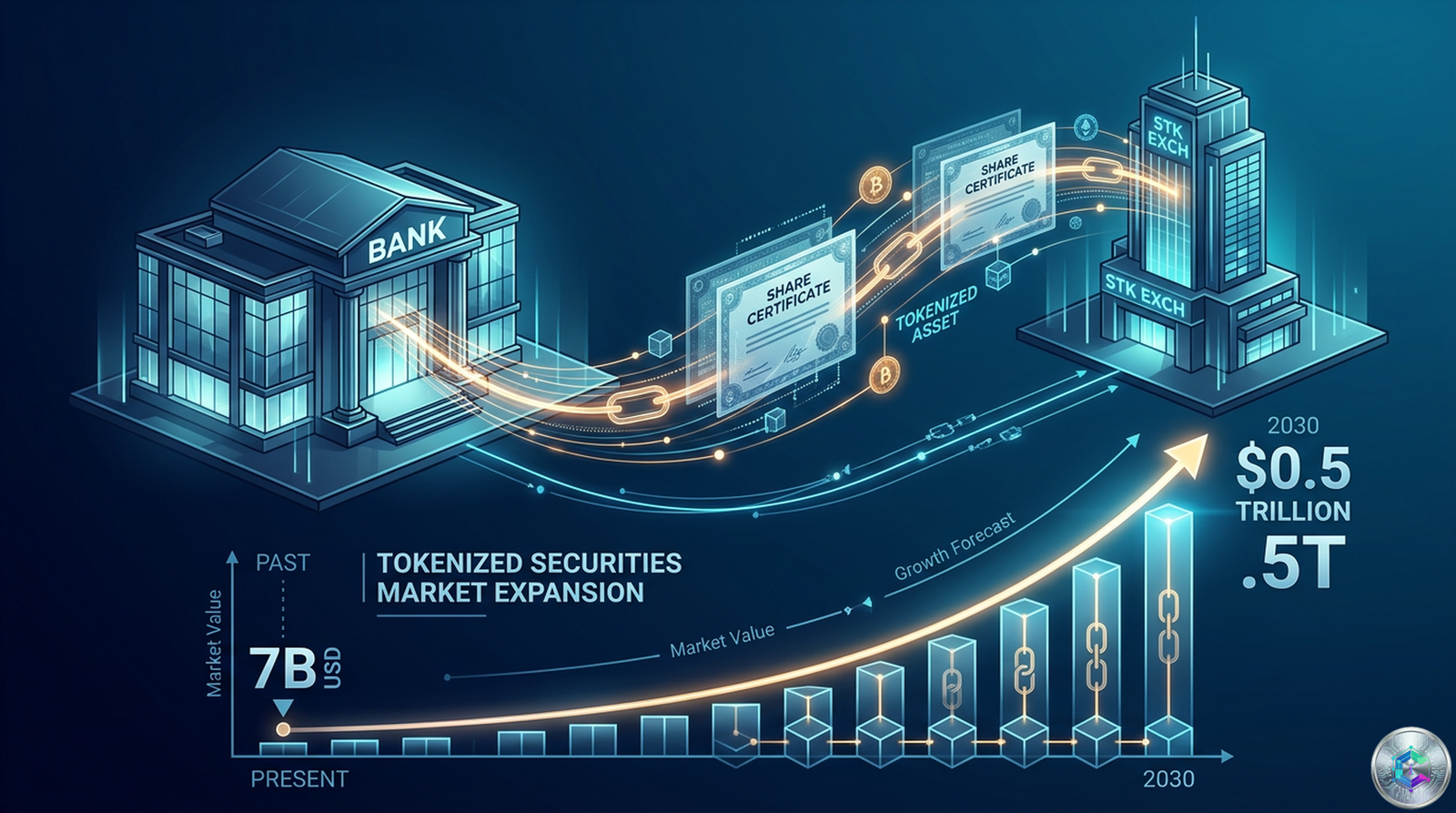
The global tokenized securities market is projected to grow from approximately $17 billion today to $5.5 trillion by 2030, representing a more than 300-fold increase in roughly four years, according to Citi Institute’s « Tokenization 2030 » report.
Citi’s Three-Tier Tokenization Architecture
Citi’s ambitions extend well beyond private shares. The bank has outlined a three-tier tokenization strategy:
| Tier | Component | Status |
|---|---|---|
| Tier 1 | Citi Token Services (instant cross-border payments) | Already operational |
| Tier 2 | Shared tokenized deposit network (with JPMorgan, Bank of America, Wells Fargo) | Target: H1 2027 |
| Tier 3 | Private equity (including late-stage pre-IPO shares) for wealth and institutional clients | Now launching |
This architecture reflects a deliberate progression from internal capabilities (payments) to industry infrastructure (deposits) to client-facing products (private equity), positioning Citi to capture value across the tokenization stack.
Regulatory Tailwinds and Market Impact
The launch coincides with improving regulatory clarity. In the U.S., the Clarity Act is advancing through Congress after passing the Senate Banking Committee 15-9 in May 2026. The SEC reaffirmed its technology neutrality stance in January 2026, while approving Nasdaq’s framework for blockchain-based share issuance in March 2026.
Major global financial infrastructure providers are moving from experimentation to operational deployment. The DTCC plans a tokenization service for DTCC-custodied assets, with regulatory clearance expected late 2025. Nasdaq‘s SEC-approved tokenized stocks and ETFs are already active, while NYSE parent ICE has entered a partnership with OKX for tokenized stocks targeting late 2026.
« You’re seeing the full weight of American financial power and the global reserve currency moving on-chain at scale. When DTCC and the NYSE embed tokenization into capital markets, this marks a tipping point. »
David Cunningham, Global Head of Institutional Business, Consensys
Stablecoins will be crucial, with a market cap projected at $1.9 trillion by 2030, generating demand for $1 trillion in on-chain U.S. Treasury bills and $2.6 trillion in tokenized stocks. They enable atomic Delivery-versus-Payment (DvP) settlement, potentially eliminating T+1/T+2 settlement cycles.
Outlook and Challenges
The tokenization of private company shares is a significant proof-of-concept for broader asset tokenization. If successful, the Citi-SDX platform could attract substantial private company participation, particularly as anticipated IPOs from SpaceX, Anthropic, and OpenAI create enormous demand for pre-listing liquidity.
Challenges remain: fee structures and minimum investment thresholds are undisclosed, U.S. investors are currently excluded, and the platform must demonstrate it can handle the operational complexity of global private company equity across multiple jurisdictions. However, the direction is clear. The combination of institutional infrastructure, regulatory clarity, and settlement innovation creates the conditions for accelerated adoption. Current tokenization adoption stands at approximately 1.5 out of 10, leaving enormous runway ahead.
Conclusion
Citigroup and SDX’s initiative places private asset tokenization at the heart of traditional financial market transformation. By offering a regulated, scalable infrastructure for pre-IPO shares, Citi is not only meeting existing client demand but actively building the digital foundations of tomorrow. While operational and regulatory challenges persist, the movement is now irreversible: global financial leaders are massively integrating blockchain into their operations, potentially redefining the rules of access and liquidity across the entire asset spectrum.
Sources
- Citigroup Press Release, « Citi and SDX Join Forces… », May 6, 2025
- CoinDesk, « Citi and Switzerland’s SDX Join Forces… », May 6, 2025
- Citi Institute, « Tokenization 2030: Wall Street On-Chain », June 2026
This article is published for informational and educational purposes only. It does not constitute investment advice. Conduct your own research (DYOR) before making any decisions.

