Iran, Venezuela, Russia: How Sanctioned Nations Turned Bitcoin Into a Geopolitical Weapon
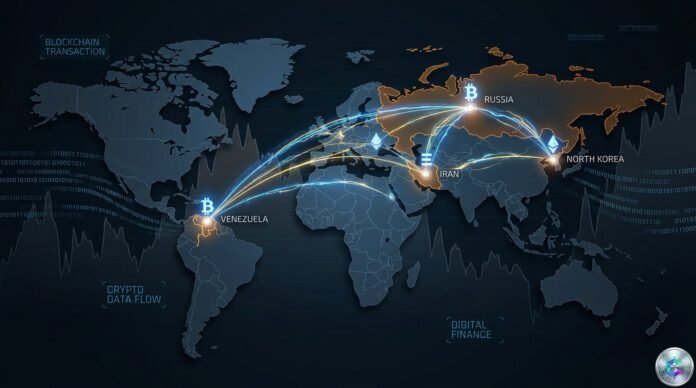
In April 2026, something fundamental shifted in the global geopolitics of finance. It is no longer just rogue traders or isolated criminal networks using cryptocurrencies to dodge international sanctions — it is sovereign states. Russia, Iran, and Venezuela have woven digital assets into the fabric of their national financial infrastructure, turning them into a core strategic tool of foreign policy. And this structural shift is reshaping the entire crypto ecosystem, far beyond the usual regulatory debates.
This is not a marginal phenomenon. The sums involved now move markets, the infrastructure being built rivals state-level systems, and the technological choices being made are redrawing the map of global financial power. In the hands of nations sanctioned by Western democracies, Bitcoin and stablecoins have become something other than a speculative asset: they have become a structural response to exclusion from traditional payment systems.
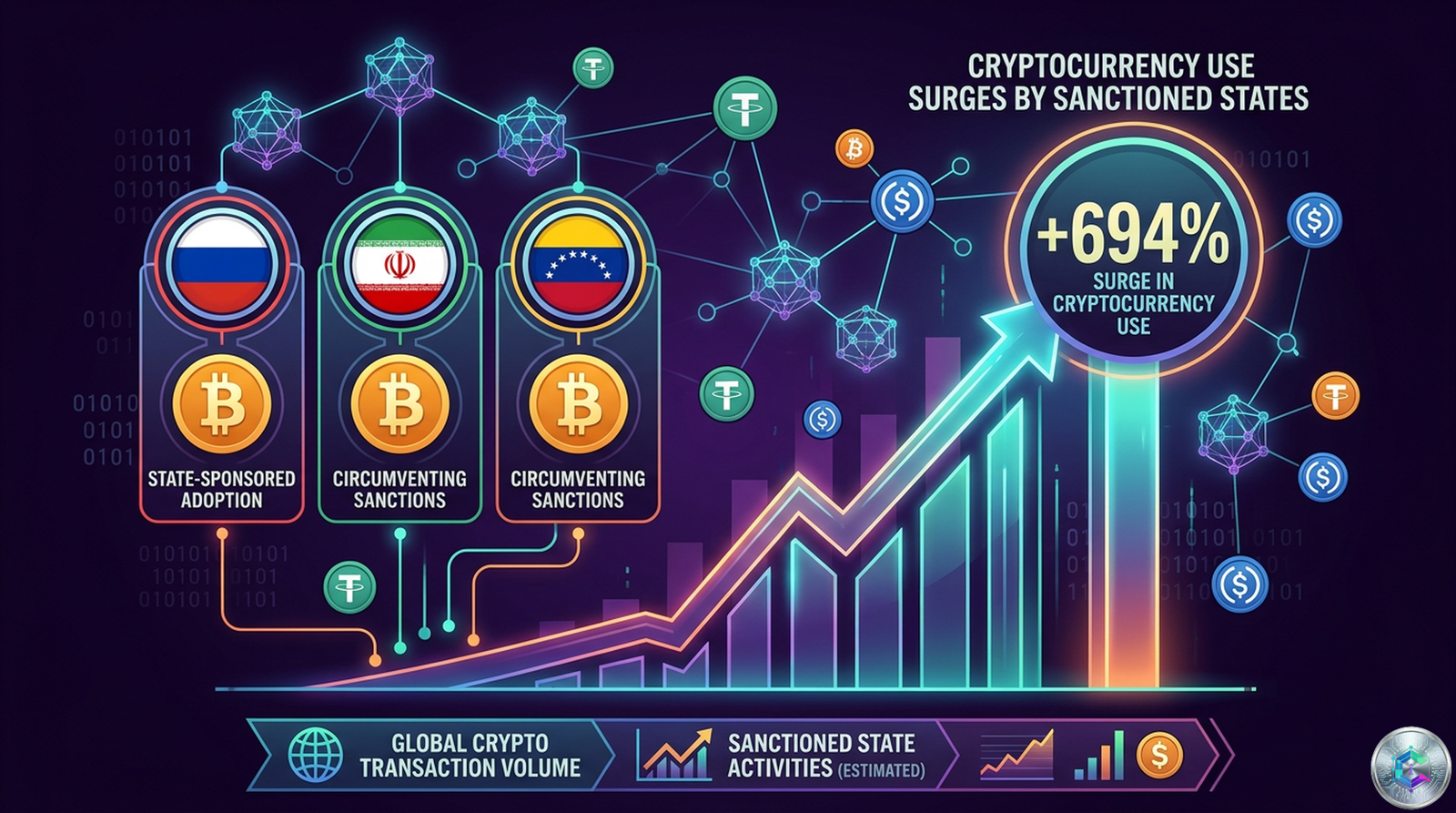
A 694% Surge in One Year
The numbers in Chainalysis’ 2026 Crypto Crime Report are staggering. In 2025, addresses sanctioned by Western governments received at least $104 billion in cryptocurrencies — a jaw-dropping 694% jump from the previous year. Total illicit transaction volume on the blockchain hit a record $154 billion, up 162% year-over-year.
These figures are not the handiwork of small-time laundering outfits. Behind this explosion are state actors who have made blockchain technology a central pillar of their financial strategy to circumvent Western sanctions. As Andrew Fierman, Head of National Security Intelligence at Chainalysis, put it: « While nation-states have been utilizing cryptocurrency for a while, it’s happening at a different scale today. »
This is no longer about occasional experiments or improvised solutions. State actors have industrialized their use of blockchain for sanctions circumvention, to the point where specialists talk about genuine state-level infrastructure in some countries. The volume of funds being moved by these actors is now comparable to that of major multinational corporations — which fundamentally changes the game for regulators worldwide.
The trend is all the more worrying since 2025 also saw intense regulatory activity on the Western side. OFAC, the European Union, and the United Kingdom all took unprecedented steps to curb this phenomenon. Despite these efforts, the curve did not weaken — suggesting that traditional sanctions are losing effectiveness against adversaries who adapt faster than regulatory frameworks can.
Russia and the A7A5 Stablecoin: $93 Billion in Ten Months
Russia’s case is arguably the most emblematic of this new era. In response to Western sanctions that cut the country off from the bulk of the international banking system — following the exclusion of numerous Russian banks from SWIFT in 2022 — Moscow built its own state-run crypto infrastructure with unexpected speed and scale.
In 2024, groundbreaking legislation was passed explicitly authorizing cryptocurrency use for international payments, progressively replacing the classic financial circuits made inaccessible by sanctions. This decision marked a turning point: for the first time, a G20 member officially integrated cryptocurrency into its foreign trade policy.
Then, in February 2025, Russia launched its ruble-backed stablecoin, the A7A5. In under ten months, this token processed nearly $93.3 billion in transactions, becoming the backbone of a parallel financial system allowing Russian businesses to access global markets despite the heaviest sanctions ever imposed on a country in peacetime. The A7A5’s success exceeded even the most optimistic analyst projections: it now represents a significant share of Russia’s foreign trade with non-aligned nations.
Two exchanges created around the same time as A7A5 — Grinex and Meer — processed at least $4.76 billion and $305 million respectively in 2025 before being sanctioned by Western authorities for facilitating the ruble-backed stablecoin’s activity. These figures, which represent only transactions documentable by Chainalysis, are likely the tip of the iceberg.
The European Union adopted measures explicitly targeting Russian crypto service providers and the A7A5 stablecoin as part of its twentieth sanctions package against Russia. This move illustrates Europeans’ determination to plug this new circumvention channel — but also the practical difficulties regulators face: how do you sanction a token operating on a blockchain — a protocol theoretically resistant to censorship — when transactions are hard to attribute to a specific state?
The economic impact on Western economies remains difficult to quantify, but analysts agree it runs into tens of billions of dollars in trade that now bypasses traditional financial circuits. That is that much more competitive advantage for Russian businesses circumventing sanctions — and that much potential tax revenue lost for the very countries imposing those sanctions.
Iran: The Revolutionary Guard
Corps at the Core of the System
Iran’s use of cryptocurrency scaled dramatically as well — but along a radically different dynamic. Where Russia developed formal state infrastructure with the A7A5, Iran watched its crypto ecosystem progressively captured by the Islamic Revolutionary Guard Corps (IRGC), to the point where it became a terrorism financing and regional proliferation tool.
In 2025, Iran emerged as a major hub for state-linked illicit finance, with the IRGC and its Middle Eastern proxy networks playing the central role. Chainalysis data shows that IRGC-linked addresses accounted for more than half of all value received by Iranian entities in the fourth quarter of 2025. Over the full year, transfers exceeded $3 billion, channeling funds to regional militia networks, facilitating illicit oil sales, and procuring dual-use equipment — potentially including technologies linked to Tehran’s nuclear program.
Iran-aligned terrorist organizations — Lebanon’s Hezbollah, Hamas, and Yemen’s Houthis — are using cryptocurrency at unprecedented scales to finance their military operations, according to the Chainalysis report. The link between Iran’s crypto ecosystem and these armed groups has become so structured that analysts now speak of a genuine militarization of the blockchain by Tehran.
This evolution carries significant international security implications. Hezbollah, Hamas, and the Houthis conduct operations destabilizing entire regions — from the Middle East to Yemen — and the funds flowing through Iran’s blockchain directly fuel these activities. Cryptocurrency use by these groups makes their financing harder to trace and freeze for Western intelligence services, which considerably heightens security risks across multiple conflict zones.
The Strait of Hormuz — through which a major share of the world’s oil flows — has become a real-world testing ground for this new reality. Sources in the sector indicate that ships navigating this strategic waterway must now pay using cryptocurrency rather than traditional banking channels, fundamentally altering the international sanctions landscape in a geographical area crucial to global energy trade.
Venezuela: Bitcoin as a Financial Lifeline for a State in Default
Venezuela offers a different — yet equally significant — case study. Mired in chronic hyperinflation that devastated its national currency’s value to the point where the bolivar became one of the world’s least reliable currencies, the South American country watched its population massively turn to cryptocurrency as an alternative to a dysfunctional and untrustworthy domestic banking system.
This dynamic developed rapidly over the years. Faced with the impossibility of using traditional banking services to preserve savings, millions of Vene zuelans opened accounts on international exchange platforms and daily use stablecoins like USDT to conduct transactions, pay salaries, or simply store value. Switching to digital dollars — in the form of stablecoins — became for many the only way to survive economically in a country where inflation reached record levels.
The Venezuelan government attempted to institutionalize crypto usage domestically, notably through the Petro, its state-backed cryptocurrency launched in 2018. However, ordinary citizens and regime-affiliated actors alike overwhelmingly prefer access to global exchanges and peer-to-peer rails to preserve and transfer value, bypassing Caracas’s capital controls in the process. The Petro, despite official backing, never managed to establish itself as a credible means of payment among the population.
Rumors also swirl around the Venezuelan state’s Bitcoin reserves, with some media outlets reporting a potential « shadow reserve » of nearly $60 billion — a figure that, if confirmed, would make it one of the world’s largest public Bitcoin holders. While these figures cannot be independently verified and sources remain questionable, they underscore the strategic weight digital assets have taken on in the Maduro regime’s financial playbook.
Recent developments have also included a partial easing of US sanctions on Venezuela’s oil and gas sector under the Trump administration — a decision that illustrates the growing complexity of American sanctions policy in the region and the difficult trade-offs facing Western policymakers.
North Korea: $2 Billion in Stolen Crypto Funding Weapons Programs
North Korea’s proceeds from cryptocurrency theft reached record levels in 2025, confirming the trend identified by blockchain analysts over several years. According to the Chainalysis report, Pyongyang stole more than $2 billion in digital assets during the year, making it the regime’s most prolific year ever in terms of crypto theft. These funds are reportedly channeled to finance the country’s weapons of mass destruction programs — an international security issue that goes far beyond the financial sphere alone.
North Korean methodology has considerably evolved, with increasingly sophisticated operations leveraging zero-day vulnerabilities and multi-layered laundering networks to vanish stolen funds before victims — often exchange platforms or DeFi protocols — or authorities can respond. This state-run crypto theft industrialization represents a systemic threat to the entire digital ecosystem.
Threat intelligence analysts note that North Korea now possesses cyberattack capabilities targeting the crypto ecosystem that rival those of the best state intelligence agencies. Hacker groups linked to the regime — Lazarus foremost among them — have become permanent players in the global cybersecurity landscape, capable of carrying out operations of remarkable technical sophistication.
Stablecoins at the Center of the Illicit Economy: 84% of Volume
One finding cuts across all analyses and deserves special attention: stablecoins — cryptocurrencies pegged to traditional fiat currencies like the dollar or the euro — overwhelmingly dominate the illicit crypto economy, accounting for 84% of all illicit transaction volume.
This dominance stems from a convergence of technical and economic factors. Stablecoins deliver the unquestionable benefits of cryptocurrency — speed, no banking intermediaries, harder-to-trace transactions — without the volatility that makes other digital assets impractical for international commerce and value preservation. A million dollars in USDT can be moved to the other side of the world in minutes, without touching a single sanctionable bank.
This is precisely the feature that makes stablecoins the ideal tool for states like Russia, Iran, and Venezuela, which need stable value for international trade while bypassing traditional financial networks. USDT (Tether) and USDC (Circle) have become the real currencies of this new geopolitical finance — well beyond Bitcoin itself.
This reality poses a fundamental question for regulators: how do you separate legitimate stablecoin usage — which notably allows unbanked populations in developing countries to access financial services — from their use by malicious state actors? Regulatory responses struggle to provide this nuance, which risks creating a framework that is too rigid and disproportionately affects legitimate users without truly curbing illicit activities.
The International Regulatory Response Finally Takes Shape
Responding to this structural shift, global regulators dramatically stepped up coordinated enforcement in 2025, even if results remain mixed. The US Office of Foreign Assets Control (OFAC), the European Union, the UK’s Office of Financial Sanctions Implementation (OFSI), and allied Western nations all took significant steps to try to curb state-linked crypto use.
OFAC continued designating crypto actors and infrastructure tied to ransomware, state-linked evasion networks, and sanctions-circumvention services. US authorities also sanctioned both Grinex and Meer, the Russian platforms facilitating A7A5 activity — a first in American sanctions history that shows Washington is taking the threat seriously.
In March 2025, however, OFAC sent shockwaves through the crypto community by formally delisting decentralized non-custodial mixer Tornado Cash from its Specially Designated Nationals (SDN) List, following a court ruling that its autonomous, decentralized smart contracts could not be treated as property subject to sanctions. The decision highlighted profound ongoing legal battles over the status of decentralized protocols under American law — and opened the door to new courtroom battles over blockchain protocol regulation.
At the European level, the EU’s twentieth sanctions package against Russia included unprecedented measures specifically targeting Russian crypto infrastructure, signaling Europe’s intent not to lag behind in this new form of financial warfare. The European Commission has proposed several legislative texts aimed at strengthening digital asset oversight within the Union, though these proposals still face divergences between member states on how best to implement such controls.
Implications for the Global Crypto Ecosystem
The integration of cryptocurrency into state financial strategies raises fundamental questions about the future of the digital asset ecosystem. The first is legitimation: when sanctioned rogue states use the same rails as traditional institutional investors, where do you draw the line?
Crypto proponents argue that the vast majority of transactions remain entirely legitimate — illicit volume represents less than 1% of the total — and that blockchain technology actually provides more powerful traceability tools than traditional financial systems for identifying suspicious behavior. The public ledger of blockchain transactions is, by this logic, far more transparent than the opaque banking circuits of traditional finance.
Critics, however, warn that this geopolitical use of crypto risks triggering unprecedented regulatory tightening in Western democracies, which might be tempted to much more strictly regulate — or even ban — certain digital asset uses. The fallout for innovation in the sector would be considerable, industry players warn.
Prediction markets reflect this structural uncertainty. On prediction contract platforms, the likelihood of Bitcoin reaching $100,000 by the end of 2026 was quoted at 35.5% in early April 2026, up from previous weeks. Market players seem torn between fear of harsh regulatory crackdown and hope that growing institutional adoption could push prices higher in the long run.
Conclusion: Crypto Has Become a Geopolitical Weapon
Whether we regret it or celebrate it, the fact is clear: by 2026, cryptocurrencies are no longer a niche asset class reserved for speculators and libertarians. They have become an instrument of foreign policy, a sanctions-circumvention tool, and an element of national security strategy for several world powers.
Russia, Iran, and Venezuela have blazed the trail. Their experiments with stablecoins, offshore exchanges, and blockchain payment systems prove that distributed ledger technology offers real possibilities for structuring a parallel financial system outside traditional networks — and that these possibilities are now being exploited as part of genuine state-level policies.
For regulators, crypto businesses, and investors, the question is no longer whether this reality will disappear — it is how to respond in a framework that preserves innovation while limiting malicious uses. Adoption by nation-states, even sanctioned ones, is a phenomenon that will not vanish. It must be factored into compliance strategies, regulatory frameworks, and market analysis.
The only certainty is that the next phase of cryptocurrency history will not be played out in the halls of traditional finance, but in the corridors of geopolitics. And the next major Bitcoin news we read could well come from Moscow, Tehran, or Caracas — far from the towers of Wall Street or the City of London.
—
*Sources: Chainalysis 2026 Crypto Crime Report, Fortune, Crypto Briefing, Steptoe International Law, Norton Rose Fulbright, Bloomberg Crypto*