


A Historic Turning Point for Europe’s Crypto Industry
The cryptocurrency world has just experienced one of the most significant regulatory shifts in its history. With the full implementation of the Markets in Crypto-Assets (MiCA) regulation on July 1, 2026, Europe has crossed a decisive threshold in normalising its digital asset market. This new regulatory era, long dreaded by some industry players, is now beginning to produce tangible effects on the ground. Analysts and market participants universally recognise that we are witnessing a structural transformation that will permanently redefine how cryptocurrencies are treated on the old continent.
According to the most recent data, more than 18% of cryptocurrency platforms operating across European territory have already decided to exit the market rather than comply with the stringent requirements of the new legal framework. This wave of defections illustrates the magnitude of the challenges facing industry participants, who are forced to rethink their economic models to survive in this significantly more regulated environment. This exodus is not about to stop, as consulting studies suggest an additional 10% of platforms could follow by year-end if compliance costs continue to rise.
Exchanges Under Maximum Pressure
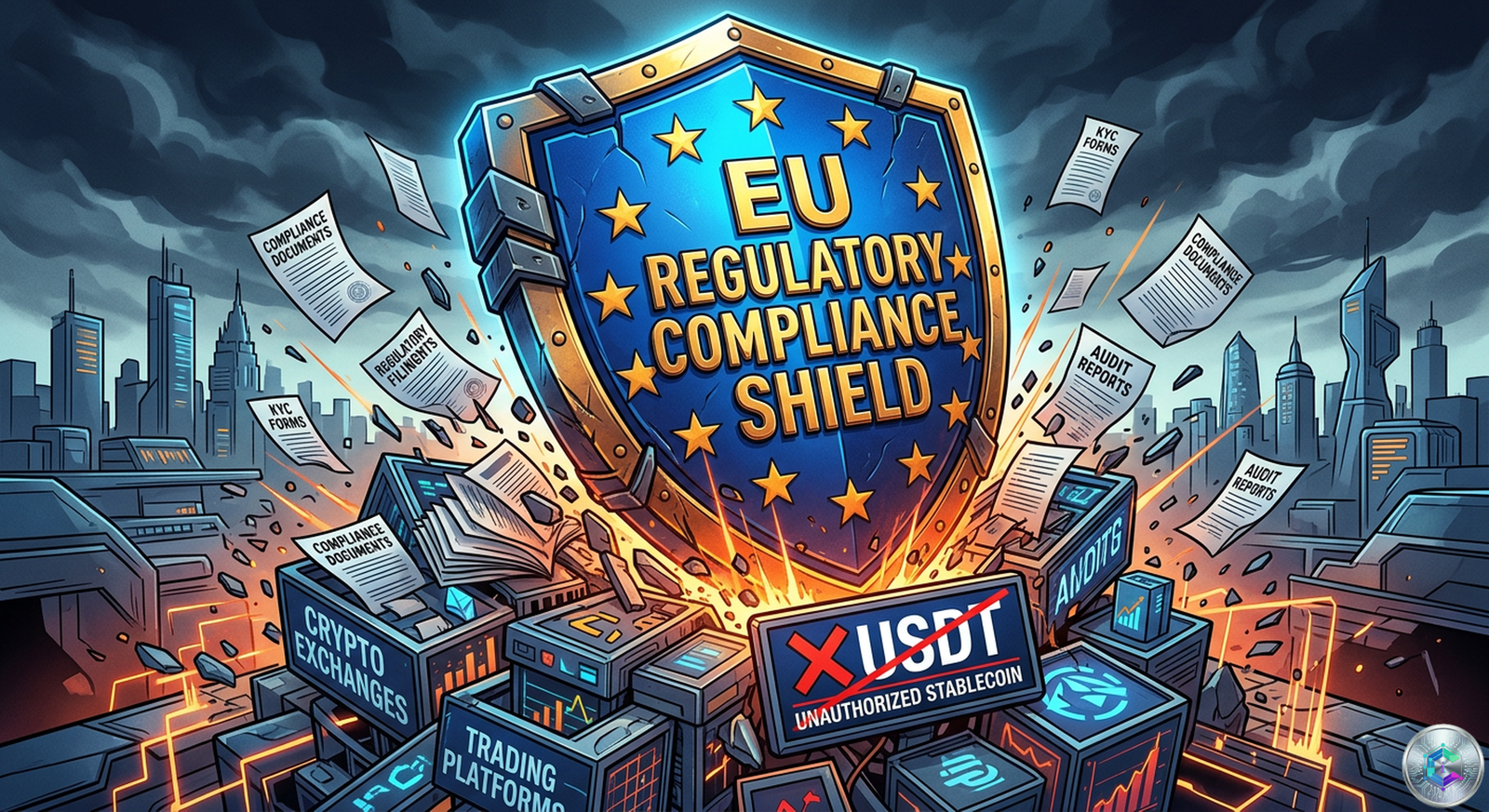
One of the most striking events of this regulatory transition concerns the fate of Tether (USDT), the world’s largest stablecoin by market capitalisation. Coinbase EU, Crypto.com, and Binance EEA have all decided to remove USDT from their platforms, citing non-compliance with the new European standards. This is not a trivial decision: USDT represents hundreds of billions of dollars in transactions on European crypto markets, and its sudden removal has sparked panic among some investors who suddenly found themselves with assets they could no longer trade on their usual platforms.
For European users, this decision means they must now turn to compliant alternatives such as USD Coin (USDC) or other stablecoins certified by European authorities. A transition that is not without friction, particularly for those who used USDT as a savings vehicle or value transfer mechanism. For now, no workaround has been found, and the major platforms have clearly chosen compliance over confrontation with regulators. This situation has also raised questions about the liquidity of other stablecoins available on the European market, with some observers fearing that the suddenly redirected demand for USDC could create bottlenecks in supply mechanisms.
The Balance Sheet of the First Weeks of Enforcement
Figures released by European regulatory authorities paint a stark picture of this first phase of implementation. Since the effective enforcement of MiCA regulation began, fines imposed on industry participants have exceeded the 540 million euro threshold. A staggering amount that testifies to regulators’ determination to enforce the new rules without hesitation or granting extended grace periods. The European Banking Authority (EBA) played a central role in coordinating these enforcement actions, establishing common guidelines that national regulators then applied according to their respective competencies.
These sanctions have affected trading platforms, token issuers, and custody service providers alike. The most frequently cited grievances relate to non-compliance with transparency requirements, absence of adequate documentation for products offered, and provision of services without prior authorisation from the relevant national authorities. Some actors saw their operations suspended immediately after sanctions were pronounced, while others were allowed to continue their activities under enhanced surveillance, provided they implemented remediation plans within very short deadlines.
The US CLARITY Act: America’s Response
While Europe hardens its regulatory framework, the United States is following a different but equally significant trajectory. The US CLARITY Act, a bill now well advanced in the legislative process, aims to create a unified regulatory framework for digital assets across American territory. This initiative responds to a growing need: the current fragmentation between different regulatory agencies (SEC, CFTC, OCC) has created an opaque legal environment where players struggle to identify their exact obligations. This confusion has long benefited the most aggressive actors while discouraging traditional institutional players from engaging with the sector.
If the CLARITY Act is adopted, it could establish a clear definition of digital assets and their legal treatment, offering market participants the long-sought visibility. Current discussions in Congress seem to indicate growing consensus on the need for this legislation, although disagreements persist on specific points regarding token classification and the scope of different agencies’ authority. For European companies also operating in the United States, this development could facilitate their transatlantic expansion, provided regulatory standards remain compatible between the two jurisdictions.
The Global VASP Licensing Rush Accelerates
Beyond the United States and Europe, a planetary phenomenon is taking shape. The enforcement of MiCA in Europe and the progress of the CLARITY Act in the United States have triggered a global regulatory dynamic. Countries, fearing that crypto activities might shift to more permissive jurisdictions or conversely lose innovative companies to better-regulated competitors, are accelerating their own regulatory work. This competition between jurisdictions creates a permanent tension between the desire to attract crypto businesses and the need to maintain high consumer protection standards.
In Japan, financial authorities have tightened their requirements for client asset storage and anti-money laundering measures, requiring platforms to maintain cold custody reserves far exceeding previous international standards. In Singapore, the Monetary Authority has published new guidelines on stablecoins that preemptively ban those without reserves fully backed by real assets, a conservative position that surprised some market players but could become a model for other cautious jurisdictions. In Dubai, the Virtual Assets Regulatory Authority (VARA) has established an increasingly demanding licensing system for operators wishing to establish themselves in the emirate, transforming the city into a preferred hub for companies seeking international regulatory recognition.
This proliferation of regulatory frameworks, while aimed at protecting consumers and limiting systemic risks, also creates a complex environment for internationally operating businesses. The need to obtain multiple licences, adapted to each jurisdiction, represents a considerable cost and a major organisational challenge for industry players. Smaller platforms, which lack the resources to navigate this regulatory maze, find themselves marginalised compared to major players who can afford dedicated compliance teams in every region where they operate.
The Technical Challenges of MiCA Compliance
To understand why so many platforms chose to leave the European market rather than comply, one must examine the technical requirements of the MiCA regulation. The text imposes very specific obligations regarding the protection of client assets, including the requirement to maintain these assets in secured cold wallets, with clearly defined verification procedures. These requirements often exceed industry standards for security, which necessitated considerable investment for platforms that chose to remain.
The mandatory whitepaper requirements for any token issued or offered on a European platform constitute another major challenge. Each token must now have a comprehensive document describing its project, technical characteristics, the rights it confers, and the associated risks. For decentralised projects, this requirement raises philosophical questions about the very nature of crypto governance: how does one sign a whitepaper on behalf of a permissionless protocol? This tension between the decentralising ideology of crypto and regulatory traceability requirements remains largely unresolved, creating legal uncertainty for many projects.
Transparency obligations regarding transactions and volumes have also proved more demanding than many platforms had anticipated. The regulation requires complete traceability of flows, with reporting mechanisms that resemble those in force in traditional financial markets, an area where crypto had precisely sought to differentiate itself. Platforms must now produce detailed reports on transaction volumes, liquidity sources, and user risk profiles, data they had not necessarily been accustomed to collecting or formalising in standardised formats.
The Winners of the Regulatory Transition
If MiCA caused defections among some players, others profited from it. Platforms that had anticipated regulation and invested in their compliance before the deadline saw their market share increase significantly. Kraken Europe, Bitstamp, and local players such as Bitpanda strengthened their position, having built the necessary infrastructure well before the deadline. This foresight proved rewarding, as they were able to welcome users from departed platforms, strengthening their customer base without having to invest heavily in marketing.
Regulation-compliant stablecoin issuers also experienced a boom period. USD Coin (USDC), with Circle having established its European headquarters in Dublin, saw its capitalisation surge on European markets, recovering part of the ground lost by USDT. This dynamic should continue as long as major platforms maintain their decision to no longer support non-compliant tokens. Other regulated stablecoins, like the institutional offerings from JPMorgan or Barclays in the tokenised space, are also beginning to gain ground, although their adoption remains limited by their primarily institutional character.
Compliance and KYC (Know Your Customer) service providers have also seen their business grow considerably. Companies specialising in digital identity solutions and transaction monitoring saw their order books fill, as platforms desperately sought to upgrade their processes to meet the new requirements. Chainalysis, Elliptic, and other sector players had to recruit massively to meet demand, while new entrants emerged to capitalise on this market opportunity.
Prospects for the European Cryptocurrency Market
In the short term, analysts expect an adjustment period during which trading volumes could remain below pre-MiCA implementation levels. Retail users, sometimes disoriented by the change in available stablecoin and new authentication procedures, may reduce their activity on European platforms. Some may also turn to platforms operating from jurisdictions outside the European Union, although this option is becoming increasingly unattractive as other countries adopt their own strict regulatory frameworks.
However, medium-term prospects appear more positive. The establishment of a clear regulatory framework, similar to what happened in other financial sectors after their respective scandals, could attract new institutional players previously reluctant to enter the crypto market due to regulatory uncertainty. Asset managers, pension funds, and European insurers are already beginning to explore the opportunities offered by digital assets, and a clear framework facilitates their risk analyses. Regulated cryptocurrency investment products, like the spot Bitcoin ETFs approved in 2024, could see broader adoption in this context.
Questions remaining outstanding primarily concern the fate of decentralised assets and DeFi protocols. MiCA was designed primarily to regulate centralised actors, leaving considerable grey areas for protocols functioning in a decentralised manner. European regulators have so far preferred to turn a blind eye to pure DeFi protocols, but this tolerance cannot last forever, and clarifications are expected in the coming months. Projects like Uniswap, Aave, or MakerDAO are under increased scrutiny, and some fear that too strict an application of MiCA rules to decentralised protocols could kill innovation in this space.
Impact on End Users
Practical implications for everyday cryptocurrency users are significant. Those who held USDT on European platforms now face the choice of converting to compliant stablecoins or finding alternative platforms outside European jurisdiction. For those who choose to stay within the European ecosystem, the transition to USDC or other regulated alternatives is relatively straightforward but requires attention to the timing of platform migrations.
Trading fees may increase as platforms pass on compliance costs to users, though increased transparency and reduced counterparty risk could offset these costs for those prioritising safety over marginal price advantages. User verification processes have become more rigorous, which while adding friction to onboarding, also provides greater assurance that platforms cannot easily vanish with user funds.
The long-term beneficiaries of this regulatory transition are likely to be those users who prioritised platform security and regulatory compliance over yield farming and high-leverage trading strategies. As the market matures and unregulated competitors disappear, users who navigated this transition thoughtfully should find themselves in a more stable and trustworthy ecosystem, even if the opportunities for spectacular gains reduce proportionally.
Conclusion: A New Era for Cryptocurrency
The implementation of MiCA truly marks the end of an era for the European crypto industry. The years of regulatory freedom that allowed the sector’s emergence and rapid growth are now over, replaced by a structured framework where compliance is no longer an option but a condition of survival. The 18% of platforms that chose to exit the market are probably only the first of a wave that could continue if compliance costs prove prohibitive for smaller players.
For users, this transition means a potentially safer environment, with reinforced guarantees on the protection of their assets. For remaining players, the opportunity to operate in a less saturated market free of unregulated competitors, but also the necessity to invest considerably in compliance infrastructure. For regulators, the challenge of maintaining a balance between innovation and consumer protection, while avoiding freezing the sector in an administrative straitjacket.
The true measure of MiCA’s success will only be known in several years, once the market has digested these changes and the long-term effects on innovation, adoption, and financial stability can be evaluated. One thing is certain: the European crypto sector has just undergone its most profound transformation since its inception, and the coming months will be decisive in shaping the future of this industry on the old continent.

