

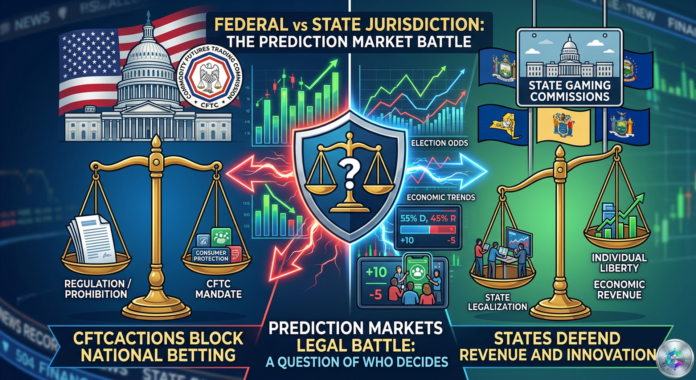
A Legal Battle for Control Over Prediction Markets
On Thursday, April 2, 2026, the U.S. federal government sued Illinois to stop what it described as the state’s unlawful efforts to regulate prediction markets. This legal maneuver marks a major turning point in the jurisdictional war between federal regulators and states regarding these rapidly growing betting platforms.

The Commodity Futures Trading Commission (CFTC), alongside the Department of Justice (DOJ), filed a complaint in Chicago federal court, alleging that Illinois’ attempt to shut down CFTC-regulated designated contract markets intruded on the federal government’s exclusive authority to regulate national swaps markets.
The Facts Behind the Conflict
Illinois had introduced legislation earlier this year that would have imposed some of the strictest guardrails in the country around prediction markets. This included an effective ban on sports-related trades within the state, a crackdown on advertising, strict age verification requirements, and sweeping consumer protections.
Illinois’ gaming board (IGB) had sent cease-and-desist letters to major platforms including Kalshi, Polymarket, and Crypto.com after finding reason to believe they violated Illinois gambling laws through their involvement in unlicensed sports wagering.
« It is unlawful to establish, maintain, or operate an internet site that permits a person to play a game of chance or skill for money or other thing of value, or that permits a person to make a wager upon the result of any sport, game, contest, political nomination, appointment or election, via the internet without an IGB-issued license, » the cease-and-desist letters detailed.
CFTC’s Position
The CFTC’s complaint states that states have attempted to outlaw, regulate, or otherwise restrain the activities of DCMs that facilitate trading in lawful event contracts. This lawsuit is the first by the CFTC to block state gaming regulators from policing operators of prediction markets.
« The CFTC will continue to safeguard its exclusive regulatory authority over these markets and defend market participants against overzealous state regulators, » said CFTC Chairman Michael S. Selig. « This is not the first time states have tried to impose inconsistent and contrary obligations on market participants, but Congress specifically rejected such a fragmented patchwork of state regulations because it resulted in poorer consumer protection and increased risk of fraud and manipulation. »
A Booming Industry
Online prediction markets are experiencing exponential growth. These platforms allow users to bet on virtually anything: from Oscar winners to weather to ongoing military conflicts. The industry argues these products are « basically gambling but with another name. »
These platforms are less regulated than conventional betting sites because they classify their offerings as « event derivatives, » meaning they fall under federal commodities law and are currently overseen by the CFTC rather than state gaming regulators. This makes them available in all 50 states to users 18 and older.
Links to the Trump Administration
While the Biden administration tried to crack down on prediction markets — notably with the FBI raid on Polymarket’s founder during the 2024 elections — the Trump administration has taken a decidedly softer stance toward the industry, with which it has close ties.
Donald Trump Jr., the president’s eldest son, is currently both an investor in and unpaid adviser to Polymarket, as well as a paid adviser to Kalshi. Trump’s social media company, Trump Media & Technology Group, recently announced it would launch its own platform called Truth Predict.
State Resistance Intensifies
State resistance has intensified, with at least 20 federal lawsuits filed nationwide to curb prediction markets. These disputes question whether companies should be treated as federally regulated financial exchanges — as they maintain — or as gambling operations that should be regulated like state-licensed sportsbooks.
This wave of litigation comes as Congress considers federal measures. U.S. senators recently introduced legislation that would ban federally regulated platforms from allowing wagers on sporting events and ban casino-style games such as virtual poker, slot machines, and blackjack from being available on these platforms.
What to Remember
This legal battle between the federal government and states over prediction market control is far from over. With considerable financial interests at stake and a rapidly growing industry, both sides seem determined to assert their position. The outcome of these proceedings could define the future of prediction market regulation in the United States for years to come.
Platforms like Kalshi and Polymarket find themselves at the heart of this jurisdictional conflict, offering event contracts that attract millions of traders while challenging traditional regulatory categories. The question remains open: will these markets ultimately be regulated as federally regulated financial products or as state-regulated gambling operations?
This article is for informational and educational purposes only. It does not constitute investment advice. Crypto is a volatile asset: do your own research before making any financial decisions.

